A hire car turns Sabinillas from a lovely beach base into a launchpad for half of Andalucía. Ronda by lunch, Gibraltar by tea, the white villages whenever you fancy. But car hire on the Costa del Sol is also where holidays quietly leak money: phantom excess, fuel stings, GPS you didn't need. This is the plain version, written by someone who collects cars at Málaga Airport more often than he'd like.
Do You Need a Car?
Short answer: no, not for a beach week in Sabinillas; the town is fully walkable. Yes, if Ronda, Gibraltar or the white villages are on your list, since a car changes what's possible.
Staying in Sabinillas for a week to swim, eat well and slow down? You don't need one. The beach is a 30-second walk from our apartment. Restaurants line the promenade. The Friday and Sunday markets are ten minutes on foot. Lidl and Mercadona are walkable. The sea is right there.
But if you fancy day trips such as Ronda (1.5 hours), Gibraltar (30 minutes), the white villages, or the Roman baths of Casares, a car changes the whole holiday. Without one you're at the mercy of guided tours, sparse buses, or taxis that mount up fast.
Our take: hire a car for 2-3 days mid-stay if the wider region appeals, and walk Sabinillas on your rest days. You get the best of both without paying for a full week of rental that sits unused in a parking space. If you'd rather not drive at all, our Málaga Airport transfer guide covers buses, trains and private transfers down to the coast.
How Does Car Hire at Málaga Airport Work?
It works in two tiers: on-airport desks (Hertz, Europcar, Avis, Sixt) hand you the keys in 15-20 minutes for a premium price, while off-site budget firms (MalagaCar, Marbesol, Centauro) shuttle you to a nearby depot in 20-30 minutes for less.
Málaga Airport (AGP) is the logical pickup. It's where most UK flights land (easyJet, Jet2, Ryanair, BA, TUI all fly here), and the place is thick with hire firms. There's a split worth understanding before you book, because it affects how long you'll stand around after a 7am Gatwick flight.
The on-airport desks. Hertz, Europcar, Avis and Sixt sit in the arrivals hall, with their cars in the multi-storey a short signed walk away. You're driving within 15-20 minutes. You pay for that convenience.
The off-site firms. Budget local operators (MalagaCar, Marbesol, Centauro, OK Mobility) keep depots a few minutes from the terminal and run free shuttle buses from outside arrivals. Rates are usually keener, but build in 20-30 minutes for the shuttle, the queue and the paperwork. Follow the green "Car Hire" signs once you're through baggage reclaim.
For a small economy car, budget €25-€40 a day in spring and autumn, €15-€25 in deep winter, and a painful €50-€70 a day across July and August when every family in Britain wants the same Fiat. Comparison sites (KAYAK, Skyscanner, momondo, DiscoverCars) let you scan dozens of suppliers at once. Booking 5-7 days ahead routinely saves 30-50% versus the walk-up rate.
One firm rule: book online, never at the desk. Counter prices are almost always higher, and you'll be choosing insurance under fluorescent lights with a queue behind you. Booking ahead locks in your car category and your insurance terms in advance. Most suppliers allow free cancellation up to 48 hours before pickup, so there's little downside to reserving early.
One more thing to check before you book: most firms want the lead driver at least 21 (a few accept 18 with restrictions), and anyone under 25 usually pays a young-driver surcharge, typically €5-€35 a day on top of the rental.
Is It Cheaper to Hire a Car at Málaga or Gibraltar Airport?
Málaga, in almost every case: the sheer number of rental firms competing for your business keeps prices down. Gibraltar only makes sense if you're flying into GIB, where it's just 30 minutes to Sabinillas versus 75 from Málaga.
The one check if you do hire in Gibraltar: make sure your contract explicitly permits taking the car into Spain. In practice most "Gibraltar Airport" hires are supplied on the Spanish side in La Línea, a short walk over the border, which sidesteps the cross-border paperwork entirely.
What Are the Money Traps in Costa del Sol Car Hire?
This is where Costa del Sol car hire earns its dodgy reputation. Three things: the excess and deposit hold, the fuel policy, and the upsells like GPS or child seats. None of it's a scam exactly, it's all in the contract, but the headline rate and the real cost can end up a hundred euros apart.
1. The excess and the deposit hold
Spanish law requires third-party liability cover, and it's baked into every rental. What varies wildly is the excess, the amount you'd pay out of pocket if the car gets damaged. Standard cover leaves you on the hook for anywhere between €500 and €2,000.
To wipe that out you have two routes:
- The supplier's own excess reduction ("Super CDW", "Premium cover"): convenient, sold at the desk, and dear, at typically €15-€25 a day.
- A standalone excess policy from a third party like iCarhireinsurance or CarInsuRent, bought before you travel for roughly €6-€12 a day. You pay any damage upfront, then reclaim it.
The standalone route is usually far cheaper, and if you have annual travel insurance it may already include car hire excess; check before you pay twice.
Either way, the supplier will pre-authorise a deposit on the main driver's credit card at pickup, often €1,000-€1,500 if you've declined their cover, less if you've bought it. It's a hold, not a charge, released a week or two after you return the car. Two things bite people here: a debit card is frequently refused for the hold, and the card must be in the lead driver's name. Turn up without the right card with enough headroom and you can be refused the car at the desk, prepaid booking or not.
Don't skip cover entirely. A kerbed alloy on a narrow village street runs €150-€300. A cracked windscreen, €200-€500. A proper scrape, €500-€1,000. Unfamiliar car, unfamiliar roads, tight Andalusian lanes: minor knocks happen. Protect yourself.
2. The fuel policy
There are two policies, and one of them is a trap.
- Full-to-full (what you want): collect it full, return it full, pay only for what you used. Top up at a petrol station within a few kilometres of the airport before you drop off.
- Full-to-empty / "prepaid fuel" (avoid): you pay for a full tank upfront at an inflated rate and bring it back empty. You almost always gift them fuel you didn't burn, and that "free" pump price can be €3-€4 a litre versus €1.50 at a normal station.
Insist on full-to-full when you book, and keep the receipt from your final fill in case they query it.
3. The upsells
Decline the GPS (€10-€25 a day); Google Maps or Waze on your phone does the job, just download offline maps for when signal drops in the mountains. Bring your own child seats if you can; supplier seats are €5-€10 a day and often tired. And ignore the hard sell on extras you arranged in advance: if you bought standalone excess cover, you don't need theirs.
How Do You Drive to Sabinillas, and Is the AP-7 Toll Worth It?
From Málaga Airport it's about 75 minutes to Sabinillas either way. The AP-7 toll motorway costs roughly €12-€20 each way and is the faster, smoother option; the free A-7 coastal road costs nothing but takes longer, especially in summer. Most guests find the toll worth it for the extra ease.
The AP-7 (Autopista del Sol) is the fast toll motorway: smooth, quiet, and the sensible choice with kids melting in the back after a flight. The full Málaga-Sabinillas run crosses three toll sections, totalling roughly €12 each way off-peak (around October-May) and close to €20 each way in summer and at Easter, at 2026 rates. Check live prices at autopistadelsol.com. Booths take cards, coins and the electronic Vía-T tag (your hire car may have one; ask, as it can add a small daily fee).
The A-7 (the free coastal road) runs the same corridor with no tolls. It's slower, busier through the towns, and stop-start in summer, but it costs nothing and you'll see more of the coast. Trade time for money depending on your mood and your passengers' patience.
Either way, our full turn-by-turn directions live in the airport transfer guide. Once you've got wheels, the day trips guide shows what they unlock, and Ronda is the one we'd send you to first (here's how).
Driving in Spain: The Rules That Catch Brits Out
Driving here is straightforward once you've reset a few British instincts: mainly which side of the road you're on, the urban speed limits, and roundabout priority. Spain drives on the right, so you'll sit on the left of the car. Give yourself the first ten minutes on quiet roads to recalibrate; roundabouts and junctions are where muscle memory misfires.
Speed limits
- Motorways (autopistas): 120 km/h standard, increasingly signed at 100 km/h on some stretches
- National roads (carreteras nacionales): 90 km/h
- Towns: 30 km/h is now the default on single-lane urban streets (50 km/h only where there are two or more lanes each way), a DGT rule in force since May 2021
Speed cameras are common on the AP-7 and A-7, both fixed and mobile, and fines climb steeply, well into the €300+ range for serious excesses, and they bite sooner in the 30 km/h town zones. When in doubt, match the local traffic.
Roundabouts and junctions. They work like British ones: traffic already on the roundabout has priority. Signage can be vague and lane discipline loose, so if you miss your exit, go round again rather than cutting across. Minor junctions are often poorly marked: slow down, look twice, assume nothing.
Tolls. Covered above: AP-7 paid, A-7 free, your choice.
The case for a small car. Andalusian old towns were built for donkeys, not SUVs. A Fiat 500, Citroën C1, VW Polo or similar slips through lanes and tucks into parking spaces a big estate never will. Unless you genuinely need six seats, hire small. Note too that most economy cars here are manual; if you only drive automatic, book it explicitly and early, as automatics are scarcer and dearer.
Documents to keep in the car
- UK photocard driving licence (valid in Spain; no IDP needed for short stays)
- Passport
- Hire agreement and insurance certificate (the firm provides these)
If you're pulled over by the Guardia Civil, you'll be asked for the lot.
What Do the Parking Line Colours Mean on the Costa del Sol?
Spain colour-codes its kerbs and bays, and getting it wrong costs you.
- Blue lines (zona azul) = paid parking, typically €1-€2 an hour and often free in the evenings and on Sundays. Pay at the meter, display the ticket.
- Green lines = usually residents-priority or limited paid stays.
- Yellow lines = restrictions: a solid yellow line bans stopping and parking; a broken one bans parking.
- No lines = free, if there's a space.
Never block a driveway (vado) or use a disabled bay without a permit; local police enforce both keenly, and a blocked vado alone can mean a €200 fine. The seafront in Estepona and Marbella often charges in summer.
Parking in Sabinillas
Sabinillas has free on-street parking throughout the town, and out of season you'll find a space without much fuss. July and August are a different story: demand soars and circling for a spot in the midday heat gets old fast.
That's exactly when our private garage earns its keep. If you're staying with us, we offer a secure, covered garage space for €10 a night: guaranteed parking, no hunting, and shade for the car so the steering wheel isn't lava at 3pm. For summer stays especially, we'd genuinely book it rather than leave it to chance on the street.
How Much Does Fuel Cost on the Costa del Sol?
Petrol (gasolina 95) runs around €1.45-€1.60 a litre depending where you fill; diesel (diésel) is currently much the same, sometimes a touch more. Supermarket forecourts (Carrefour, Lidl, and the unmanned low-cost stations like Plenoil) are reliably the cheapest, often 10-15 cents under the motorway services. Most pumps are self-service; some unmanned stations want payment at a machine before you fill, so have a card ready.
A small economy car will return roughly 45-55 mpg. A week of pottering plus a couple of day trips burns maybe €30-€50 of fuel; add €10-€15 if you're using the AP-7 a fair bit.
How Much Does Car Hire Cost?
Indicative shoulder-season totals (spring/autumn), all in euros. Summer rentals run materially higher.
| Scenario | Duration | Car | Hire | Insurance | Fuel | Tolls | Total |
|---|---|---|---|---|---|---|---|
| Budget (local firm, e.g. MalagaCar) | 7 days | Small manual | €140-180 | €45-85 (standalone excess) | €40 | €25-35 | €250-340 |
| Standard (major chain) | 7 days | Small manual | €200-280 | €80-120 (supplier excess reduction) | €40 | €25-35 | €345-475 |
| Premium (major chain, automatic) | 7 days | Medium automatic | €300-400 | €100-150 (Super CDW) | €50 | €25-35 | €475-635 |
| Short trip (any firm) | 3 days | Small manual | €80-120 | €20-40 | €20 | €15-20 | €135-200 |
The budget option isn't budget on quality; local firms like MalagaCar are professional and well reviewed. The difference is no fancy add-ons and pricing you can read.
What's the Best Way to Book a Costa del Sol Rental Car?
Book a small economy car through a comparison site 5-7 days ahead. Pick a local firm for value or a major chain if you want the reassurance of a brand and an on-airport desk. Buy full-to-full fuel, take standalone excess cover rather than the supplier's, decline the GPS, and turn up with a credit card in the lead driver's name that can take the deposit hold.
The maths: if you're out and about for four days or more, hiring pays for itself in freedom. If you only want one beach day in Estepona, take the bus (the M-240 from the Sabinillas seafront does it cheaply) and skip the faff.
And go gently. Spanish roads are safe but often narrower than ours, and the driving is more assertive. Give yourself time to settle in, keep to the limits, and enjoy it: the coast road south towards Gibraltar at golden hour is one of the quiet pleasures of a Costa del Sol holiday.
Stay Right on the Beach
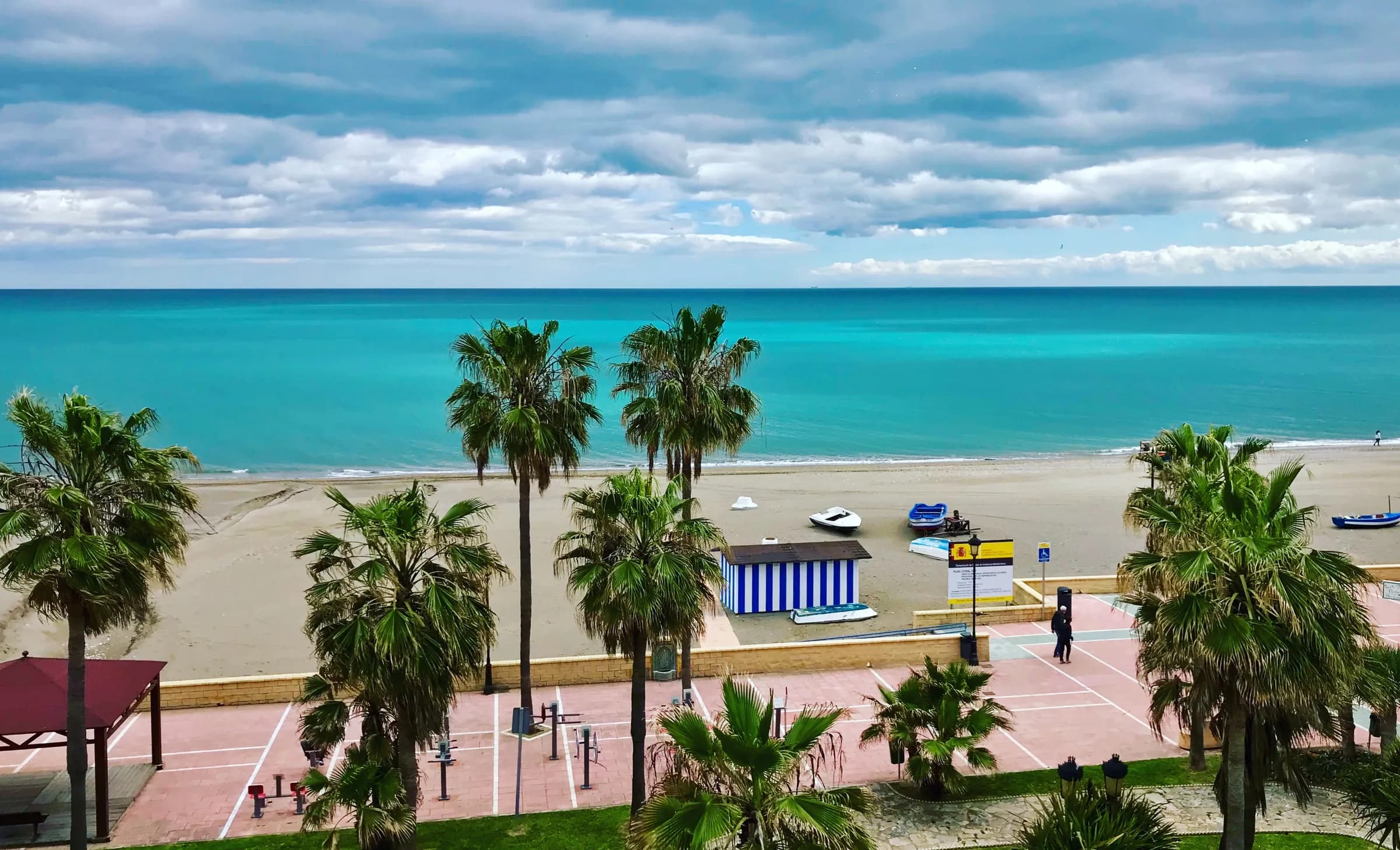
The sand is 30 seconds from the door, and the balcony looks straight out at it. Book direct and save up to 20%.
- 3 Bedrooms
- 6 Guests
- 96 m²
Frequently Asked Questions
Related Articles

Day Trips from Sabinillas & the Western Costa del Sol
Best day trips from Sabinillas and the western Costa del Sol: Ronda, Gibraltar, Caminito del Rey, white villages and Tangier, with drive times and costs.

Ronda Day Trip from Sabinillas: Things to Do & Itinerary
A Ronda day trip from the Costa del Sol: the best things to do, where to eat, how to get there from Sabinillas or Málaga, and a full one-day itinerary.

Málaga Airport to Estepona & Sabinillas: Transfer Guide
Málaga Airport to Estepona and Sabinillas, every way: private transfer, taxi fares, the Avanza bus, the train that won't reach you, plus the Gibraltar shortcut.
The Local's Costa del Sol, Monthly
One email a month: what's on in Sabinillas, the best local finds, and first pick of apartment dates. Free welcome gift: our Sabinillas Insider Guide.
We respect your privacy. Unsubscribe at any time.
Comments
No comments yetHave a tip, a question or a correction? Every comment is read and approved by hand before it appears, usually within a day.
No comments yet. Be the first to share a tip or ask a question.