Every morning in summer, someone from the lifeguard service walks to the mast on Sabinillas beach and runs up a coloured flag. Most people barely glance at it until the day it turns red, the sea looks perfectly swimmable, and they want to know who decided otherwise and whether the rule has teeth. It does. This guide covers what each colour means on a Spanish beach, the purple flag everyone googles after their first jellyfish week, and what the system looks like in practice on our own stretch of the Costa del Sol.
What Do the Flag Colours Mean on Spanish Beaches?
Spain works on three core colours, and they mean the same thing from Galicia to Cádiz. The system's legal roots go back to a national ministerial order of 31 July 1972 on safety in bathing areas (BOE-A-1972-1153), which is still the reference text; coastal regions and town halls have since written it into their own rules. The Canary Islands' beach-safety decree, Decreto 116/2018, is the tidiest modern statement of it, and in Andalucía each municipality's beach ordinance applies the same colours locally.
| Flag | Meaning | What it means for you |
|---|---|---|
| Green | Bathing allowed | Conditions are considered safe; swim normally |
| Yellow | Caution | You may swim, but stay within your depth and near shore |
| Red | Bathing prohibited | Do not enter the water; fines apply |
Two details worth knowing. The flag describes the day's conditions, not the beach's general quality, and it can change during the day: a green morning can become a yellow afternoon when the wind picks up. And where a red flag flies generally, some regions allow the lifeguard service to mark out a limited safe bathing corridor between two red-and-yellow bicolour flags, so if you see those, swim between them and nowhere else.
Can You Swim Under a Yellow Flag?
Yes. Yellow is the most misread flag on the coast: it does not mean "no swimming", and it does not mean "ignore it, the lifeguards are being careful". It means swim, but on the sea's terms. Keep within your depth. Stay reasonably close to shore. Keep children where you can reach them in two strides, not two lengths. Leave airbeds and inflatables on the sand, because the same wind that raised the flag will carry them out faster than you can follow.
On our beach, yellow usually accompanies the levante, the easterly wind that chops the water up and pushes a current along the shore. It can also fly for reduced visibility or a moderate jellyfish presence. When in doubt, ask at the lifeguard post; they hoisted it, and they will tell you exactly why.
The Purple Flag: Bandera Morada, Explained
This is the one that fills search engines every July. The purple flag, almost always called the bandera morada in Spain, warns of dangerous marine fauna in the water. In practice that means jellyfish nearly every time, and occasionally something rarer such as a Portuguese man o' war. The Canarian decree defines it exactly that way: a warning of danger from marine fauna, requiring precautions from bathers.
The point people miss is that purple is a supplementary flag. It is not part of the core green-yellow-red system, and there is no single national rule requiring it; municipalities add it on their own initiative, which is why you will see it on some beaches and not on others with the same jellyfish in the same water. It flies alongside the main colour, and the combination is what matters. Under the Canarian rules it is always paired with yellow or red; elsewhere you will occasionally see it flown with green. Purple with yellow, or with green, generally means you may still swim, alert and at your own judgement. Purple flying with red means the water is off limits, fauna included.
Around here, jellyfish arrivals come and go with the wind: a few days of levante can push medusas inshore, and a westerly clears them out again. The free Infomedusa app, run by the Aula del Mar foundation in Málaga with the provincial council, forecasts jellyfish conditions beach by beach across Málaga province and takes real-time sightings from users and lifeguards. We keep it on our phone all summer and suggest guests do the same; thirty seconds of checking beats a morning of regret. If you are stung, go to the lifeguard post rather than improvising remedies; treating stings is routine work for them.
What Happens If You Ignore a Red Flag?
First, a lifeguard whistles and orders you out. If you refuse, the local police get involved, and at that point it becomes a formal infraction under the town's beach ordinance. The fines are real and vary by municipality. To give one published example, the town hall of Sagunto sets up to €150 for a minor offence, €150 to €450 for a serious one and up to €901 at the top of the scale, under article 23 of its beach ordinance, and its police have issued batches of red-flag fines on a single Sunday. Andalusian coastal towns take the same approach in their own ordinances, with amounts that differ from one municipality to the next.
The money is the smaller argument. Red flags on this coast usually mean strong current, heavy shore-break or contaminated water, and every summer Spanish news carries drownings of swimmers who went in past one. The lifeguards who raise it would rather be ignored about sunscreen.
The Black Flag, and the Other "Black Flags"
A black flag hoisted on the mast means the beach itself is closed, water and sometimes sand included, for something exceptional: serious contamination, an extreme weather event, a hazard the council cannot manage that day. It is rare, it is municipal rather than part of the national three-colour set, and if you ever see one, the day's plan changes, no exceptions.
Confusingly, Spain also has an annual "Banderas Negras" report from the campaign group Ecologistas en Acción, which names two stretches of coast per province for poor environmental management. That is a press release, not a flag on a pole; a beach "given a black flag" in the news is not closed and may be perfectly swimmable.
Blue Flag Is an Award, Not a Safety Flag
One more disambiguation, because the names collide. The Blue Flag is an annual certification for water quality, facilities and management, awarded each May and flown all season regardless of the day's conditions. Sabinillas holds it, and our Blue Flag beaches guide covers what it certifies and which Málaga beaches carry it. The safety mast is a different instrument: it answers "can I swim today?", changes daily, and a Blue Flag beach can still fly red in a storm. Read them separately and both make sense.
Who Decides, and When Are Lifeguards on Duty Here?
The municipal lifeguard service decides the flag each morning, based on sea state, wind, water quality and anything reported overnight, and adjusts it through the day if conditions shift. There is no committee and no appeal; the person in the tower with the binoculars makes the call.
In Sabinillas, lifeguards work broadly mid-June to mid-September, with the exact dates confirmed by the municipality each year. Outside those months no flags are flown and the beach is unsupervised, so autumn and winter swimming is a matter of reading the sea yourself and staying humble about it. Our Sabinillas beach guide covers the beach in full, season by season, and the beach webcam shows the sea state live before you commit to a towel.
Reading the Beach From Your Balcony
Families get the most out of the flag system, because it takes the guesswork out of a swimming day: green means let them loose in the shallows, yellow means keep it to paddling, and the gentle shelving here is forgiving on cautious days. If you are travelling with children, our family beach clubs guide pairs well with this one.
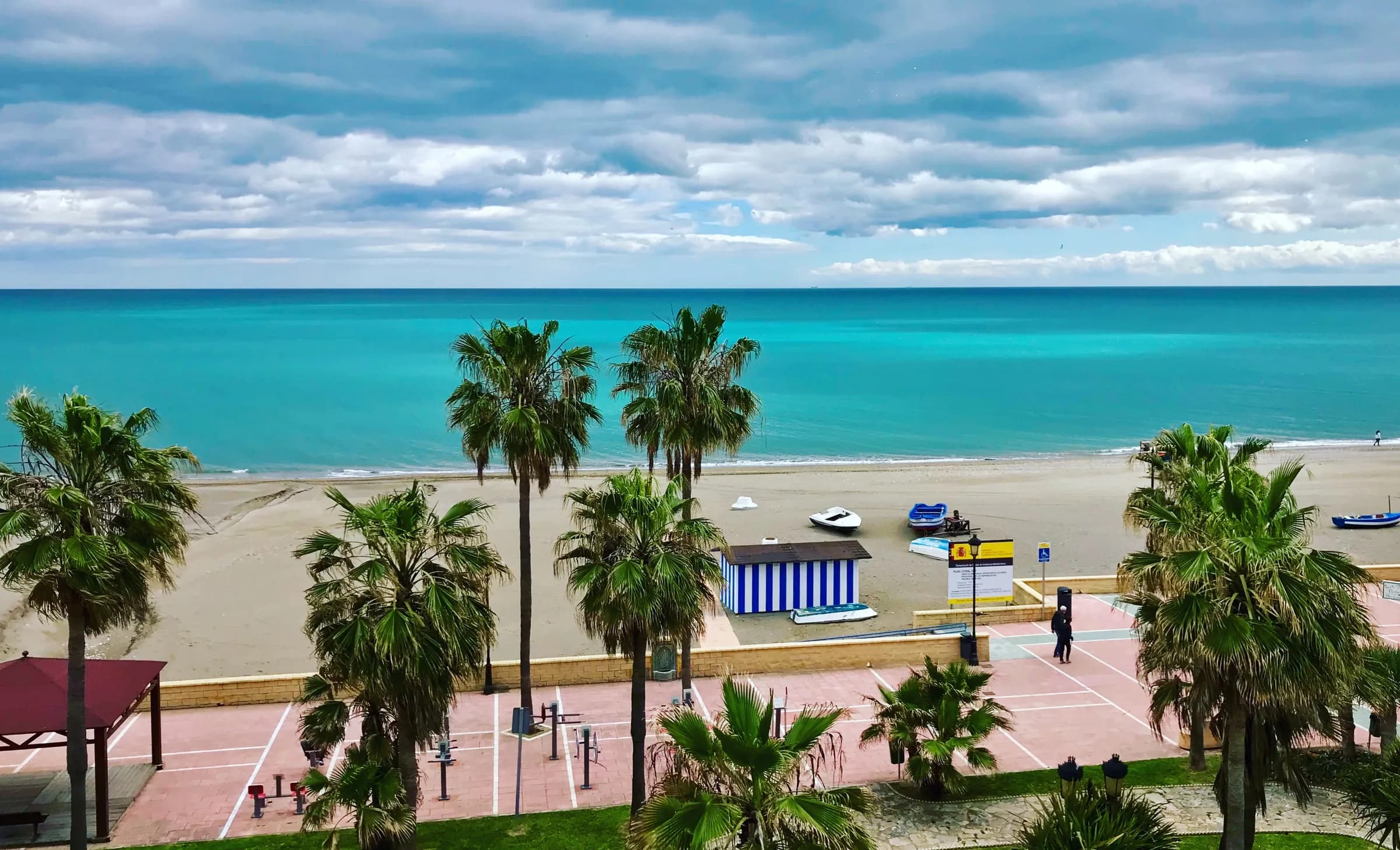
From our apartment, the routine takes no effort at all. The beach is 30 seconds from the door, and you can see the sea, and on a clear morning the mast, from the balcony with your first coffee. Flag up, swim before breakfast; jellyfish week, check Infomedusa and plan the pool instead. Either way, you knew before you picked up the beach bag.
Stay Right on the Beach
The sand is 30 seconds from the door, and the balcony looks straight out at it. Book direct and save up to 20%.
- 3 Bedrooms
- 6 Guests
- 96 m²
Frequently Asked Questions
Related Articles

Family Beach Clubs: Marbella, Estepona & Sotogrande Guide
Which Costa del Sol beach clubs really work with kids? Every option from Sotogrande to Marbella: real 2026 prices, minimum spends, who to skip.

Blue Flag Beaches in Spain: Málaga Province Guide
Which Blue Flag beaches in Spain's Málaga province are worth your towel? A local's guide to the cleanest, safest sand on the Costa del Sol, town by town.

Sabinillas Beach: Blue Flag Guide to the Quiet Costa del Sol
A local's guide to Sabinillas beach: Blue Flag sand, the best chiringuitos, water sports, sun loungers and the calm side of the Costa del Sol.
The Local's Costa del Sol, Monthly
One email a month: what's on in Sabinillas, the best local finds, and first pick of apartment dates. Free welcome gift: our Sabinillas Insider Guide.
We respect your privacy. Unsubscribe at any time.
Comments
No comments yetHave a tip, a question or a correction? Every comment is read and approved by hand before it appears, usually within a day.
No comments yet. Be the first to share a tip or ask a question.