Choosing where to swim on the Costa del Sol is easier than it looks: follow the flags. A Blue Flag is a yearly promise of clean water, lifeguards, decent loos and a council that maintains the place. Spain flies more of them than any other country on earth, and within Spain, Málaga province is Andalucía's clear heavyweight: 45 beach flags for 2026, the most of any province in the region, strung from Casares in the far west to Algarrobo in the east.
We live in Sabinillas, and the Blue Flag was part of why we settled here. It isn't just a badge bolted to the beach entrance. It means water tested through the season, sand that gets cleaned, professional lifeguard cover in summer and facilities that work. You can swim without a second thought. Below is a proper local's run-through: what the flag really certifies, which Málaga beaches carry it, how to reach the best ones, and why our own Sabinillas beach earns its keep.
One caveat up front. Blue Flag status is reassessed every year and announced each May for the coming summer season, so any list, ours included, is a snapshot; even the beaches below have shuffled since our last update (Estepona's town beaches lost every one of theirs for 2026; more on that shortly). ADEAC's 2026 national announcement also introduced a two-year award cycle this year (what it calls "a temporary transition mechanism" tied to new EU accreditation rules), so don't assume the current list is fixed for years at a time. Before you build a whole day around one specific beach having a flag, glance at the official ADEAC results for the current season.
What Does a Blue Flag Beach in Spain Guarantee?
A Blue Flag beach guarantees tested water quality, lifeguard cover, accessible facilities and up-to-date safety information, reassessed every year and not handed out for a pretty view. The Foundation for Environmental Education (FEE) runs the international programme; ADEAC is its Spanish operator. A beach has to satisfy around 33 criteria across four headings (water quality, environmental management, safety and services, and information and education), and the "imperative" ones are all compulsory.
Water quality is the non-negotiable core. Samples go to a lab through the bathing season and get tested for the bacteria that matter (E. coli and intestinal enterococci), and every single sampling point has to rate "excellent" under the EU Bathing Water Directive: not just pass, excellent. No sewage outfalls, no industrial discharge, no visible muck. Results are published, so you can look them up.
Environmental management means the council runs a proper plan: waste sorted and recycled, dunes and protected habitats respected, hazardous materials handled correctly. This is the bit that translates into daily cleaning and a beach that doesn't degrade over a season.
Safety and services require lifeguards, first aid, accessible toilets and changing facilities, and clear multilingual signage. Step-free access for people with reduced mobility is mandatory, not a bonus.
Information and education is the quiet fourth pillar: up-to-date water-quality boards, emergency numbers, and at least five environmental-education activities the council has to run each year, so visitors aren't trampling something fragile by accident.
Worldwide, the programme covers more than 5,000 sites across 51 countries. Spain alone holds close to 800 of them (677 beaches, 111 marinas and 6 tourist boats for 2026), which ADEAC's own figures put at around 15% of every Blue Flag on the planet. Crucially, it expires every year: a council can't earn it once and rest, and can lose it after a bad season, as you'll see further down this page. That annual churn is exactly why the label is worth something.
Which Blue Flag Beaches Are Near Sabinillas (Western Costa del Sol)?
Near Sabinillas, the flagged beaches are Sabinillas and Las Gaviotas in Manilva, Playa Ancha in Casares, and, further along, Marbella's eight. This is the quiet end of the province, between the Gibraltar side and Marbella, and within an hour's drive of Sabinillas you've got a string of flagged beaches and a couple of marinas, without the high-rise wall you get further east.
Sabinillas, our home beach in the municipality of Manilva, flies the Blue Flag for 2026, and Manilva also flies one at Las Gaviotas (the town hall's announcement). It's a long, easy stretch of dark, mineral sand running roughly between Puerto de la Duquesa and the Manilva river mouth. The water comes in gently, genuinely good for small children and nervous swimmers, and it gets tested and cleaned through the season. Lifeguards cover the summer, guests at our apartment can rent our own paddleboard steps from the water, and the chiringuitos are the real thing rather than tourist theatre. Full detail in our complete Sabinillas beach guide.
Puerto de la Duquesa (La Duquesa Marina) is a marina rather than a beach, but it's held a Blue Flag for 28 consecutive years for its facilities and management, and there's a small, tidy beach beside it. Worth a wander for the working-port atmosphere and the restaurants; it's a 15-20 minute walk south along the front from Sabinillas. More on it in our La Duquesa marina guide.
Estepona, about 15 km east, has wide, well-kept beaches (El Padrón, El Saladillo, El Cristo and La Rada among them), but for 2026 none of them carry a Blue Flag; only the Puerto Deportivo de Estepona marina kept its flag, its 32nd year running. Sand and sea are still genuinely good here (this is a flag gap, not a quality drop), and the long promenade remains one of the nicest walks on the Costa del Sol. Our best beaches near Estepona guide breaks them down one by one.
Marbella, around 45 minutes away, flies more Blue Flags than anywhere else in the province: eight for 2026, including Cabopino with its dunes, La Fontanilla and San Pedro. Bigger, busier, glossier. Beautiful sand, but bring your sense of humour about the prices behind it.
Which Blue Flag Beaches Are in Eastern Costa del Sol?
East of Marbella you'll find flagged beaches in Fuengirola, Mijas, Benalmádena, Torremolinos, Málaga city, Torrox, Vélez-Málaga and Nerja. The coast tips into resort country here, then settles back into something more Spanish out past Málaga city.
Fuengirola and Mijas sit next to each other and rack up nine flags between them for 2026: four in Fuengirola, five in Mijas. Mijas in particular (La Cala and the various Calahonda sections) is a solid family shout, with a tidy promenade and reliable facilities.
Benalmádena, about 70 km from us, flies three flags for 2026 (Fuente de la Salud, Carvajal and Torre Bermeja-Santa Ana) along a long, lively seafront. This is proper holiday-resort territory: hotels, marina nightlife, package crowds. Good beaches, far busier than ours.
Torremolinos is the original Costa del Sol package destination, and all four of its named beaches (Bajondillo, Playamar, La Carihuela and Los Álamos) fly Blue Flags for 2026, backing that up with strong facilities and a buzzy, international crowd. It's the most crowded slice of the province. Brilliant if you want noise and life; less so if you want a quiet swim.
Málaga city keeps seven urban beaches flagged along its front for 2026, from the touristy Malagueta to neighbourhood favourites like Pedregalejo and El Palo, where the espetos (sardines skewered and grilled over driftwood fires right on the sand) are a genuine institution. Pair a beach hour with the city itself and you've got a good day; see our Málaga city guide.
Nerja, right at the eastern end of the province and about 150 km from Sabinillas, is the standout for a day trip. A former fishing village that grew up without losing the plot, with four flagged beaches: Burriana, Torrecilla, Playazo and the gorgeous cove of Maro just east of town. It's a long drive (allow around 1h45 each way), so make a full day of it.
Torrox and Vélez-Málaga, between Málaga and Nerja, are quieter and more Spanish (Torre del Mar's long promenade, El Morche, the Cenicero-Las Dunas stretch), and between them they hold six flags for 2026 (three each), without the resort circus.
Which Málaga Municipalities Have Blue Flag Beaches?
Málaga province holds 45 Blue Flag beaches for 2026, spread across 12 municipalities: Marbella leads with eight, Málaga city has seven, Mijas five. Treat the table below as an orientation map, not gospel: the precise roster shifts each May, and the official ADEAC results are the only current-season source of truth. For everything coastal across the region, browse our full beaches section.
| Municipality | Flags (2026) | Example flagged beaches | Vibe |
|---|---|---|---|
| Casares | 1 | Playa Ancha | Quiet, western tip of the Costa del Sol |
| Manilva | 2 (+1 marina) | Sabinillas, Las Gaviotas | Calm water, real fishing-village character, our patch |
| Estepona | 0 (+1 marina) | None in 2026: El Padrón, El Saladillo, El Cristo, La Rada all lost their flags | Wide, easy beaches; worth a look again next May |
| Marbella | 8 | Cabopino, La Fontanilla, San Pedro | Big, polished, busy |
| Mijas | 5 | La Cala, Calahonda, El Chaparral | Family-friendly, good promenades |
| Fuengirola | 4 | Carvajal, Boliches-Gaviotas, Castillo-Ejido | Resort beaches, full facilities |
| Benalmádena | 3 | Fuente de la Salud, Carvajal, Torre Bermeja-Santa Ana | Lively resort strip |
| Torremolinos | 4 | Bajondillo, Playamar, La Carihuela, Los Álamos | Classic package-holiday buzz |
| Málaga city | 7 | Malagueta, Pedregalejo, El Palo | Urban beaches + city on the doorstep |
| Torrox / Vélez-Málaga | 6 | El Morche, Torre del Mar, Cenicero-Las Dunas | Quieter, more Spanish |
| Nerja | 4 | Burriana, Maro, Torrecilla, Playazo | Pretty town, scenic coves |
Algarrobo (Algarrobo Costa) rounds out the 12 municipalities that hold at least one flag in 2026: 45 beaches in total, plus the marinas at Estepona and La Duquesa.
Good to know: flags are renewed every May, judged on the previous year's performance. If you're here in early spring, a beach may not yet have its current-year flag flying even though the standards are unchanged. Don't panic: check the ADEAC list and look at the water-quality board on the beach itself.
Is Sabinillas Beach a Blue Flag Beach?
Yes: Sabinillas has held the Blue Flag for 2026, and Manilva's second flag flies just along the coast at Las Gaviotas. We've hosted guests on this beach for years, and the line we hear most is some version of "the water's so clear." That's not luck: the Blue Flag means the water gets sampled through the season, the sand is cleaned, lifeguards work the summer, and the protected bits are left protected.
The sand here is the coast's characteristic dark, mineral grey. It has more character than the bag-of-sugar pale of the big resorts, and it warms up nicely underfoot. The seabed shelves gently, which is exactly what you want with kids or a hesitant swimmer. Our guests can rent our own paddleboard right at the apartment; if that's your thing, our SUP paddleboarding guide rates Sabinillas as one of the easiest launches on the coast. The water's still warm into October (around 20-22°C) and far quieter; April and May swims are bracing (roughly 16-18°C) but you'll have the place to yourself.
The fishing-village feel is genuine: you'll see Spanish families here, not just visitors, and the chiringuitos are run by people who've done it for decades. A proper lunch with a glass of wine runs about €20-30 a head. Nobody's hustling you into a €14 cocktail or a fridge magnet.
From our place it's a 30-second walk to the sand. That sounds like marketing until you've nipped down for a swim before breakfast, gone back up for a siesta, and come back out for a sundowner without ever getting in the car. For the wider picture (markets, fiestas, where to eat), our complete Sabinillas guide covers the lot.
How to Pick the Right Blue Flag Beach
Different flags suit different days. A rough steer:
For families: Sabinillas, La Cala de Mijas, or the calmer end of Estepona. Lifeguards, gentle shelving, clean facilities, relaxed restaurants. Give central Torremolinos and Málaga city a miss in August if you want space.
For swimming and water sports: Nerja for clear water and scenery, Sabinillas for easy paddleboarding and kayaking, Cabopino near Marbella if you don't mind company. Our water sports round-up has the full menu.
For atmosphere: Sabinillas for unfussy fishing-village dining, Nerja for small-town charm, Estepona for the promenade, Torremolinos for nightlife and an international crowd.
For photographs: golden hour at Sabinillas (roughly 07:00-08:30 or 19:00-20:30 in summer) is the easy win. Maro near Nerja, with its cliffs and clear water, photographs beautifully year-round.
How Do You Get to Blue Flag Beaches from Sabinillas?
| Destination | Distance | By car | Notes |
|---|---|---|---|
| Sabinillas (our beach) | 0 km | 30-sec walk | Beachfront; you're already there |
| La Duquesa marina | ~1.5 km | 15-20 min walk | Flagged marina + small beach, good restaurants |
| Estepona | ~15 km | ~20 min | Lovely beaches, but none flagged for 2026 (the marina is); busy in summer |
| Marbella (Cabopino etc.) | ~45 km | ~45 min | Big, glossy, busy |
| Benalmádena | ~70 km | ~50 min | Resort beaches, full facilities |
| Torremolinos | ~78 km | ~55-60 min | Major resort, package vibe |
| Málaga city | ~95 km | ~75 min | Urban beaches + city to explore |
| Nerja | ~150 km | ~1h45 | Scenic, worth a long day |
By public transport, Avanza runs coaches along the coast from Sabinillas (the stop is up on the A-7 side of town) to Estepona, Marbella and Málaga, with onward connections; check current times at avanzabus.com. It's doable, but a car makes beach-hopping far less of a faff; see our car hire tips for the Costa del Sol.
Planning Your Beach Days
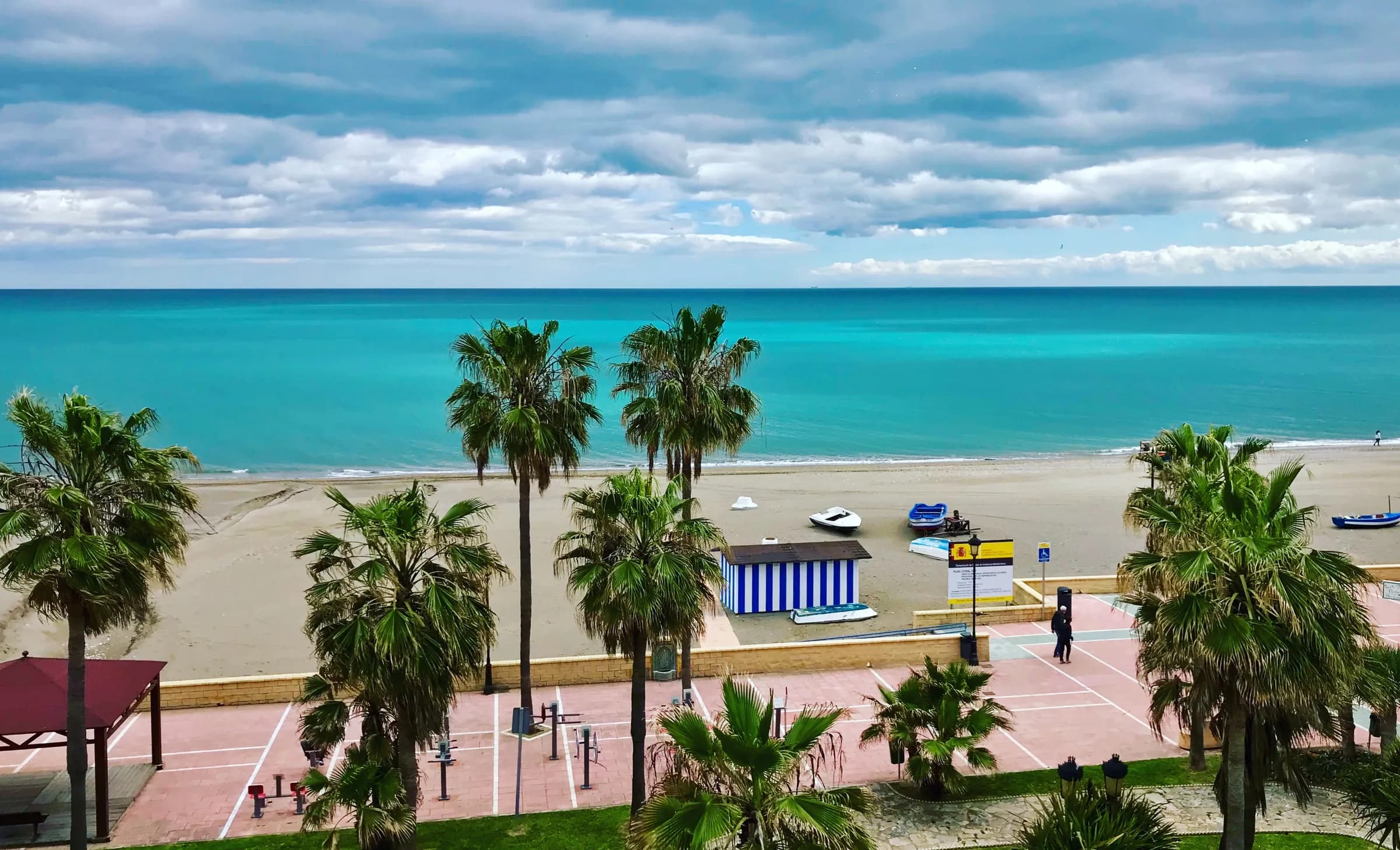
Stay at our beachfront apartment in Sabinillas and a Blue Flag beach is quite literally outside the door: 30 seconds to the sand, which changes how a beach holiday feels. Swim before breakfast, retreat for the worst of the midday heat, drift back out for an evening dip. No car park, no schlep.
For the rest of the coast, hire a car and a day shapes itself nicely: early swim at home, drive to Estepona for a chiringuito lunch, an afternoon on the sand, back for sunset. Or commit a full day to Nerja (about 1h45 each way) for the coves and the old town together.
Time it for May to mid-June or September to mid-October if you can. The sea's swimmable (around 17-19°C in May, climbing to 22-26°C from late June through October), the crowds thin out, and the light does the heavy lifting for your photos. If you're locked into July or August, get to the beach before 10:30 to claim your patch and treat the midday sun with respect. Our month-by-month guide to visiting the Costa del Sol goes deeper on weather, crowds and prices.
Wherever you end up, the principle holds: spot the flag, check the water board, and you can stop worrying and start swimming.
Stay Right on the Beach
The sand is 30 seconds from the door, and the balcony looks straight out at it. Book direct and save up to 20%.
- 3 Bedrooms
- 6 Guests
- 96 m²
Frequently Asked Questions
Related Articles
Quiet Beach Towns on the Costa del Sol (Not Marbella)
Tired of the Marbella crowds? These quiet beach towns on the Costa del Sol (Sabinillas, Manilva, La Duquesa and more) still feel like real Spain.

Estepona Beach Guide: The Best Beaches Nearby
A local guide to the best Estepona beach options: calm Playa del Cristo, the long town beach La Rada, plus quieter sands west towards Sabinillas.
Sabinillas Beach: Blue Flag Guide to the Quiet Costa del Sol
A local's guide to Sabinillas beach: Blue Flag sand, the best chiringuitos, water sports, sun loungers and the calm side of the Costa del Sol.
The Local's Costa del Sol, Monthly
One email a month: what's on in Sabinillas, the best local finds, and first pick of apartment dates. Free welcome gift: our Sabinillas Insider Guide.
We respect your privacy. Unsubscribe at any time.
Comments
No comments yetHave a tip, a question or a correction? Every comment is read and approved by hand before it appears, usually within a day.
No comments yet. Be the first to share a tip or ask a question.