What Are the Quietest Beach Towns on the Costa del Sol?
The quietest beach towns on the Costa del Sol are Sabinillas, Manilva, Casares Costa and La Duquesa on the western coast, plus Estepona, Nerja and Frigiliana further along: real Spanish towns with a fraction of Marbella's crowds.
Everyone knows Marbella. And Puerto Banús. And Benalmádena. What most visitors never find out is that Spain's most famous coastline has a quieter side entirely: one where you can get a patch of beach to yourself, eat dinner without an English menu, and pull up a chair at a chiringuito where the locals outnumber the tourists.
We've been hosting guests at our beachfront apartment in Sabinillas for years. The reaction is always the same: "Why didn't we know about this place before?" That question is the whole reason for this guide. The Costa del Sol is not just package holidays and yacht clubs. There are ten genuinely quiet beach towns where the slow Mediterranean life still goes on, and four of them sit within a 20-minute drive of each other on the western coast.
This guide is clear about which is which. Some are sleepy fishing villages. One is a proper town. A couple aren't strictly on the Costa del Sol at all. We'll tell you which suits couples, which suit families, and which to skip if you want a bit of buzz.
Why Choose a Quiet Beach Town on the Costa del Sol Over a Resort?
A quiet beach town trades resort infrastructure for a slower pace, real Spanish food and elbow room on the sand, exactly what Marbella and Puerto Banús don't offer.
Here's the reality of the big-name resorts. They are loud, crowded and, frankly, tiring. Puerto Banús is handsome enough, if you enjoy fighting through tour groups to see it. The seafront is lined with the same international restaurants charging €18 for an average burger. And in August the popular beaches are so packed that bagging a metre of sand means arriving by 08:00 and guarding your spot all day.
A quiet beach town offers the opposite. It keeps what makes Spain worth the flight. The pace is slower. The food is the real thing. And the water, remarkably, has fewer people in it.
The trade-off is straightforward. You won't get a superclub with an international DJ every night. Shops shut for siesta. The restaurants are Spanish-run and serve Spanish food, so if jamón ibérico and fried fish aren't your thing you'll need to flex a little. Most people count all of that as the point.
There's a money angle too, and it's not small. A week in a Marbella resort in August can cost double what the same week costs 25 minutes west, for a beach that's arguably nicer. Booking a direct apartment rather than a hotel takes another chunk off, and gets you a kitchen, a washing machine and a balcony instead of a room. That gap between "famous" and "quiet" is mostly a marketing bill, not a quality one.
Why Is Sabinillas Our Top Pick for a Quiet Costa del Sol Beach Town?
Sabinillas sits at the western edge of the Costa del Sol and is our number one pick for anyone after authentic Spanish beach life.
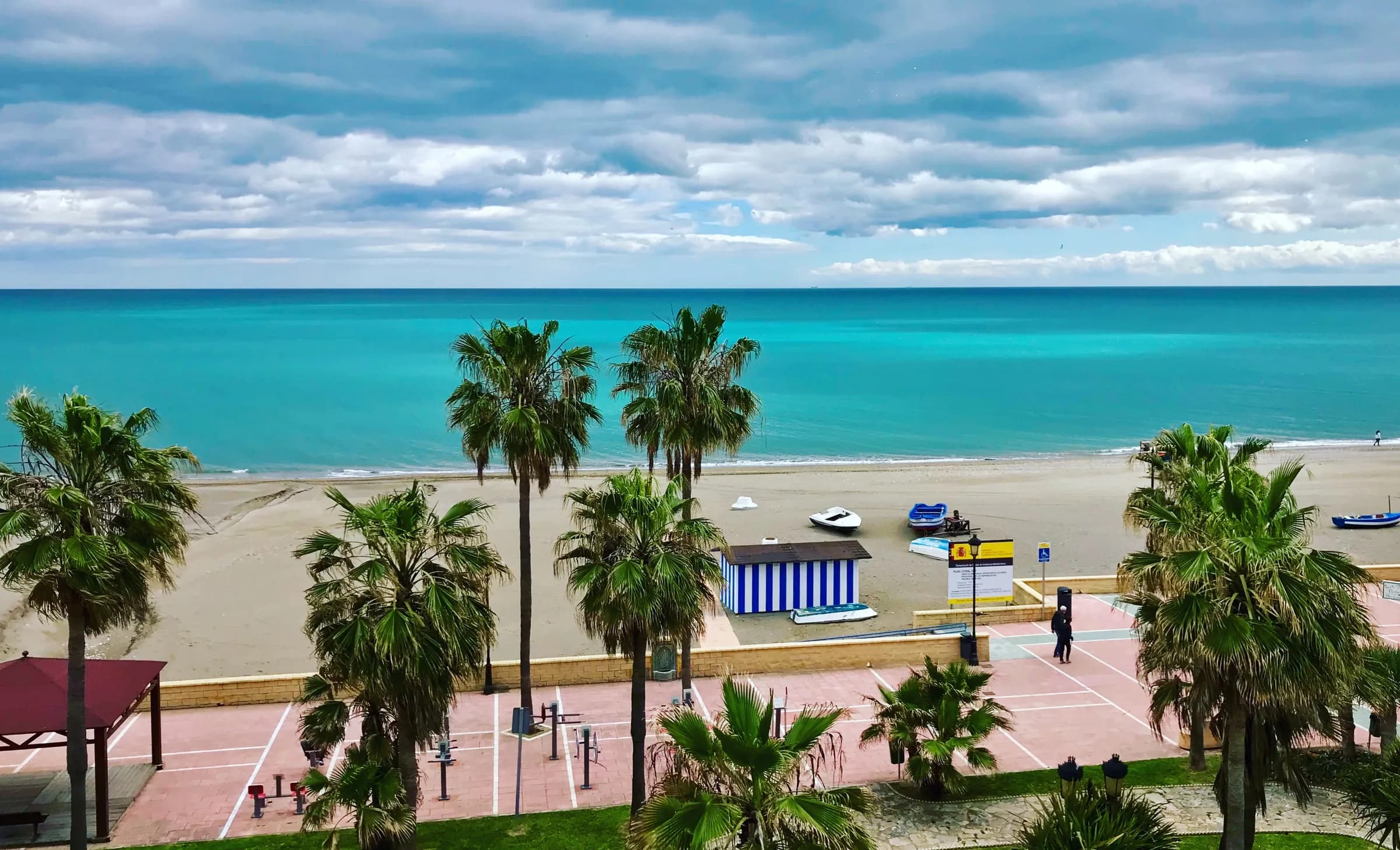
First, the facts. Sabinillas (full name San Luis de Sabinillas, part of Manilva municipality) is a fishing village of around 7,400 people that happens to have a first-line beach. It holds the Blue Flag, renewed again for 2026, which means the water quality meets the top European standard and lifeguards patrol in season. The beach runs for about 1.5 kilometres with a generous average width. Even at the height of August you can find space on the sand. The reason is simple: there are barely any large hotels, because the town was never built for mass tourism.
The feel here is a world away from Marbella. Walk the promenade after 20:00 and you'll see Spanish families with their kids, couples on dates, and pensioners taking their evening stroll before dinner. The chiringuitos on the beach grill espetos (fresh sardines threaded on a cane and cooked over a wood fire in an old boat) for roughly €5 a skewer. The air smells of grilled fish and sea salt, not sun cream.
From our apartment it's a 30-second walk to the sand. We didn't engineer that as a selling point; it was simply the flat that felt right. Guests turn up frazzled from the journey and, within five minutes of stepping onto the beach, they unwind. That's the Sabinillas effect, and it's the single most consistent thing our visitors tell us.
Driving time from Málaga Airport: around 1 hour 15 minutes (95 km via the AP-7).
Best for: families, couples after somewhere romantic, anyone who picks authenticity over nightlife, and repeat Costa del Sol visitors who already know Marbella and want the opposite.
Pro tip: for the real Sabinillas, shop the Friday market on the promenade (roughly 09:00-14:00): local produce, flowers, leather. For fresh fish, skip the market (there are no fish stalls there) and go to a town pescadería such as Dieguichi on Calle Fuengirola, where locals have bought their fish for decades. Note that restaurants won't cook fish you've bought yourself; order off the menu for that.
Want the full rundown? Our complete Sabinillas guide covers beaches, restaurants, markets and getting around in one place. When you're ready to stay, you can check dates and book direct.
Manilva: Wine Country Meets the Coast
Manilva sits on the hillside directly inland from Sabinillas and La Duquesa, and it's known for one thing above all: moscatel grapes. The terraced vineyards tumbling down toward the sea have produced sweet muscat for centuries, and the tradition lives on in family-run bodegas and local restaurants where the wine is refreshingly cheap.
This isn't a beach town in the usual sense; you reach the actual coast through its satellite districts like La Duquesa and Sabinillas. But Manilva pueblo itself gives you sweeping views toward Gibraltar and Morocco and a pace that feels properly off the tourist trail. Around 4,000 people live in the old town on the hill; the air is a touch cooler than the coast and the evenings are quiet.
Visit Manilva if you fancy wine tasting without the flight to Rioja. The grape-harvest festival in early September draws locals and a trickle of wine fans but never gets crowded. Pair a fritura malagueña (a mixed fried-fish plate) with a crisp local white for not much money. For the full route, see our Manilva wine trail guide.
Beaches in the Manilva area:
- Sabinillas Beach: about 1.5 km, Blue Flag, calm
- Playa de la Duquesa: sheltered, ideal for families
- Playa Chullera: smaller and more tucked away, toward the Cádiz border
Driving time from Málaga Airport: around 1 hour 15 minutes (about 100 km).
Casares Costa: Village Life by the Sea
Casares the white village clings to the hills inland, but Casares Costa is its beachfront stretch: a quiet residential area with a working beach and next to no tourism machinery.
What makes it special is the sheer calm. It's quiet even by quiet-town standards. The sand is unspoiled and the water clear; the main beach, Playa Ancha, runs about 1.3 km and held the Blue Flag again in 2026. You'll find the odd chiringuito but nobody pumping music across the beach. There are apartment blocks and villas, but no "resort" feel whatsoever.
This one suits couples or families who want absolute peace and don't need a town centre to keep them entertained. Estepona is 20 minutes away when you fancy more choice for dinner. But if nightlife is on your list at all, this isn't the spot, and we'd rather tell you that now.
Best time to visit: spring and autumn. Summer is warm (28-32°C), but outside the Spanish school holidays you'll have the beach more or less to yourself.
Driving time from Málaga Airport: around 1 hour 10 minutes.
La Duquesa: Marina Charm Without the Crowds
La Duquesa Marina is the exception to the sleepy-village rule on this western stretch: it has a bit of buzz. The harbour is ringed with restaurants, bars and cafés looking out across the Mediterranean toward Morocco on clear days. The Castillo de la Duquesa, an 18th-century coastal fort that now hosts exhibitions, anchors one end and gives the place some genuine history.
Crowds stay manageable because there are no big hotels in La Duquesa itself. The marina pulls in day-visitors from Marbella and Estepona, but the people staying overnight are mostly renting nearby apartments rather than passing through. The result is a real working marina with an evening paseo where tourists and Spanish locals mix.
Beaches:
- Playa de la Duquesa (El Castillo): sheltered, calm, great for families
- Sabinillas Beach is a 5-minute walk east
Restaurants: a dozen-plus places, from casual chiringuitos (around €15-25 for a main) to smarter seafood (€30-45). Book ahead in July and August. Our La Duquesa marina guide has the full picture.
Driving time from Málaga Airport: around 1 hour 15 minutes (95 km).
The Quiet Western Cluster: Sabinillas vs Manilva vs Casares Costa vs La Duquesa
These four sit so close together that choosing between them is really about what kind of day you want, not how far you'll have to drive. Here's how they compare.
| Town | The vibe | Beach on the doorstep? | Eating out | Best for |
|---|---|---|---|---|
| Sabinillas | Real Spanish beach town, lived-in | Yes (first line, 1.5 km) | Chiringuitos + town tapas | All-rounder; first choice |
| La Duquesa | Pretty marina, a little livelier | Beach 5 min walk | Most restaurant choice | Marina dinners, day-visitors |
| Manilva | Hill village, wine, big views | No (coast is 5 min downhill) | Local bodegas + fried fish | Wine, quiet, cooler evenings |
| Casares Costa | Residential, deeply quiet | Yes, but very low-key | Handful of chiringuitos | Total peace, switching off |
The trick most people miss: you don't have to pick. Base yourself in Sabinillas, where the beach and the daily shops are on your doorstep, then walk to La Duquesa for a marina dinner, drive five minutes up to a Manilva bodega, and have a do-nothing beach day at Casares Costa when you want true silence. That's exactly how our guests use the area; our apartment sits right in the middle of it.
Estepona: Is It the Best Alternative to Marbella?
Estepona is the best alternative to Marbella for most visitors: proper infrastructure and excellent restaurants, minus the party crowds and the price tag.
Estepona (population around 80,000) is the largest place on this list, but it's the smallest of the proper Costa del Sol resorts. It sits between Marbella (famous, busy) and Sabinillas (small, quiet), and lands in the sweet spot: good infrastructure without the overwhelm.
The key is to stay in old Estepona (Estepona pueblo), not the seafront strip. The old town is a warren of whitewashed lanes with red geraniums spilling from wrought-iron balconies, family-run tapas bars and a genuinely Spanish feel. The beaches away from the centre are quieter, particularly Playa Guadalmansa and Playa del Castor.
Estepona is nicknamed the "Garden of the Costa del Sol" for its near-obsessive flowers and greenery; pretty much every corner has planters and hanging baskets. It's the sort of place you wander into by accident and think: how is this still on the Costa del Sol?
Best for: families wanting a balance of amenities and authenticity. Estepona has excellent restaurants, supermarkets, pharmacies and facilities, minus the Marbella party scene. For the beaches specifically, see our best beaches near Estepona guide.
Beaches:
- Playa del Cristo: sheltered cove, lifeguards, famously calm water
- Playa El Saladillo: quieter, less built up
- Playa Guadalmansa: the most peaceful of the lot
Driving time from Málaga Airport: around 53 minutes (77 km).
Nerja: The Eastern Alternative
Nerja marks the eastern end of the Costa del Sol (population around 21,000). It was named Spain's Most Charming Coastal Town back in 2016 and the title is fair. Whitewashed houses tumble down steep streets toward the sea, and the beaches are backed by cliffs rather than apartment blocks. The town's signature viewpoint, the Balcón de Europa, juts out over the water and is worth timing for sunset.
Nerja's main draw is the Caves of Nerja (Cuevas de Nerja), about 3 kilometres east: vast karst chambers that are among Spain's best-known natural sites, with prehistoric art among the formations. They get hundreds of thousands of visitors a year, yet the town itself stays relatively calm. Buy cave tickets online in advance for summer; entry is around €14 on the door (cheaper booked online) and slots sell out.
The beaches are genuinely lovely. Playa de Burriana (home of the famous Ayo paella chiringuito) and Playa de Maro are framed by cliffs and pines, with clear water. The centre has good fish restaurants and an authentically Spanish evening paseo.
Why it's quiet: Nerja is the easternmost Costa del Sol town. It's far enough from Málaga Airport (70 km, about 52 minutes) that most tourists peel off at closer resorts, but near enough that it works as a day trip too.
Best for: couples, photographers, and anyone interested in geology or archaeology. The caves alone justify the drive.
Driving time from Málaga Airport: around 52 minutes (70 km).
Frigiliana: Mountain Meets Coast
Frigiliana sits 7 kilometres inland and about 300 metres up on the slopes of the Sierra Almijara (population around 3,000). It's an official member of Los Pueblos Más Bonitos de España, the Most Beautiful Villages of Spain association, and unlike a lot of award-winners it earns it.
This is white-village Andalucía at full strength. The old quarter is a tangle of impossibly narrow cobbled lanes lined with whitewashed houses, wrought-iron balconies and pots overflowing with geraniums. People still live here; you'll see laundry strung between balconies and locals nursing coffees in tiny bars. It isn't a museum piece, even though tourism plainly exists.
The village is known for miel de caña (cane-sugar molasses), still made the old way at a historic mill in the village; the process traces back to Moorish times.
Beach access: Frigiliana isn't coastal, but the Nerja beaches are about a 10-minute drive down the hill. Most people pair a morning in the village with an afternoon by the sea.
Best for: photography, walking, culture, couples. Less ideal for families with toddlers, thanks to those steep cobbles.
Driving time from Málaga Airport: around 1 hour 5 minutes (about 65 km).
Salobreña: Granada's Beach Secret
Salobreña (population around 13,000) sits in Granada province, technically on the Costa Tropical rather than the Costa del Sol. It's roughly half an hour east of Nerja and feels properly separate from the Málaga coast.
The town piles up a rocky promontory above two beaches: Playa de la Charca and Playa de la Guardia. A Moorish castle of medieval origin crowns the top, with wide views along the coast. The old quarter is a tight maze of white, winding, Moorish-influenced streets.
Why it's quiet: Salobreña is off the standard Costa del Sol circuit. Most visitors stay around Málaga, Marbella or Estepona, and Salobreña draws mainly Spanish holidaymakers from Granada and Madrid. There are plenty of apartments, but Spanish families own most of them, so outside July and August the town is wonderfully calm.
Best for: couples after history and atmosphere; families happy to be off the main tourist circuit; walkers exploring the meeting point of sea and the Sierra Nevada.
Beaches: two main options split by El Peñón de Salobreña, a striking rock on the shoreline. Locals tend to favour Playa de la Guardia for its calmer water.
Driving time from Málaga Airport: around 1 hour 15 minutes (100 km).
Mojácar: Off the Costa del Sol Entirely
Mojácar sits in Almería province (population around 6,500), off the Costa del Sol proper, but it's the spiritual cousin of these quiet towns. The whitewashed hilltop village looks down over Mojácar Playa, the beach settlement below, and together they make a genuinely undeveloped alternative to the famous resorts.
Almería's beaches are wilder and emptier than the Costa del Sol's, some reachable only on foot. The Mojácar seafront runs for several kilometres with a mix of small coves and longer sandy strips, and the chiringuitos are small, seasonal and family-run rather than chains.
Why it's quiet: Mojácar is roughly 290 km (around 3 hours' drive) east of Málaga, far enough to feel like a different holiday altogether. Summer brings Spanish families and some international visitors, but it's nothing like Marbella's crowds. Off-season, it's a place where you'll start recognising the same faces in the bars by day three.
Best for: off-season escapes, families, and anyone wanting a true break from mass tourism.
Driving time from Málaga Airport: around 3 hours (290 km).
Zahara de los Atunes: Atlantic Tranquillity
Full day-trip guide: Zahara de los Atunes from Sabinillas.
Zahara de los Atunes sits on the Costa de la Luz in Cádiz province, around 40 kilometres by road from Tarifa and home to just over 1,000 people year-round (INE, 2024). It's not Málaga and it's not the Mediterranean, but it's close enough and quiet enough to earn its place here.
This is a small fishing village where boats still work the bluefin tuna run that gave the town its name. The beach is kilometres of barely touched golden sand backed by dunes. The water is Atlantic: cooler than the Med, but startlingly clear and turquoise. No package holidays, no big hotels, no organised entertainment beyond the landscape.
People come to Zahara to swim, to windsurf (the Atlantic winds here are legendary), for family beach days, and for very little else. The restaurants serve the day's catch, the beach bars are simple wooden things that close after sunset, and in winter you can hear the sea and the birds and not much else.
Why it's quiet: Zahara is off the Costa del Sol circuit entirely, about 200 km from Málaga (roughly 2.5 hours' drive), and the Atlantic beaches pull a different crowd to the Mediterranean resorts. Most visitors are Spanish families, surfers and kite-flyers. International tourists barely feature.
Best for: families after absolute peace; windsurfers and water-sports fans; anyone chasing authentic Andalusian coast over tourism.
Beaches: essentially one long, simple, quiet stretch. That's the appeal.
Driving time from Málaga Airport: around 2.5 hours (200 km).
Quick Comparison Table
| Town | Population | Beach quality | Tourist crowds | Best for | From the airport |
|---|---|---|---|---|---|
| Sabinillas | ~7,400 | Blue Flag, calm, ~1.5 km | Minimal | Families, authenticity | ~1 hr 15 min |
| Manilva | ~4,000 | Varied (Sabinillas, Duquesa) | Low | Wine enthusiasts | ~1 hr 15 min |
| Casares Costa | small | Secluded, low-key | Minimal | Couples seeking peace | ~1 hr 10 min |
| La Duquesa | small | Sheltered, family-friendly | Moderate | Marina lovers, day trips | ~1 hr 15 min |
| Estepona | ~80,000 | Excellent town beaches | Moderate-Low | Families, balance | 53 minutes |
| Nerja | ~21,000 | Cliff-backed, clear | Low-Moderate | Couples, caves | 52 minutes |
| Frigiliana | ~3,000 | Not coastal (10 min drive) | Very Low | Photography, villages | ~1 hr 5 min |
| Salobreña | ~13,000 | Calm, two beaches | Low | History, Granada access | ~1 hr 15 min |
| Mojácar | ~6,500 | Long wild beach | Minimal | Alternative seekers | 3 hours |
| Zahara | small | Long untouched sand | Minimal | Windsurfers, peace | 2.5 hours |
How Do You Get to These Quiet Towns from Málaga Airport?
For nine of these ten towns, the journey starts the same way: pick up a hire car at Málaga Airport and head west or east on the AP-7 toll motorway (the parallel A-7 is free but slower, with traffic lights through the towns). Heading west toward Estepona and Sabinillas, the AP-7 hugs the coast and the drive is easy. Tolls on the western stretch are modest (a few euros) and well worth it in summer.
If you'd rather not drive at all, you can. The Avanza coach network links Málaga, Estepona, La Línea (for Gibraltar) and the bigger towns, and there are direct airport buses to Marbella where you can change. It's cheap but slow, and it won't get you to the smaller villages or the inland white villages without a taxi at the far end. For most stays of a few days or more, a car pays for itself the first time you fancy a day trip to Ronda or the white villages.
The third option is a private airport transfer straight to your accommodation: no car park, no toll booths, no driving on the wrong side after a 6am flight. We can arrange this for our Sabinillas guests for €140 one-way from Málaga (a driver meets you at arrivals); see our extras. It's the smoothest way to start, and you can still hire a car locally later for the day trips.
For a deeper dive on routes, toll costs and journey times, our Málaga Airport transfer guide and car hire tips cover the detail.
Why We Chose Sabinillas
When we were hunting for a base to host guests from, we visited most of the towns on this list. Estepona was lovely but still felt like a town. Nerja was beautiful but too famous. La Duquesa charmed us but felt small for a full week. Casares Costa was gorgeous and almost too quiet.
Then we found Sabinillas, and it ticked every box. First-line beach access: literally 30 seconds. Genuine Spanish character: families in the restaurants, fishermen out at dawn, Spanish the default language in the bars. Proper everyday infrastructure: supermarkets, pharmacies, a decent coffee bar. And, just as importantly, room to breathe.
Our guests arrive wound up from the drive from Málaga. Within half an hour on the beach they've stopped checking their phones. By day two they're planning the next visit. By day three they're asking, only half-joking, how long the apartment is free.
That's what a quiet beach town does. It hands back something you didn't realise you'd misplaced.
Good to know: August is high season everywhere on the Costa del Sol, and even Sabinillas fills up with Spanish families on their summer break. If crowds or noise bother you, aim for late May, June or September: warm enough to swim, calm enough to relax. October works too: the sea is still around 20°C and the summer crowds have thinned (see Costa del Sol weather in October for the details). Winter (November-February) is quieter again and still mild by day, though the sea cools to about 15-17°C.
How Do You Get Around Once You're Here?
From our beachfront apartment, every town on this list is within day-trip reach. The nearby ones (Manilva, Casares Costa, La Duquesa) are 5-20 minutes by car. Estepona is 20 minutes east. Nerja and Frigiliana are a full day out (about 1 hour 45 minutes each way, so set off early and do them together). Salobreña is around 2 hours from here but rewards the effort. For more on the immediate area, our hidden beaches guide maps the secluded coves between Estepona and Manilva.
Within the western cluster you barely need the car at all. Sabinillas to La Duquesa is a 20-minute walk along the promenade. The Friday market, the chiringuitos and the daily shops are all on foot. Save the driving for the proper excursions.
Planning Your Quiet Costa del Sol Holiday
The secret to these towns is booking a direct apartment rather than a big hotel. You'll find family-run flats, villas and small guest houses that give you the genuine local experience instead of the tourist bubble, and the staff at your local café will know your face by day two.
A few practical notes:
- Go shoulder season. Late May, June and September give you the best balance of warm weather and space. Book accommodation a couple of months ahead for summer; the good direct apartments go first.
- Decide on the car early. Public transport exists but is limited, so either hire a car or plan an airport transfer plus the odd taxi.
- Adjust to Spanish hours. Shops close roughly 14:00-17:00 for siesta; restaurants get going for dinner around 20:30, with 21:00 a typical start.
- Don't over-schedule. These towns reward slowness. The point isn't to tick boxes; it's to sink into the place.
If you fancy comparing it month by month before you commit, our best time to visit the Costa del Sol guide breaks down weather and crowds across the year, and our Costa del Sol weather by month page has the temperature, sea and rainfall averages for each month.
Make Yourself at Home in Sabinillas
If you decide to base yourself in Sabinillas at our beachfront apartment, we can have the kitchen ready for your first evening with pre-arrival grocery stocking and a stocked drinks selection. We can also sort an airport shuttle from Málaga if you'd rather skip car hire on arrival, and a private garage if you'd sooner park securely than hunt for a space on the street.
More than anything, we'd love to show you the Sabinillas that changed our minds about what the Costa del Sol could be.
Stay Right on the Beach
The sand is 30 seconds from the door, and the balcony looks straight out at it. Book direct and save up to 20%.
- 3 Bedrooms
- 6 Guests
- 96 m²
Frequently Asked Questions
Related Articles
Hidden Beaches Costa del Sol: Quiet Coves West of Marbella
A local's guide to the hidden beaches of the Costa del Sol: the quiet coves and wild sands between Estepona, Manilva and Casares that the guidebooks miss.

Estepona Beach Guide: The Best Beaches Nearby
A local guide to the best Estepona beach options: calm Playa del Cristo, the long town beach La Rada, plus quieter sands west towards Sabinillas.

Sabinillas: The Complete Guide to This Costa del Sol Town
A local's complete guide to Sabinillas: the beach, restaurants, markets, fiestas, day trips and practical tips for this quiet western Costa del Sol town.
The Local's Costa del Sol, Monthly
One email a month: what's on in Sabinillas, the best local finds, and first pick of apartment dates. Free welcome gift: our Sabinillas Insider Guide.
We respect your privacy. Unsubscribe at any time.
Comments
No comments yetHave a tip, a question or a correction? Every comment is read and approved by hand before it appears, usually within a day.
No comments yet. Be the first to share a tip or ask a question.