See it live: the Sabinillas beach webcam shows the sand, sea and promenade right now, with real on-site air and sea temperatures, a quick look before you head down.
Sabinillas Beach at a Glance
If you only read one section, read this. The essentials, before the detail.
| Official name | Playa de Sabinillas, San Luis de Sabinillas (Manilva) |
| Length / width | Roughly 1.5-1.7 km long (the Ministry's beach guide gives 1,700 m), around 50 m wide |
| Sand | Fine, dark golden-grey mineral sand, soft underfoot |
| Status | Blue Flag, renewed annually |
| Sea entry | Gentle, gradual slope; good for children |
| Lifeguards | From June; in July and August along the whole Manilva coast (dates set yearly by the ayuntamiento) |
| Best swimming | July to September; sea 22-23°C in August |
| Chiringuitos | Several, open roughly May to October |
| Sun loungers | About €10-15 a pair with parasol |
| Parking | Hard in summer; municipal car park or our garage add-on |
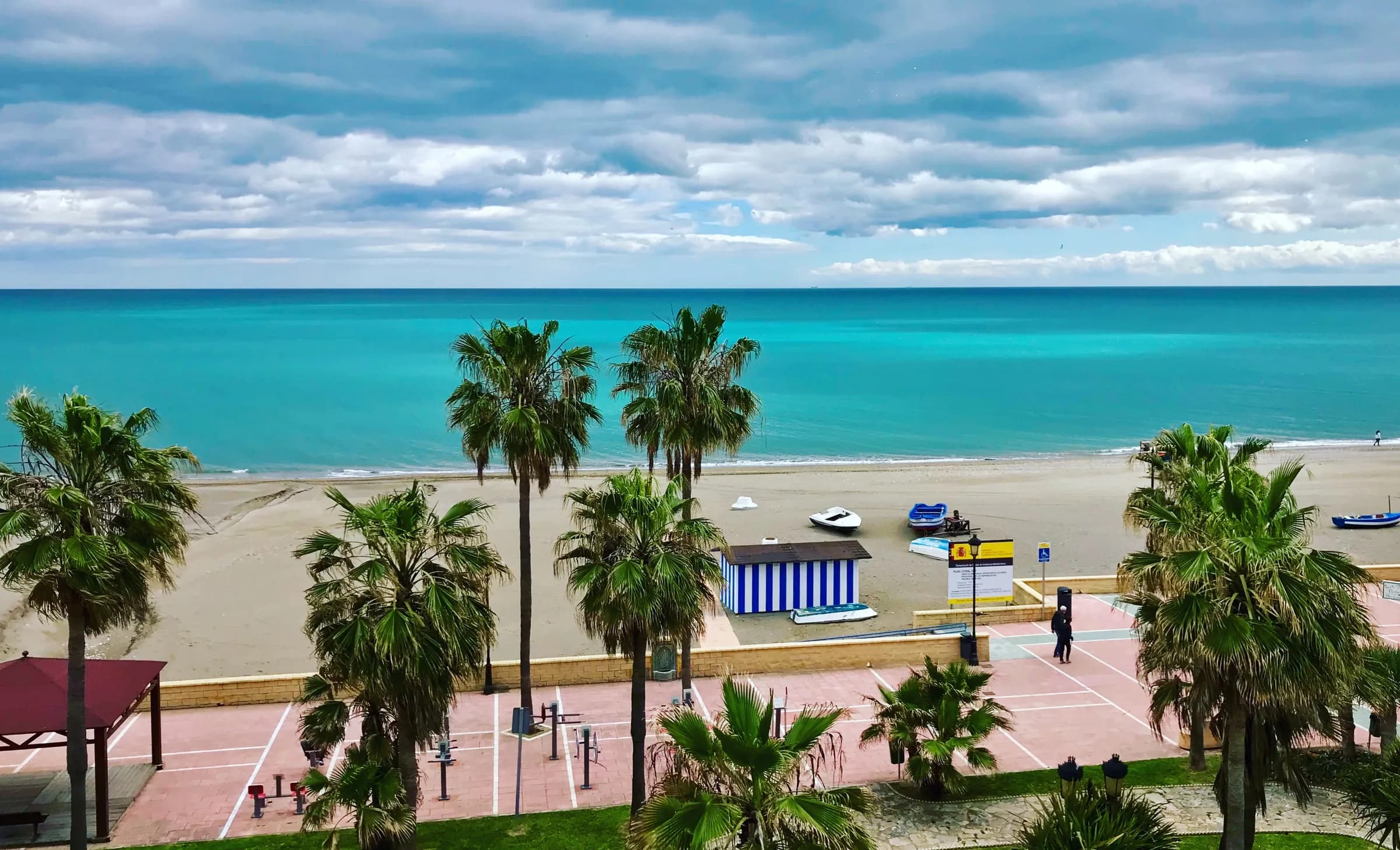
| From the apartment | 30 seconds' walk to the sand |
Why Sabinillas Beach Stands Out
There are perhaps fifty beautiful beaches along the Costa del Sol. Yet walk along any of them and you will eventually encounter a high-rise skyline, a theme-park atmosphere, or crowds shoulder-to-shoulder on a summer's day. Sabinillas beach is different. It feels like a local secret, not because we are trying to hide it, but because it has not been industrialised into a destination.
This is a beach where Spanish families gather every August. Where fishermen still bring their boats ashore at dawn. Where the rhythm of the day follows the sun and the tides, not a booking system or a lifeguard schedule. Walk along the sand and you are as likely to hear Castilian Spanish as English. The chiringuitos have no laminated photo menus or wait staff with clipboards. They have espetos, cold beer, and time.
We have been hosting guests at our beachfront apartment here for years, and their reactions are remarkably consistent: "Why did nobody tell us about this place?" The answer is simple: Sabinillas has been too busy being itself to market itself.
How Long Is Sabinillas Beach, and Is It Blue Flag Certified?
Sabinillas beach runs some 1.5 to 1.7 kilometres along the coast, depending on where you put the ends (the Ministry's beach guide says 1,700 m), with an average width of 50 metres, and it holds Blue Flag certification, renewed every year. That is enough space, on even the busiest August days, for a beach to breathe. You can find a quiet corner, a lively section with chiringuitos, or a family-friendly spot with playgrounds steps away. In the last week of August the beach shares the town with the San Luis patron fiesta, two minutes back from the sand.
The sand itself is the fine, dark golden-grey mineral sand distinctive to this stretch of the western Costa del Sol: river-borne rather than volcanic, and part of the coast's authentic character (no imported resort sand here). It is ideal for building castles with children or simply lying flat for hours. The seabed descends very gradually, meaning shallow water extends far, excellent for young swimmers or anyone wary of sudden depth changes.
Sabinillas holds Blue Flag certification, awarded annually through ADEAC, the Spanish member of the international Foundation for Environmental Education (FEE), renewed again for the 2026 season by the Ayuntamiento de Manilva. This is no marketing badge. To earn and retain Blue Flag status, beaches must meet exacting standards:
- Water quality: Tested regularly throughout the swimming season. Sabinillas consistently meets the highest EU bathing water standards.
- Environmental management: Waste bins, recycling facilities, and daily beach cleaning.
- Safety infrastructure: Lifeguards, first aid equipment, accessible pathways, and clear signage.
- Environmental education: Information boards about local marine ecology and conservation.
During summer months, the municipal team cleans the beach early each morning, usually before the first swimmers arrive. It is a quiet discipline, not advertised, simply expected.
One thing worth knowing: the Blue Flag on the mast is the annual award, while the green, yellow and red flags flying beside it change with the day's conditions. Our guide to Spain's beach flags explains what each colour means, including the purple jellyfish flag you may see in high summer.
Which Part of the Beach Should You Pick?
A beach of 1.5 km or more has different moods along its length. Knowing this saves you carrying a cool bag to the wrong end.
- The central section: opposite the town and the bulk of the promenade. Most chiringuitos, easiest access, closest to shops and toilets. This is where our apartment sits, and where most visitors settle. Busiest, but never crushed.
- The western end (towards La Duquesa): thins out as you walk towards the marina. Good for a longer stroll and a quieter towel. The water-sports cluster sits down this way.
- The rocky eastern end: where local fishermen still work and the snorkelling is best. Fewer families, more character. Bring reef shoes for the stones.
If you want lively, plant yourself centrally near a chiringuito. If you want space, walk ten minutes in either direction and the crowd simply falls away. That choice (buzz or solitude, on the same beach, the same afternoon) is the whole point of Sabinillas.
Chiringuitos: Where the Soul of the Beach Lives
A Spanish beach without a chiringuito is like coffee without a café: technically possible but missing the entire point. These open-air beach restaurants are not just places to eat. They are where mornings become afternoons, where strangers become lunch companions, and where food tastes better because it is cooked over wood fires with sand between your toes.
Sabinillas has several excellent chiringuitos along the beach. The rule is simple: walk along and follow the smoke. A chiringuito with a roaring espeto fire and a terrace full of Spaniards is almost always a safe bet. The ones with laminated tourist menus and photos of food are generally to be avoided.
What to Order (and What It Costs)
Espetos de sardinas: The signature dish of the Málaga coast. Fresh sardines skewered on bamboo sticks, laid across wood fires built literally on the sand. Smoky, salty, simple, and extraordinary. Cost: usually around €3-5 per skewer. Ask for how many you want.
Fritura malagueña: A generous plate of mixed fried fish: baby squid (chopitos), anchovies (boquerones), red mullet (salmonetes), and others. Lightly battered, perfectly crispy. Locally caught, seasonally available. Cost: €10-14 per plate. This is working food, meant to be eaten with fingers and cold beer.
Gambas al pil pil: Prawns sizzling in a clay dish with olive oil, garlic, and chilli. Served with crusty bread for dipping. Simple, elegant, about €10-12. Takes ten minutes to prepare; use the time to watch the sea.
Pescaíto frito: Whatever fish was caught that morning, floured and fried. The daily special. Cost: €8-12 depending on fish type and size. Ask what is fresh before ordering.
Pulpo a la gallega: Octopus sliced and dressed with paprika and olive oil. Chewy in the best way. €10-14. More common in autumn and winter when octopus is in season.
Pair everything with a cold Cruzcampo beer (around €2-2.50) or a glass of local wine from the Manilva vineyards. Tinto de verano (red wine mixed with lemon soda) is the ultimate beach drink and costs almost nothing. A full pitcher for two people comes to under €6.
Pro tip: Nobody will bring you the bill until you ask for it. That is not slow service; it is Spanish hospitality. Sit, eat, drink, and enjoy. When you are ready to leave, catch a server's eye and say "la cuenta, por favor." Billing happens in the moment, after you have finished, not before.
Most chiringuitos operate from May through October. During peak summer, getting a beachfront table for lunch can require arriving before 13:30 or after 15:00. This is not a bad thing; it gives you permission to time-shift your day to match the local rhythm.
For named spots, what they cook well and where to sit, see our full guide to the best chiringuitos in Sabinillas.
What Water Sports Can You Do at Sabinillas Beach?
Sabinillas beach is set up for stand-up paddleboarding, kayaking, jet skiing, beach volleyball and snorkelling, thanks to its calm, sheltered water and gentle slope, particularly good for beginners and families. Most rental operators cluster around La Duquesa marina, a 15-20 minute walk west along the beach.
Stand-Up Paddleboarding (SUP)
SUP has exploded in popularity along this stretch of coast over the last five years. The water is typically calm in early mornings, making for perfect glass-flat paddling conditions. You can paddle along the coastline towards La Duquesa marina, explore shallow rocky areas at the beach ends, or simply float and watch the hills behind town. Staying with us? You don't need to hunt for a board at all: we rent our own premium SUP to guests from €30 an hour, handed over at the apartment 30 seconds from the sand, life vest included, on calm days. Early morning paddles, when the sea is flat and the light is golden, are spectacular; our SUP guide has routes and technique.
Local operators on and around the beach and at La Duquesa marina rent boards by the hour or day; ask us when you arrive and we'll point you to the current best option for your level.
Kayaking
Double kayaks are available for summer rental from local water sports operators, with the ones based around La Duquesa marina the most reliable place to find them. Paddle tandem along the coast towards La Duquesa, explore the rocky coves, or take a guided tour. Children often love kayaking more than paddleboarding; it feels more like piloting a vessel than balancing on a board. Snorkel gear can sometimes be rented alongside, making for combined water adventures.
Jet Skiing
For higher-energy thrills, jet ski operators set up seasonally (primarily July and August), with several based around La Duquesa marina. Rates vary by operator and season, and longer packages are usually available alongside short tasters. It is best for confident swimmers who like speed and do not mind the noise. Ask us for the operators running locally that season.
Beach Volleyball
Public beach volleyball courts are set up each summer on the sand, usually mid-June through August. They are free to use and surprisingly well-maintained. Local players gather in the early evening when the heat drops. Tourists are welcome to join. Even if you do not play, watching from a chiringuito terrace with a cold drink is entertainment in itself.
Snorkelling
The rocky sections at both ends of Sabinillas beach offer decent snorkelling. Water clarity is best in early mornings before afternoon winds stir the surface. You will see small fish, sea urchins, and occasionally an octopus tucked into rocks. You can bring your own snorkel gear or ask at the beach if rentals are available locally. The rocky eastern end is particularly good: less crowded, better snorkelling, and closer to where local fishermen work.
The Promenade: Paseo Marítimo
The Paseo Marítimo runs the entire length of the beach, some 1.5 to 1.7 kilometres of palm-lined walking path separating sand from town. It is perhaps the best way to understand Sabinillas' dual nature: local beach community and holiday destination existing in balance.
Early mornings, the paseo fills with Spanish walkers: retired couples, morning runners, elderly men with walking sticks and newspapers under their arms. By mid-morning, families with children claim the playgrounds (there are several, all well-maintained and free). By late afternoon, everyone returns for the evening paseo, that sacred Spanish tradition of walking and being seen, usually between 18:00 and 20:00.
The promenade has benches, public toilets (clean and maintained), foot showers for rinsing sand, and several small shops and kiosks selling ice cream, drinks, and basic beach supplies. During summer, small markets sometimes set up: local artisans, fresh fruit vendors, craftspeople. It is worth exploring beyond the main beach area. For the real weekly market (not just the small seasonal stalls here), head a five-minute drive inland on a Sunday; our Sunday market in Sabinillas guide covers times and what to buy.
When Is the Best Time to Visit Sabinillas Beach?
June and September give the best balance of warm sea and thin crowds. July-August is warmest but busiest, and April-May or November-March suit walkers more than swimmers. Here is the season-by-season detail.
Spring: April-May
Lovely for beach walks and sunbathing. Water temperature ranges 16-19°C: refreshing rather than warm, suitable for wetsuits or for the hardy. Fewer tourists, beautiful golden light for photography. Chiringuitos begin opening mid-April. The beach feels local again, with more Spanish families than international tourists. Ideal if you like space and do not mind cool water.
Early Summer: June
The sweet spot for most visitors. Water reaches 19-21°C, comfortable for extended swimming without a wetsuit. Sunny nearly every day. Crowds begin arriving but never feel overwhelming. San Juan celebrations on 23 June mean bonfires on the beach and an unforgettable local festival atmosphere. This is when the season truly awakens.
Peak Summer: July-August
Full summer. Water reaches 22-23°C. All facilities operating. Water sports available daily. Chiringuitos buzzing. The beach is busier, though never feels overcrowded by broader Costa del Sol standards. Families dominate. Temperatures climb to 28-32°C. Morning swims before 11:00 and evening swims after 17:00 are most pleasant; midday heat can be intense. Mid-July brings the Virgen del Carmen (16 July, the patron saint's seaborne procession), and early August the Feria de Manilva (traditional fair), both with street celebrations and events.
Early Autumn: September-October
Many argue September is the best beach month. The sea has absorbed the entire summer's heat, reaching its warmest around late August-September. Crowds thin dramatically after the first week. Prices drop noticeably. Weather remains sunny and warm. Locals return to the beach after the tourist crush. October is still pleasant for sunbathing, though water temperature begins dropping and evenings cool down. September feels like the beach's own time again.
Winter: November-March
The beach transforms from a social destination into a contemplative landscape. Winter days are often sunny (average 5-6 hours of sunshine even in January). A winter beach walk followed by coffee on the promenade becomes a simple daily ritual. Water temperature drops to 14-16°C: only for the brave or those with wetsuits. Facilities close down, chiringuitos operate limited hours, and the beach returns fully to locals. It is beautiful in a different way: empty, peaceful, authentically Spanish.
| Season | Water Temp | Best For | Crowd Level | Facilities |
|---|---|---|---|---|
| April-May | 16-19°C | Walking, photography, peace | Very low | Limited |
| June | 19-21°C | Swimming, family holidays | Moderate | Fully open |
| July-August | 22-23°C | Peak swimming, water sports | High | All available |
| September | 21-22°C | Swimming, relaxed crowds | Moderate-low | Fully open |
| October | 19-21°C | Sunbathing, walking | Low | Limited |
| November-March | 14-16°C | Walking, winter sun | Very low | Minimal |
What Facilities Does Sabinillas Beach Have?
Sabinillas beach has free freshwater showers, public toilets, lifeguard stations (from June; the whole coast is covered in July and August), sun-lounger rental and wheelchair-accessible boardwalks: everything for a full day without leaving the sand.
- Showers: Multiple free freshwater shower stations positioned along the beach, for rinsing salt and sand before heading home or to town.
- Toilets: Public facilities at several access points (well-maintained during summer). Chiringuitos have toilets available for customers.
- Sun loungers & parasols: Available through most chiringuitos, May-October. Typical cost €10-15 per day for a pair of loungers with an umbrella, while some beach clubs offer larger double daybeds for around €30-40. Some chiringuitos include loungers free for customers spending a certain amount on food.
- Accessibility: The beach has good accessibility infrastructure. Wooden boardwalks and ramps allow wheelchair and pushchair access. Accessible toilets are available. Staff at lifeguard stations can assist visitors with mobility requirements.
- Parking: Free street parking exists on the residential roads behind the beach, but it is genuinely difficult to find in Sabinillas and fills completely in summer; expect to circle for a while. The town's municipal public car park is the more reliable option. For a stress-free stay, our apartment includes a private garage space as an optional add-on, so you can park once and walk everywhere.
- Waste management: Bins positioned along the promenade. Recycling facilities available. Keeping Blue Flag status is a community responsibility; please use bins.
- Dogs: Not allowed on the sand in the bathing season, like nearly every beach on this coast; the promenade is fine on a lead. The nearest marked dog beaches are Manilva's own at Las Arenas and Piedra Paloma in Casares Costa, both about ten minutes by car; our guide to dog beaches near Sabinillas covers both and the rules.
- Lifeguard stations: Staffed from June, with the whole coast covered in July and August (the ayuntamiento sets the dates each year), and first aid equipment on site.
- WiFi: Not on the beach itself, but several chiringuitos offer WiFi. Our apartment is close enough that the signal sometimes reaches the near section of beach; work from the beach if you must, though we suggest leaving the laptop at home.
What to Bring for a Perfect Beach Day
A few essentials transform a day at Sabinillas beach from good to unforgettable:
- Sun cream: SPF 50 recommended, particularly between 12:00-16:00. Southern Spanish sun is stronger than you anticipate, even on hazy days. Reapply after swimming.
- Water: Stay hydrated. Chiringuitos sell cold water and drinks, but bringing your own saves money and plastic waste.
- Beach shoes or sandals: Sand heats significantly in peak summer. Reef shoes are useful for rocky sections and protecting feet from sea urchins.
- Hat or cap: The sun overhead is intense. A wide-brimmed hat provides hours of relief.
- Cash: Some chiringuito operators still work cash-only, though this is changing. A €20 note covers most beach expenses.
- Snorkel gear: If exploring rocky sections. Cheap to buy locally, and the beach operators rent sets in season.
- Book or tablet: You will have time. Reading on the beach is the whole point.
- Beach bag or backpack: Something waterproof for valuables. Most people simply leave unnecessary items at accommodation and bring essentials only.
How Does Sabinillas Beach Compare to Nearby Beaches?
Sabinillas is the quietest and most local of the beaches nearby; La Duquesa and Estepona trade some of that calm for more restaurants and a livelier scene, a 15-20 minute walk or short drive away. The western Costa del Sol has a string of beaches within half an hour, each with its own personality; here is how they compare, from someone who lives among them.
| Beach | Distance from Sabinillas | Vibe | Best for |
|---|---|---|---|
| Sabinillas (Playa de Sabinillas) | You're here | Quiet, local, family-paced | Swimming every morning, chiringuitos, peace |
| La Duquesa | 15-20-min walk west | Marina-side, restaurants, boats | A meal out and a wander after the beach |
| Estepona (Playa de la Rada) | 15-min drive | Longer, more developed seafront | Buzz, choice, town amenities on the sand |
| Casares (Playa Ancha) | 10-min drive east | Broad, open, low-rise | Space and a windier, wilder feel |
| Manilva / Punta Chullera coves | 10-min drive west | Small, rocky, undeveloped | Snorkelling and getting away from everyone |
Estepona has more going on, no question: a bigger marina, more restaurants, a smarter promenade. But it is also busier and more built-up. Sabinillas trades some of that polish for calm and authenticity: you can still find a quiet stretch of sand in August, and the chiringuitos still feel like locals' canteens rather than tourist machines. If you are weighing up the two, our Estepona beaches guide lays out the case in full, and the Sabinillas complete guide covers the town beyond the sand.
The short version: come to Sabinillas for the beach you swim at every day, and day-trip to the busier places when you fancy a change of scene. The rest of Manilva's coast, from La Duquesa and El Castillo to the wild coves at Punta Chullera, is mapped beach by beach in our guide to the beaches of Manilva.
Base Yourself Here: Why Location Matters
Living 30 seconds from this beach is not a luxury; it changes the rhythm of your entire holiday. Morning coffee on the balcony watching the sea warm with sunrise. A quick swim before breakfast. Lunch at a chiringuito where they know you by name after two visits. An evening paseo along the promenade as colours bloom in the western sky. Return to the apartment, shower off the salt, rest during siesta, and emerge for dinner when the sun drops.
This is not a beach destination you visit; it is a base from which you explore. From Sabinillas, you can day-trip to Ronda, Gibraltar, the white villages and beyond. Yet the appeal of the location is that you need not go anywhere. The best thing about Sabinillas beach might simply be staying here.
For those considering where to base themselves on the western Costa del Sol, we have positioned our beachfront apartment on the central section of the beach, within easy reach of chiringuitos, the promenade, and all facilities. It is the kind of location that makes you wonder why anyone would choose to stay anywhere else.
For families: The gentle slope, soft sand, and calm waters make Sabinillas ideal for children. Buckets and spades are sold cheaply at the beachfront shops. Most chiringuitos welcome children and have children's meals available. The promenade playgrounds are free and well-maintained. Life jackets and flotation aids are sometimes available for rent locally; ask at the lifeguard stations in summer.
How Do You Get to Sabinillas Beach?
By car, Sabinillas is about 75 minutes from Málaga Airport and 30 minutes from Gibraltar Airport, the two most common routes in. It sits in the municipality of Manilva, on the westernmost Costa del Sol, approximately 15 kilometres south-west of Estepona and around 95 kilometres from Málaga city.
By car from Málaga airport: Head west on the AP-7 motorway towards Estepona. Exit towards Manilva and follow signs for Sabinillas/San Luis de Sabinillas. Total journey: approximately 75 minutes (90-95 km). Parking as described above: free street parking or the small car park near the eastern beach access.
By bus: Avanza bus services connect Estepona and the western Costa del Sol towns. The M-240 line runs from Estepona to Sabinillas and on towards La Línea (for Gibraltar), roughly 15-25 minutes depending on stops, around €3-4 per journey. Service is regular but not frequent; check current timetables.
By car from Gibraltar airport: Approximately 30 minutes (30 km), heading north-east towards Manilva.
For guests staying at our apartment, we can arrange private transfers from either airport; see our extras options for pricing and booking.
Planning Your Sabinillas Beach Visit
For more context on the surrounding area, including restaurants, activities, and local culture, read our comprehensive Sabinillas Complete Guide. For those interested in water sports specifically, our SUP Paddleboarding Guide details conditions, rentals, and technique.
If Sabinillas fits your vision of a holiday (beach-based, local-feeling, unpretentious), then check availability and book your stay here. We welcome guests year-round, from spring beach walks to summer swimming to winter sun. The apartment accommodates up to 6 guests and offers optional add-ons including a private garage, airport shuttles, and pre-arrival grocery stocking.
Stay Right on the Beach
The sand is 30 seconds from the door, and the balcony looks straight out at it. Book direct and save up to 20%.
- 3 Bedrooms
- 6 Guests
- 96 m²
Frequently Asked Questions
Related Articles
Full Moon Festival Sabinillas 2026: A Beach in White
Each July, Sabinillas beach becomes a sea of white for the Full Moon Festival: candles, fire shows and moonlight. The 2026 timing, dress code and how to do it.
Chiringuitos on the Costa del Sol: Sabinillas Guide
A local's guide to the best chiringuitos on the Costa del Sol around Sabinillas and Manilva: where to eat espetos on the beach, what to order, and prices.

Estepona Beach Guide: The Best Beaches Nearby
A local guide to the best Estepona beach options: calm Playa del Cristo, the long town beach La Rada, plus quieter sands west towards Sabinillas.
The Local's Costa del Sol, Monthly
One email a month: what's on in Sabinillas, the best local finds, and first pick of apartment dates. Free welcome gift: our Sabinillas Insider Guide.
We respect your privacy. Unsubscribe at any time.
Comments
No comments yetHave a tip, a question or a correction? Every comment is read and approved by hand before it appears, usually within a day.
No comments yet. Be the first to share a tip or ask a question.