The clock runs differently at Christmas in Spain, and in Jerez de la Frontera it runs differently again. Here the season does not start with a market or a tree. It starts on a Friday in late November when the first zambomba breaks out in a plaza, a hundred people stand in a circle and sing carols to a flamenco beat until the small hours, and the town does not stop until Christmas Eve. We drive over from Sabinillas most years. It is an hour and a half and it is the best Christmas evening in Andalucía.
What a zambomba is
The word means an instrument first: a clay pot or a tin with a skin stretched over it and a reed stuck through the middle. You wet your hand, rub the reed up and down, and it makes a low, hoarse thrum. Jerez has a habit of naming the party after the thing that makes the noise, so the gathering became a zambomba too.
The gathering began in the shared courtyards of the old town and in the workers' quarters on the sherry estates, which is how the town council's own bando describes it, and tradition puts it in the late 18th century. Neighbours lit a fire in the patio, brought out the anís and the fried pastries, and sang villancicos, Spanish carols, late into the night. Over the generations Jerez put its own rhythm under the words, and today the carols go to a bulerías beat: lyrics about the Virgin and the Child, sung the way a flamenco party sounds. A zambomba in the old style has no stage and no microphone. People stand in a ring, the ones who can sing take a verse each, everyone else claps, and the chorus belongs to the whole plaza.
The Junta de Andalucía listed the Jerez zambomba as a Bien de Interés Cultural in December 2015, the same protection given to the version in nearby Arcos de la Frontera. Ten years on there are hundreds of them every season, in brotherhoods, flamenco peñas, bodegas, tabancos, bars, schools and whole squares.
When: 20 November to 25 December 2026
The season is fixed by the mayor's bando, signed on 30 September 2026 and published by the council on 3 October: Friday 20 November to Friday 25 December 2026, both included. Outside that window the council does not authorise zambombas in public space.
The bando also sets hours, and they shape the day:
- 15:00 to midnight for zambombas that need no permit: bars, tabancos, terraces and private gatherings.
- Until 02:00 at the latest for authorised ones in streets and plazas; terraces stop at midnight.
In other words it is an afternoon party that runs late. A brotherhood zambomba typically starts at three or four, straight after lunch, and by nine the centre is full. Nobody gets up early for a zambomba.
The 2026 lights switch-on had not been announced when we wrote this. In 2025 it was Friday 21 November, the same Friday the bando period opened, with a free public concert as the opening act. The sensible assumption is that 2026 follows the same pattern on Friday 20 November; check jerez.es the week before you book anything.
Which ones are free
The number of "Jerez Christmas flamenco show" products sold online makes the whole thing look ticketed. Most of it is not.
Streets and plazas: free. The bando only allows non-profit groups to hold zambombas in public space (brotherhoods, flamenco peñas, residents' and traders' associations), two per group at most, with no sound system. The ones a brotherhood holds outside its church door or in the next square are the heart of the whole tradition, and they belong to everyone. You arrive, you find a gap in the circle, you sing.
Bars and tabancos: no entry charge. The bando lets a licensed bar host a popular zambomba without a permit as long as it stays what it is: singing a cappella or with tambourines, zambombas, anís bottles and clay jars, no stage, no microphones. You are expected to order something. A glass of fino in an old-town tabanco costs very little, and the zambomba is a metre from your elbow.
Bodegas: usually ticketed or run on a capacity limit with a reservation, and many of them are now staged shows with hired performers. More comfortable, and a long way from the courtyard original. If the bodegas themselves are what you came for, that is a different day and a different article: our Jerez sherry and Sherry Triangle guide covers the cellars and the tastings. Here we will only say that in December several of them open their patios for singing.
The Teatro Villamarta has its own Christmas cycle. In 2026 it opens with the zambomba of the Peña Flamenca La Buena Gente; tickets went on sale on 8 September through the box office (+34 956 14 96 86) and online, and the popular dates sell out. This is the option for anyone who wants a seat and a clear start and finish.
The puente weekend, 5 to 8 December
If you can only do one weekend, the Inmaculada long weekend is the big one. In 2024 the council counted 138 authorised zambombas, around 100,000 visitors and hotel occupancy of 96 and 97 percent on the Friday and Saturday. In 2026 the puente runs from Saturday 5 to Tuesday 8: Andalucía moves Constitution Day from Sunday 6 to Monday 7, and Tuesday 8 is the Inmaculada, so it is four days straight and the peak is Saturday to Monday.
Two things to know about that weekend. First, the centre fills to the point where the local police channel the crowd one way along certain streets (in 2024 that happened around Calle Algarve and at the entrance to Plaza Plateros). With a pushchair, with anyone who walks slowly, or if crowds get to you, the puente is not your weekend. Second, beds run out. If you plan to sleep in Jerez, book in November.
The alternatives work just as well. Saturdays 12 and 19 December have the same atmosphere with far fewer people, and Friday evenings are easier than Saturdays. Christmas Eve morning, Thursday 24 December, is the farewell: the centre sings from mid-morning until everyone goes home for the family dinner. For a family with small children it is the best zambomba on the calendar.
Finding today's zambombas
Do not look for one official programme listing every street zambomba, because there is none. The council authorises each one separately, and brotherhoods and peñas announce theirs a week or two ahead, often as a poster on the door and a photo on social media. The Christmas section of jerez.es explains the tradition and carries the council's own events; the day's list is something the town writes as it goes.
The week before, check the local Jerez press agenda or one of the local websites that gather the dates by day; once there, ask in the first bar. On a December Saturday between four in the afternoon and midnight, walking between Plaza del Arenal, Plaza de la Asunción, Plaza Plateros and the lanes of the Santiago quarter, you will run into half a dozen without looking.
What people eat and drink
The courtyard zambomba ran on home-made sweets: pestiños (fried pastry twists in honey), buñuelos and roscos, made by the family and handed round free to the singers. Brotherhood and neighbourhood zambombas still have a table of sweets, and the more traditional ones serve a bowl of something hot: berza jerezana, a chickpea and greens stew, or ajo caliente, a warm mash of bread and peppers. If either is offered, say yes.
To drink, what the land makes: fino or oloroso in a copita, and at the neighbourhood ones anís and aguardiente, with the bonus that the empty anís bottle becomes an instrument. Eat first, though. Zambombas start at three and Jerez eats lunch at two, so a long lunch in the centre and straight on to the first circle is the natural order of the day.
Getting there from Sabinillas
By car: 129 km and around an hour and a half. Take the A-7 west towards Algeciras, pick up the A-381 at Los Barrios and follow it across the cork-oak country of Los Alcornocales straight into Jerez. It is an easy road and, in December, a quiet one until you arrive.
Do not drive into the centre. On zambomba Fridays the council restricts traffic in the centre from 15:00, and on Saturdays and holidays from 12:00. The central car parks admit cars until they are full, after which police let vehicles through only as spaces free up. What works is the shuttle bus: one runs from the Feria del Caballo fairground to the Alameda Cristina, the other from the Monday market ground behind the Pedro S. Garrido stadium to Calle San Agustín, from 14:00 to 23:55. Park at the fairground, ten minutes on the bus, and you are in the centre.
Public transport: no. There is no direct bus from Manilva to Jerez and no railway on our part of the coast.
The getting-home question. If one of you drives and stays off the fino, you can come back: shuttle at eleven, home by quarter to one. Spain's drink-drive limit is 0.5 g/l, lower than the UK's 0.8, and the Guardia Civil sits on the roads out of Jerez at this time of year. If you want to stay until a street zambomba winds down at two, sleep there. Jerez has hotels at every price except on the puente, and El Puerto de Santa María is a good fallback: ten minutes from Jerez on the C-1 local train, and the seafront hotels often have rooms when Jerez has none.
Our own December Saturday, with two children, runs: leave Sabinillas at noon, shuttle in, a long lunch at two, a brotherhood zambomba in a plaza at four (the easiest kind with children), the lights on Calle Larga and a tabanco, a second zambomba, and the eleven o'clock shuttle back.
Who it is not for
Anyone who wants a flamenco show with a seat and a clear beginning and end: that is the Villamarta, or one of the tablaos in our guide to flamenco shows in Andalucía, and a street zambomba will feel like chaos. Anyone who cannot stand a crowd: the puente is out, and the other Saturdays will feel long too. And anyone who wants to park at the door: the closest you will get is the shuttle stop.
For everyone else it is the best Christmas in Andalucía, and it fits easily around a December stay with us. Our guide to the December puente on the Costa del Sol says what is open over the long weekend, and Christmas Day on the Costa del Sol explains how the 24th and 25th work here. The apartment is in low season from November to March, from €110 a night, and an hour and a half from a plaza full of people singing carols by bulerías. Check dates and prices and we will tell you which Saturday we are going.
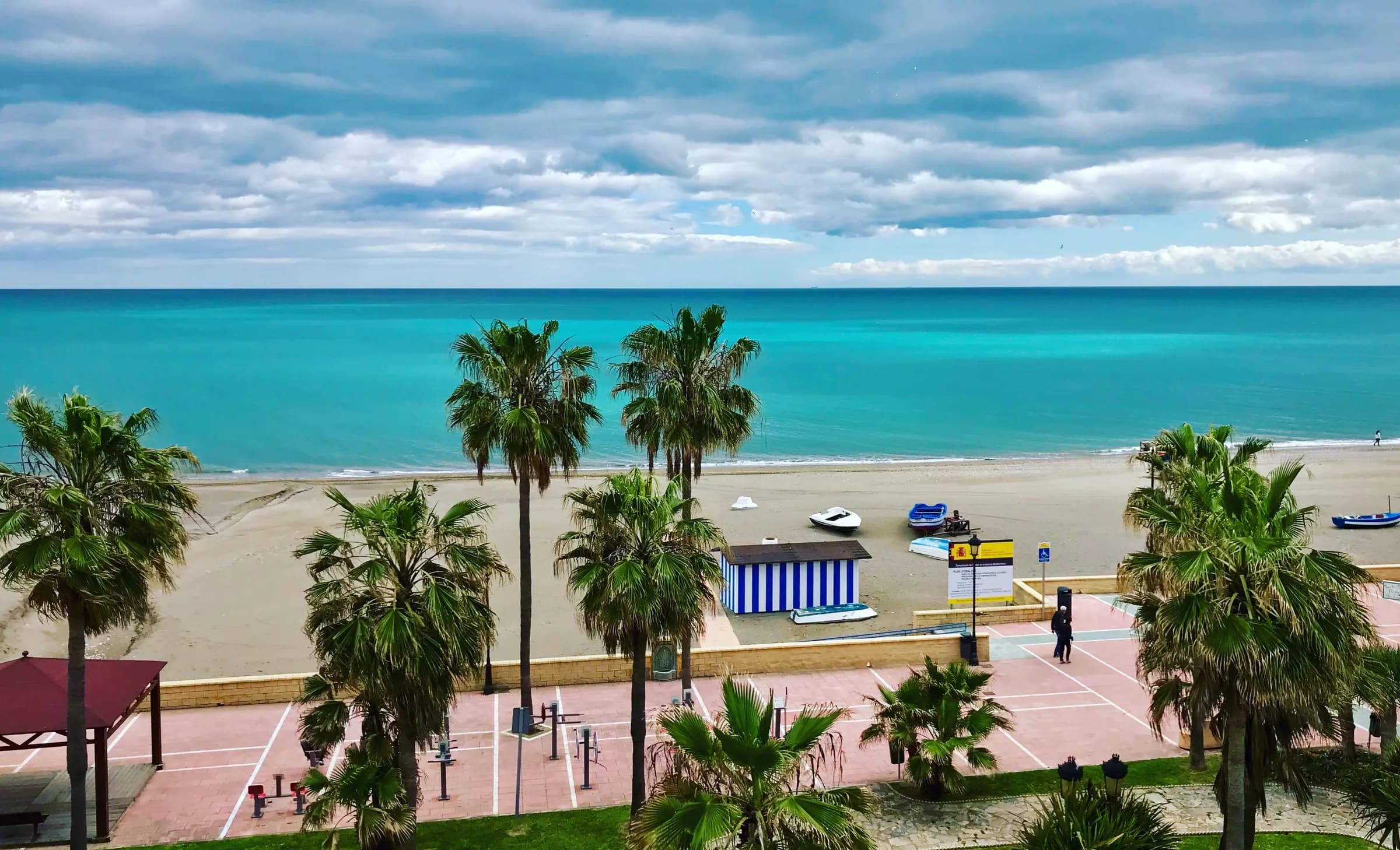
Stay Right on the Beach
The sand is 30 seconds from the door, and the balcony looks straight out at it. Book direct and save up to 20%.
- 3 Bedrooms
- 6 Guests
- 96 m²
Frequently Asked Questions
Related Articles
Christmas Day in Spain: What's Open on the Costa del Sol
Christmas Day in Spain from a beach town: Nochebuena, Misa del Gallo, what is open on 24, 25 and 26 December on the Costa del Sol, and where to eat.
December Puente on the Costa del Sol: The Four-Day Weekend
Spain's December puente, 5 to 8 December 2026, on the Costa del Sol: what is open, Málaga's lights, Estepona's ice rink, day trips and where to stay.
Flamenco in Málaga & Andalucía: Where It's Real
Where to see real flamenco in Málaga and across Andalucía: our picks from intimate tablaos and Estepona peñas to the legendary stages of Seville and Jerez.
The Local's Costa del Sol, Monthly
One email a month: what's on in Sabinillas, the best local finds, and first pick of apartment dates. Free welcome gift: our Sabinillas Insider Guide.
We respect your privacy. Unsubscribe at any time.
Comments
No comments yetHave a tip, a question or a correction? Every comment is read and approved by hand before it appears, usually within a day.
No comments yet. Be the first to share a tip or ask a question.