Spain starts November with flowers. In the last days of October the florists of the Costa del Sol fill with chrysanthemums, whole pavements of them, and on 1 November families carry them to the cemetery to wash headstones, change the water and stand a while with their dead. Todos los Santos, All Saints' Day, is one of the oldest fixtures in the Spanish calendar, and it is nothing like the imported pumpkin party that now sits next to it. It is also, for a visitor, the holiday most likely to catch you out at the supermarket door.
We have spent enough early Novembers here to know both sides of it: the quiet, moving version in the villages, and the practical version where you realise on Sunday evening that Monday is a holiday too. This guide covers what the day means, what happens on this stretch of coast, what to eat, and exactly which days the shops shut in 2026.
What Todos los Santos is, and what it is not
All Saints' Day honours, as the name says, all the saints. The day that follows, 2 November, is the Día de los Difuntos, All Souls, for everyone else. In practice Spanish families roll the two into one long weekend of remembrance centred on 1 November: the cemetery visit, the flowers, a family lunch afterwards.
The cemetery part is the heart of it. In the weeks before, relatives clean and repaint niches and headstones; on the day itself, cemeteries that sit silent for most of the year are full of people, and the flower trade does more business than at any other point in the calendar. Chrysanthemums dominate because they flower in autumn and last, though you will see lilies and carnations too. There is nothing sombre-for-show about any of it. People chat between the rows, children run about, and the mood is closer to a family gathering than a funeral.
One clarification worth making once: this is not the Day of the Dead. Mexico's Día de los Muertos shares the dates and the Catholic root, but the altars, sugar skulls and painted faces are Mexican, not Spanish, and you will not find them here.
The 2026 dates: which Monday the shops shut
Here is the practical hook for anyone visiting this year. In 2026, 1 November falls on a Sunday, and when a national holiday lands on a Sunday, Andalucía's official labour calendar moves it. The Junta's decree for 2026 (Decreto 101/2025 of 14 May, published in BOJA 93) transfers the holiday to the Monday immediately after, so Monday 2 November 2026 is the public holiday.
For you, that means two quiet days in a row:
| Date | What it is | What to expect |
|---|---|---|
| Saturday 31 October | Normal Saturday (and Halloween) | Everything open; do your food shop today |
| Sunday 1 November | All Saints' Day, the feast itself | Sunday hours: large supermarkets and most chain shops closed |
| Monday 2 November | The transferred public holiday | Banks, large supermarkets and most bigger shops closed or on holiday hours |
The rule behind that table is worth knowing, because it decides which door you find locked. Andalucía lets small shops, broadly those under 300 m², open on Sundays and holidays whenever they like, while larger supermarkets are restricted to a set list of permitted Sundays and holidays each year. Estepona and Manilva do hold "zona de gran afluencia turística" status, which suspends those limits, but only for the summer season and Semana Santa, so it does you no good in November. In practice: the corner alimentación and the petrol-station shop will be open, the big Mercadona and Lidl very likely will not.
Restaurants, bars and chiringuitos mostly carry on regardless, and bakeries do some of their best trade of the year. The businesses to plan around are the large supermarkets, banks, pharmacies (duty rotas apply) and anything administrative. Buy what you need on the Saturday and none of it will trouble you.
The tostón: chestnuts by the cemetery gate
Málaga province adds its own flavour to the date, and it smells of woodsmoke. The tostón is the local custom of roasting chestnuts together around All Saints, a tradition tied to the end of the chestnut harvest in the Genal valley, the wooded uplands behind this coast. Traditionally groups of friends and families head out to the countryside, light a fire, split the chestnut skins and roast them in a perforated pan, with sweet wine or anís passed around for the adults.
Casares, the white village 15 to 20 minutes inland from us, keeps the tostón alive in a form that says a lot about the place: the village's final-year secondary students have traditionally roasted chestnuts at the cemetery gate on the evening of 1 November, selling them alongside fried tortas and hot drinks to raise money for their end-of-school trip. Remembrance on one side of the wall, chestnuts and chatter on the other. We would not promise a fixed programme for any given year, small-town traditions run on their own schedule, but if you are in a village around 1 November, follow the smoke.
The chestnuts themselves come from the Genal valley, and the same harvest gives this coast its one great autumn colour show: in November the chestnut forests above the valley turn a deep copper, a scene worth a drive in its own right. Our guide to the Copper Forest of the Genal valley covers that route in full; this piece stays with the tradition, that one stays with the trees.
What to eat: huesos de santo and buñuelos
Every Spanish feast has its sweets, and the ones for Todos los Santos are unmistakable once you know them. From late October the bakery windows fill with huesos de santo, saint's bones: little tubes of marzipan filled with yema, a rich egg-yolk cream, then glazed in syrup until they take on a pale, faintly bone-like colour. The name is more macabre than the sweet, which is soft, dense and very good with coffee.
Alongside them come buñuelos de viento, puffs of wind: light balls of fried choux-style dough filled with whipped cream, custard or chocolate. Tradition says that each buñuelo you eat frees a soul from purgatory. We pass that on without comment, except to note that it is a generous system and people use it generously.
In Catalonia the same date belongs to panellets, small almond-and-pine-nut sweets, but on the Costa del Sol the bones and the buñuelos are what you will find. Any decent panadería in Sabinillas or Estepona will have them for the last week of October and the first days of November, and they vanish soon after. If you see them, that is the season telling you the date.
Halloween next door
The evening before all this, 31 October, is Halloween, and Spain has taken to it with enthusiasm in the last couple of decades, especially for children. Schools run dress-up days, supermarkets stock costumes and pumpkins, and small groups of witches and skeletons do the rounds of the urbanisations. Some older Spaniards grumble that an American import has parked itself in front of a serious feast; plenty of families simply do both, sweets on Halloween night, flowers on Sunday morning.
As a visitor you can hold both without any friction. Take the kids out on the 31st if they fancy it, then notice what happens over the next two days: the florists, the full cemeteries, the chestnut smoke. The two traditions answer the same turn of the year in different registers, one playing with death and one sitting quietly beside it, and seeing them back to back is its own small lesson in where you are.
Visiting the coast in early November
Early November is one of our favourite moments here, and one of the least known. The summer crowds are a memory, the sea is often still warm enough for a swim from the beach in front of the apartment, and the light goes low and golden. Our month-by-month guide covers the November numbers properly, so we will not repeat the climate tables here; the short version is that this is walking, chestnut and long-lunch weather rather than sun-lounger weather, with the odd rainy spell to respect.
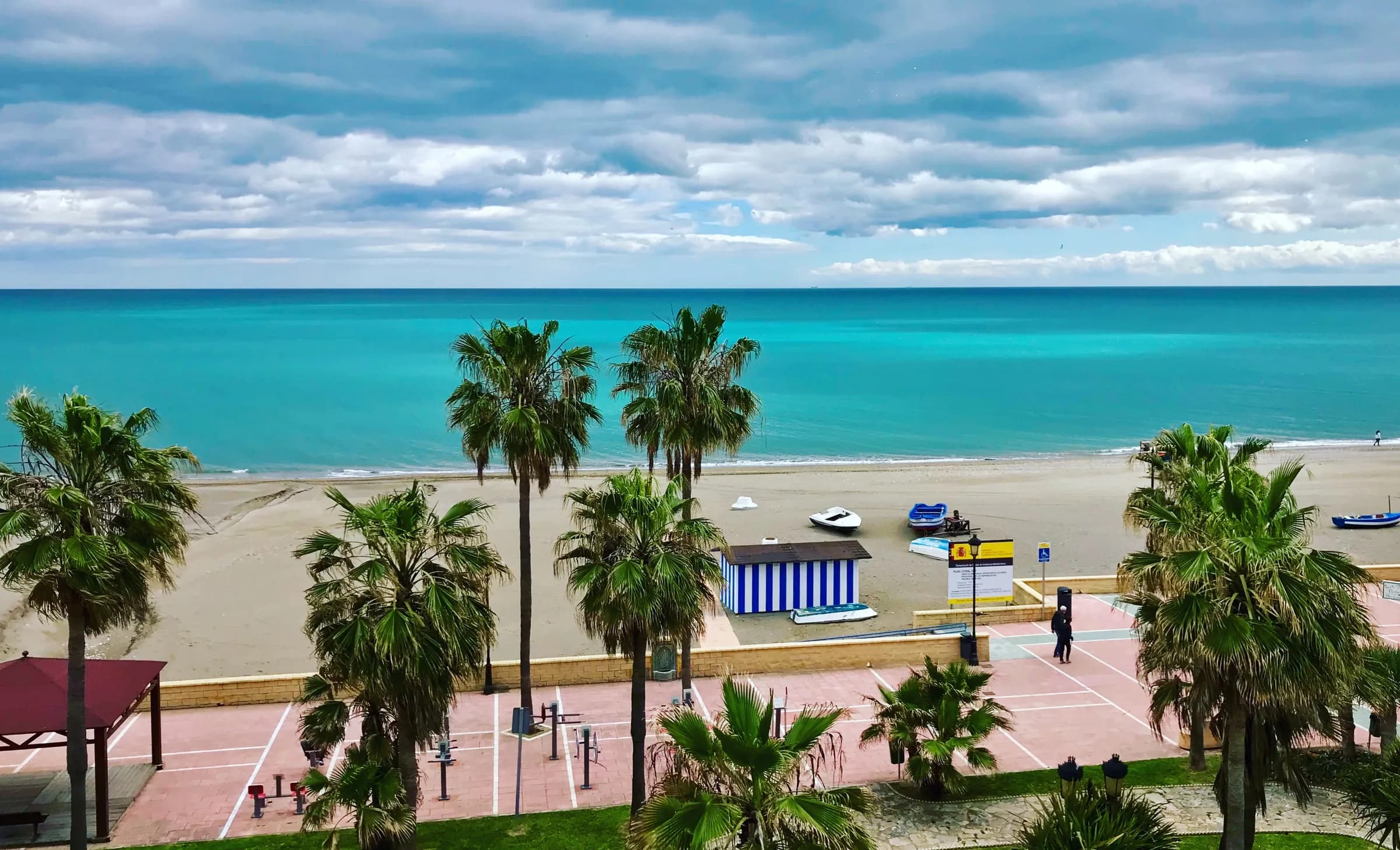
A Todos los Santos weekend from Sabinillas builds itself: Saturday shop and a Halloween wander, Sunday a slow morning and a drive up to a village for the flowers and, with luck, the chestnuts, Monday a copper-coloured walk in the Genal woods while everything on the coast is shut anyway. Autumn is the quiet season at our beachfront apartment, and this particular weekend is the coast at its most Spanish, with the beach thirty seconds from the door and empty. Stay on a few weeks and the calendar hands you the next fixture: by late November the Málaga Christmas lights switch on, and the winter season begins in earnest.
Stay Right on the Beach
The sand is 30 seconds from the door, and the balcony looks straight out at it. Book direct and save up to 20%.
- 3 Bedrooms
- 6 Guests
- 96 m²
Frequently Asked Questions
Related Articles

Copper Forest: Autumn in the Genal Valley (Bosque de Cobre)
The Copper Forest is the Genal valley's three-week chestnut autumn: when to go, which villages to string together, and the walks that work from the coast.

Málaga Christmas Lights 2026: Dates, Times & the Day Trip
When Málaga's Christmas lights switch on, why the Larios show needs no ticket, the markets worth a walk, and how to do it as an evening from the coast.

Casares, Spain: White Village Guide & Day Trip
Casares, Spain is the cliffside pueblo blanco 20 minutes from Sabinillas. Castle, miradores, Roman baths and where to eat: a complete day-trip guide.
The Local's Costa del Sol, Monthly
One email a month: what's on in Sabinillas, the best local finds, and first pick of apartment dates. Free welcome gift: our Sabinillas Insider Guide.
We respect your privacy. Unsubscribe at any time.
Comments
No comments yetHave a tip, a question or a correction? Every comment is read and approved by hand before it appears, usually within a day.
No comments yet. Be the first to share a tip or ask a question.