Every year on the night of 23 June, the Costa del Sol lights its beaches on fire. Up and down the coast of Andalucía, whole towns drift down to the sand after dark to mark the Noche de San Juan, the night when old pagan fire rituals meet a Christian feast day, flames meet seawater, and people burn last year's worries into the warm summer sky. It is the most loved night of the Spanish summer, and once you have stood on a beach at midnight watching the effigy go up, you understand why.
We have hosted guests here in Sabinillas for years, and one question lands in the inbox every June: "What's this San Juan thing everyone keeps mentioning?" Short answer: it is fire, community and a midnight swim, all on the beach a few steps from the door. This guide covers what San Juan in Spain is, where to go on the western Costa del Sol, what happens hour by hour, and how to do it well with kids, a car park to find, and a sea to swim in at midnight.
What Is San Juan in Spain?
The Noche de San Juan, the Night of Saint John, goes back a very long way. It grafts the ancient solstice tradition (when our ancestors lit bonfires to "feed" the sun before the days began to shorten) onto the Christian feast of Saint John the Baptist on 24 June.
The Church, cleverly, folded the solstice into its own calendar. Solar magic became a saint's day. But the fires stayed. So did the rituals. And the night of 23 June still carries a charge that feels older and stranger than any one religion.
In Andalucía this is not a ticketed event or a resort show. It is locals and visitors standing on the sand together at midnight, watching the flames climb, and genuinely believing something is being cleared away and renewed. Three things sit at the heart of it everywhere in Spain: a bonfire (the hoguera), wishes written and burned, and a midnight swim. Coastal towns add their own flourishes on top.
A quick note on names. You will see San Juan, Sant Joan (in Catalonia), and Fogueres de Sant Joan (the huge, UNESCO-listed version in Alicante). They are all the same solstice night, celebrated differently region to region. On the Costa del Sol, the beach-and-bonfire format below is what you will find.
San Juan in Sabinillas: The Authentic Version
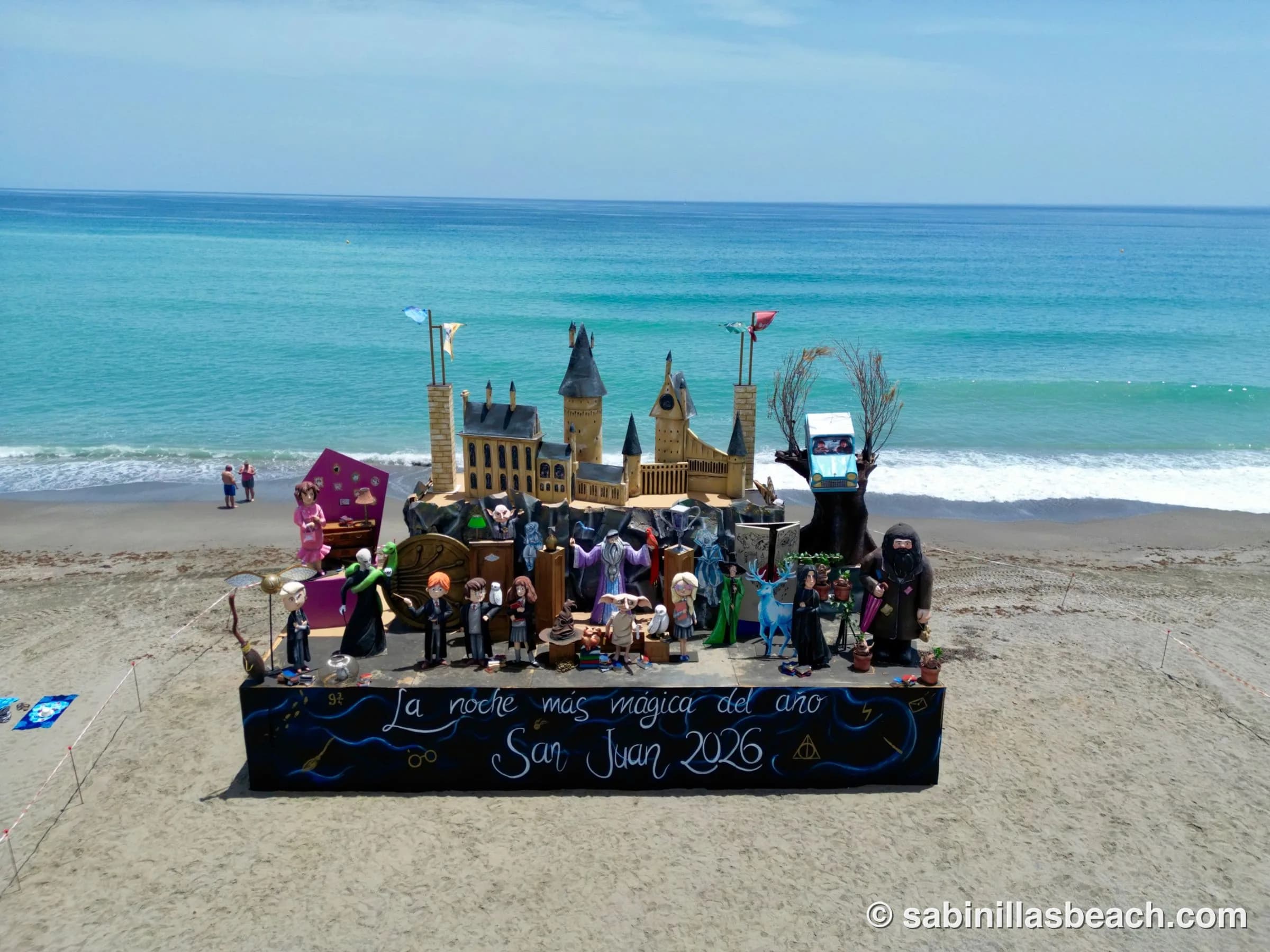
Sabinillas has quietly become one of the western Costa del Sol's best spots for San Juan, and the reason is simple: it stayed local. This is a working seafront town, not a resort, and on the 23rd it opens its beach to everyone: residents, holidaymakers, families, the lot.
The action is on Playa de Sabinillas, the long beach fronting the town centre and stretching either way along the promenade. Where Marbella leans commercial and Málaga city draws thousands, Sabinillas feels communal. Visitors come, of course. But the spine of the night is still the people who live here year-round, doing what they have always done.
What gives Sabinillas its character is the effort that goes in. The town builds elaborate figures and cartoon characters and sets them alight, and people dance around the fire until dawn. There is live music, food from beach vendors, and a mood of pure enjoyment rather than obligation. Kids tear up and down the sand. Grandmothers hold court on blankets. Friends hug, soaked, after the midnight swim.
From our beachfront apartment it is a 30-second walk to all of it. You step out of the door and you are in it.
Good to know: The Sabinillas celebration is free and refreshingly non-commercial next to the bigger Costa del Sol towns. It does pull a real crowd after about 21:00, so arriving by 19:00 buys you a good spot and a calmer start to the evening.
What Happens on San Juan Night: An Hour-by-Hour Guide
San Juan is not a single moment; it is a whole night that unspools in stages. Here is the rhythm of it.
Afternoon and early evening (15:00-19:00)
The beach starts filling in the late afternoon. Families turn up with blankets, cool bags and food, claim their patch of sand, and settle in. The mood is pure holiday: eating, chatting, watching the light soften over the water. Vendors set up stalls, barbecues and drinks. If you want a spot near the water or close to the main bonfire, this is when to arrive.
Evening (19:00-22:00)
As the sun drops, the pace picks up. Live music and DJs start: usually local bands, pop covers and current Spanish hits. More people pour in. The beach gets properly busy. This is the sensory peak before midnight: music, laughter, grilled food on the air, warm night, everyone in high spirits.
The effigy burn (around midnight)
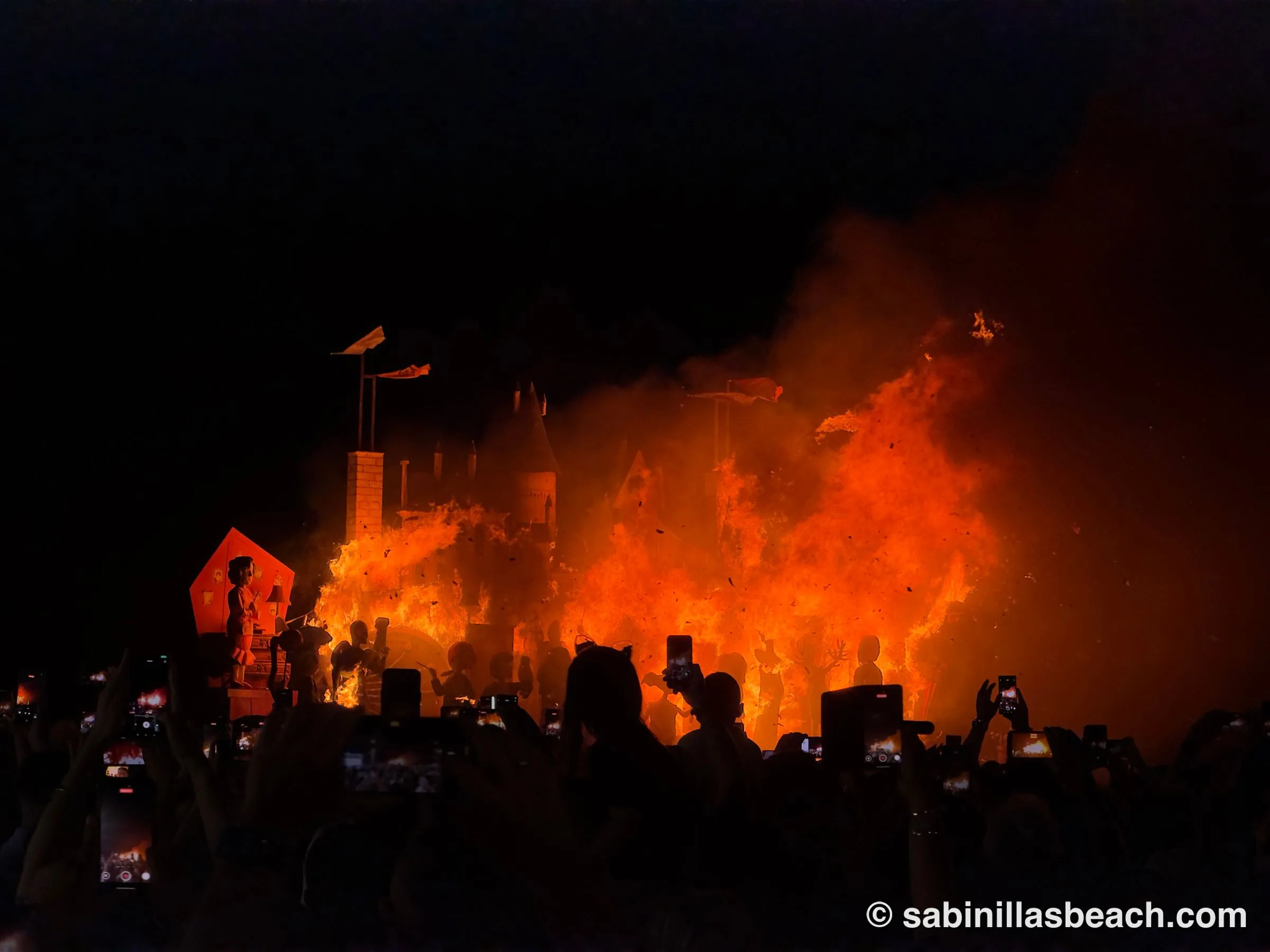
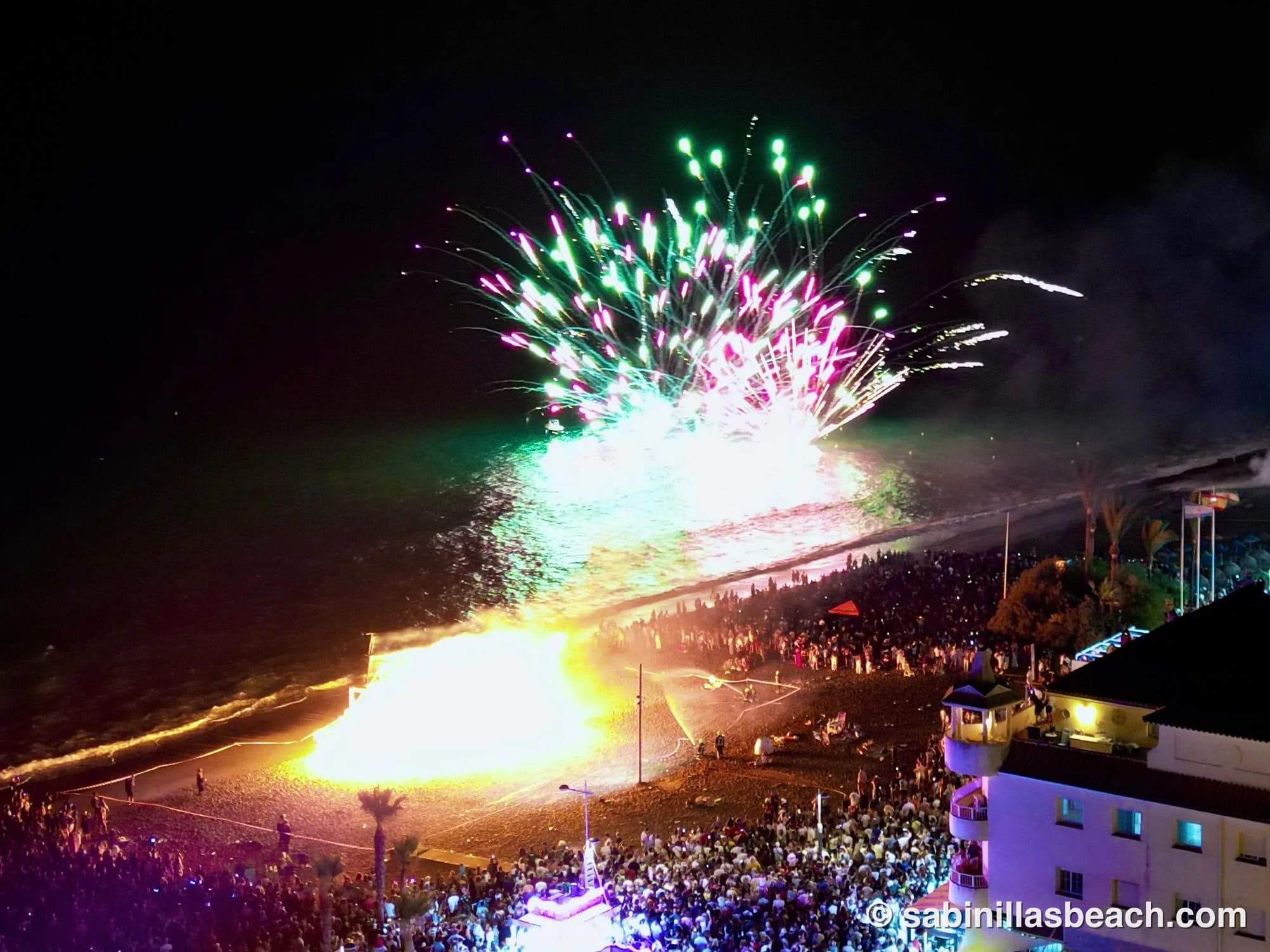
The centrepiece is the burning of the San Juan effigy, the quema del muñeco, which the official Manilva programme has traditionally lit at midnight, followed straight away by fireworks. Smaller informal fires flicker on the sand earlier, but this midnight burn is the pivot of the night. The figure catches, the first flames go up, and the crowd forms a wide ring to watch it blaze, faces lit orange as the year's troubles rise with the smoke. It is a big, hot fire, a spectacle to watch, not to approach, with fireworks overhead and music rolling down the beach.
Midnight and beyond (00:00-04:00)
Midnight is the crescendo, and the moment of the traditional swim. People wade into the sea: some clothed, some in swimwear, some just splashing their face and feet. The water is still warm in June. The idea is to wash off the bad and pull in good luck for the year ahead. After the swim, the night carries on: more music, more dancing, more huddling round the fires. Plenty stay until sunrise.
The Traditions and Rituals, and What They Mean
San Juan is built from a handful of interlocking customs, each with its own weight.
The bonfire. This is the heart of it. The belief, and many here mean it sincerely, is that San Juan fire cleanses the soul, brings luck, and burns off the past year. In Sabinillas the centrepiece is that large effigy, lit around midnight with fireworks to follow, and the whole beach turns to face it.
You may have read about jumping the fire: leaping the flames three or nine times for luck. It is a real San Juan custom in parts of Spain, but always over small, low fires. The Sabinillas bonfire is far too big and hot for that. Watch it from a safe distance, keep children well back from the sparks, and enjoy it as one of the most striking sights of the Andalusian summer.
Writing and burning wishes. Before the night gets going, people write down their hopes and worries on paper and feed them to the fire. The symbolism is direct: whatever you want rid of (anxiety, regret, a bad situation) goes up as smoke, and whatever you are wishing for is sent off into the night. Some vendors in Sabinillas sell little paper strips or lend a pen so visitors can join in. Write in English, Spanish, whatever you like. Watching dozens of tiny wishes vanish into the flames is oddly moving.
The midnight swim. Less about athletics, more about renewal. People wade into the Mediterranean, dunk themselves, wash their face or feet, or just stand in the water with intent. June water is lovely: refreshing, not cold. Stepping into the sea at midnight among hundreds doing the same thing is the bit people remember for years. Some go in fully dressed. Some in swimsuits. Some just roll up their trousers. No wrong way to do it.
Las hierbas de San Juan. A gentler tradition worth knowing: on the eve, some leave a bowl of water out overnight with aromatic herbs (rosemary, lavender, verbena) to wash their face with at dawn for luck and clear skin for the year. You will not see it on the beach, but a local host or neighbour may mention it.
San Juan Beyond Sabinillas: Where Else on the Costa del Sol
Sabinillas is our pick for an authentic night, but it helps to know what the neighbouring towns do.
Estepona (15km east) runs a quirky, much-loved tradition: the Quema de los Bigotes de San Juan, literally "the burning of San Juan's moustache." The "moustache" is shorthand for bad luck and wickedness (historically the bandoleros, the old highwaymen, were known for theirs), so satirical effigies (the júas) made by local associations are burned to symbolically scrub out misfortune. Local, odd, entirely genuine.
Marbella (around 35km east) goes bigger and slicker: DJ sets, sponsored stages, large young crowds. Fun if you want spectacle and a late night out, less so if you want intimacy.
Málaga city (around 95km east) is the heavyweight: the city beaches of La Malagueta and Pedregalejo fill with thousands, professional acts play, and the production is full-scale. A real event, but you are one of a vast crowd, not part of a village.
| Town | Distance from Sabinillas | Feel | Best for | Get there by |
|---|---|---|---|---|
| Sabinillas | here | Local, communal, non-commercial | Genuine tradition, families, small-town warmth | 19:00 |
| Estepona | 15km east | Traditional, the "burning moustache" custom | Authentic feel, something different | 19:00 |
| Marbella | ~35km east | Commercial, DJ stages, big crowds | Nightlife, spectacle, young adults | 20:00 |
| Málaga city | ~95km east | Major festival, professional acts | Festival scale, city beaches | 20:00 |
For an intimate night rooted in real local tradition, Sabinillas and Estepona win. Both celebrate as communities, not as performances laid on for outsiders.
How to Get to San Juan in Sabinillas
If you are basing yourself elsewhere on the coast, here is the practical side.
By car. Sabinillas sits just off the coast road in the municipality of Manilva. From Málaga Airport (AGP) it is roughly 75 minutes via the AP-7 toll motorway (a few euros in tolls but faster) or the free A-7. From Gibraltar Airport (GIB) it is about 30 minutes. Car hire is the most flexible option if you also want to explore; see our tips on hiring a car on the Costa del Sol and the full Málaga Airport transfer guide.
Parking on the night. This is the catch. Spaces near the beach go fast on the 23rd, so aim to arrive by 18:00. The car parks around the town centre fill first; street parking opens up the further back you go. The smartest move is to stay within walking distance and leave the car where it is.
By public transport. Avanza and local buses run along the coast through Estepona and Manilva in the daytime, but services thin right out late at night, which is exactly when San Juan is in full swing. If you are coming from another town, plan a taxi home, or better, stay over.
The cleanest answer to "how do I get there?" is to not need to. Staying in central Sabinillas means the celebration is on your doorstep and the journey home is a 30-second walk.
Is San Juan Worth Planning a Holiday Around?
If you like the idea of a real Spanish tradition, not a show staged for tourists, then yes, comfortably. June on the Costa del Sol is close to ideal: long warm days, the sea finally swimmable, and the summer crowds not yet at their August peak. Our month-by-month guide to visiting the Costa del Sol breaks June down in full, and the Costa del Sol weather guide has the live sea temperature and monthly averages if you want the numbers before you book.
Book the nights of 22-24 June. The 22nd gives you a settling-in day to find your feet in Sabinillas. Spend the 23rd taking it easy (a slow morning, a swim, maybe a nap to bank some energy), then walk out onto the beach as the afternoon turns to evening and you are simply there. No drive, no parking hunt, no rush.
Staying in central Sabinillas beats driving in from another town every time. You can nip back to rinse off the sand and seawater, change out of wet clothes, grab a forgotten jumper, or just have a base to retreat to. That last point matters most with children or older guests, who will want a break somewhere in a night that can run to sunrise. Many families with little ones head off after the bonfire and the swim, around 01:00, rather than staying to dawn, and from a beachfront base, leaving early costs you nothing.
Practical Tips for San Juan Night
A first San Juan rewards a bit of planning. Here is what helps.
What to bring. A beach towel or blanket is non-negotiable; you will be on the sand for hours. Swimming at midnight? Pack a change of clothes and a bag for the wet ones. Flip-flops or water shoes earn their place. The evening is warm but the temperature drops noticeably after midnight and standing by the water gets chilly, so bring a light jumper or hoodie. Sunscreen is wise earlier on (sand and water bounce more sun at you than you expect), insect repellent helps later, and a refillable water bottle is the thing people most often forget. Plenty of vendors operate, but a few snacks of your own never hurt.
Safety and etiquette. San Juan is a safe, family night, but use your head: keep valuables on you, don't leave bags unattended, and set a clear meeting point if you are with children in case anyone gets separated in the crush. The main bonfire is large and very hot: stay back from the flames and flying sparks, and watch children closely around any fires on the sand. If you fancy the midnight swim but can't swim or feel uneasy in the dark water, just wade in to your knees or wash your feet; the symbolism is exactly the same.
Pro tip: Arrive as a group, agree a rough time to head home, and pick a landmark to regroup at. With young children, leaving after the bonfire and swim (around 01:00) is far less fraught than trying to wrangle tired kids off the beach at 3am.
Food and drink. Vendors line the beach: grilled meats, seafood, Spanish snacks and drinks, generally in the region of €5-15 for a main item. For a proper sit-down before the night kicks off, our guide to restaurants in Sabinillas has the best local tables, and our roundup of the best chiringuitos in Sabinillas covers the beachfront spots that stay open into the evening. A picnic is fine too, with one rule: many beaches ban glass, so bring plastic or cans, never bottles. And note that drinking in public is technically restricted on Andalusian beaches; it is relaxed in practice on San Juan night, but be discreet and, again, no glass.
Getting set up from a beachfront base. If you are staying with us, pack a cool bag and beach towels for the evening, and if you would like the fridge stocked with cold drinks ready for the night, you can add our drinks selection or pre-arrival grocery stocking to your booking before you arrive.
Book a stay around 23 June 2027 and you will experience Spain's most magical night from a beachfront apartment, quite literally steps from one of Andalucía's most authentic summer traditions. If you are staying into midsummer, the Full Moon Festival in Sabinillas is the next big beach fiesta of the summer, and if you are here for the longer fiesta season, the fishermen's great sea celebration a few weeks later is just as special: see our guide to Virgen del Carmen in Sabinillas. And the season does not stop there: the fiesta calendar runs to the Fiestas Patronales de San Luis on 25 August, when Sabinillas closes its summer with a verbena on the plaza.
Stay Right on the Beach
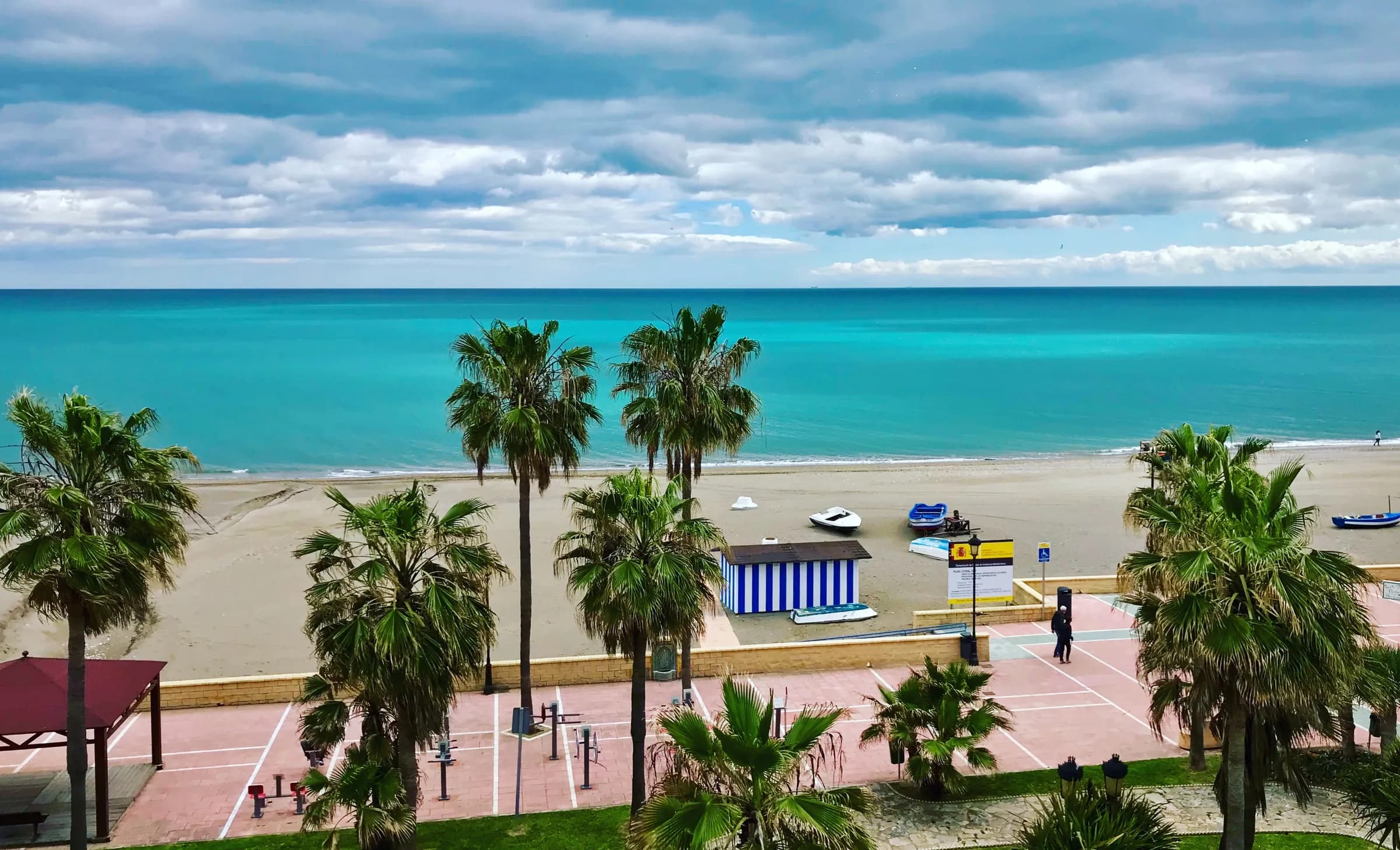
The sand is 30 seconds from the door, and the balcony looks straight out at it. Book direct and save up to 20%.
- 3 Bedrooms
- 6 Guests
- 96 m²
Frequently Asked Questions
Related Articles
Full Moon Festival Sabinillas 2026: A Beach in White
Each July, Sabinillas beach becomes a sea of white for the Full Moon Festival: candles, fire shows and moonlight. The 2026 timing, dress code and how to do it.
Virgen del Carmen Sabinillas 2026: Sea Procession, 16 July
Thursday 16 July 2026: Sabinillas sends its Virgen del Carmen out to sea at sunset. Timings, the decorated boats, El Castillo, and where to stand to watch.
Sabinillas Beach: Blue Flag Guide to the Quiet Costa del Sol
A local's guide to Sabinillas beach: Blue Flag sand, the best chiringuitos, water sports, sun loungers and the calm side of the Costa del Sol.
The Local's Costa del Sol, Monthly
One email a month: what's on in Sabinillas, the best local finds, and first pick of apartment dates. Free welcome gift: our Sabinillas Insider Guide.
We respect your privacy. Unsubscribe at any time.
Comments
No comments yetHave a tip, a question or a correction? Every comment is read and approved by hand before it appears, usually within a day.
No comments yet. Be the first to share a tip or ask a question.