Where this fits: our day-trips overview ranks everything within reach of Sabinillas; this one is the February entry, and the only one that involves 40 men in sequins singing about the prime minister.
Two Carnivals in One City
Cádiz has one carnival with two halves, and visitors who confuse them come home disappointed.
The first half is the COAC, the Concurso Oficial de Agrupaciones Carnavalescas: a singing competition that runs for a month before the carnival proper in the Gran Teatro Falla, the red-brick theatre at the heart of the old town. Groups perform night after night in front of a jury and a packed house, the whole city follows it on television, and the Gran Final decides who wrote the best songs of the year. The 2027 edition opens with the preliminaries on 8 January and ends with the final on Friday 5 February. Tickets for the final are the hardest in Andalucía to get: in recent years they have been sold directly at the Falla box office with a cap per person, and before that by lottery. For a day-tripper, forget the final.
The second half is the street carnival, and that is the one you drive to. From Thursday 4 to Sunday 14 February 2027 the same groups, plus hundreds of unofficial ones that never entered the contest, sing in the squares and lanes of the old town for free. You walk, you hear a group, you stop with the crowd until they finish, you move on. The dates are set by the Ayuntamiento de Cádiz and follow Lent: Ash Wednesday 2027 is 10 February, so the carnival sits on either side of it.
The 2027 Dates, and Which Weekend to Pick
The official programme published by the tourism office fixes these dates:
| Date | What happens |
|---|---|
| Thu 4 Feb | Street carnival opens; final of the romanceros in the Falla |
| Fri 5 Feb | Gran Final of the COAC, Gran Teatro Falla |
| Sat 6 Feb | Official pregón (opening speech) in Plaza de San Antonio |
| Sun 7 Feb | Gran Cabalgata Magna, the big parade along the main avenue |
| Mon 8 Feb | Lunes de Coros, a local holiday in Cádiz; coros carousel through the old town |
| Wed 10 Feb | Ash Wednesday (the carnival carries on regardless) |
| Sat 13 to Sun 14 Feb | Second weekend; closing with the burning of the Bruja Piti on the Sunday |
| Sun 21 Feb | Carnaval Chiquito, the small carnival for those who cannot stop |
Routes and start times for the carousels, concerts and children's events appear in the full programme closer to the date, published by the Delegación de Carnaval and reprinted by the local press.
As a day-tripper you have two sensible choices. The first weekend (6 to 8 February) has the big set pieces: the pregón on Saturday evening, the parade on Sunday afternoon and the Lunes de Coros on Monday, when the coros do their circuits on decorated carts and half of Cádiz takes the day off to follow them. It is the busiest weekend of the year in the city; in 2025 some 1,100 excursion coaches came in over the carnival, most of them on the first Saturday.
The second weekend (13 to 14 February) is the locals' weekend. The crowds thin, the groups have found their favourite corners, and the singing in La Viña and around the central market is easier to get close to. The closing act on the Sunday evening, the burning of the Bruja Piti, is a good place to end a day.
For a family or a first visit: the first Sunday, for the parade and the carts, arriving before lunch and leaving by early evening. For a second visit: the second Saturday, daytime and early evening.
What You Will Hear
The Cádiz carnival is a sung carnival. Costumes matter, but the costume exists to serve the song. Four kinds of group compete in the Falla and then take to the streets:
- Chirigotas are the comic groups, around seven to twelve singers with guitars, a bass drum and a kazoo-like pito de caña. Their cuplés, short satirical verses with a shared chorus, are the carnival's best-known product and the reason a cuplé about a politician can make national news.
- Comparsas are the serious ones: twelve to fifteen voices, tight harmonies, pasodobles about Cádiz, loss, love and politics. If you only hear one thing that moves you, it will probably be a comparsa.
- Coros are the big groups, dozens of singers who perform from bateas, decorated open carts pulled through the old town. They own the tango de Cádiz, a rhythm nobody else sings, and the carrusel de coros is their show: on the first Sunday and the Monday, and again on the second weekend in La Viña, the carts move from square to square and the crowd follows.
- Cuartetos are the sketch groups, three to five people doing spoken comedy with a song at the end.
Add the romanceros, solo performers with a painted board who recite rhymed stories on street corners, and the hundreds of ilegales or callejeras, street groups that skip the contest and sing wherever they stand. The ilegales are the part visitors remember most, because you stumble on them.
A visitor without Spanish gets the music, the costumes, the carts and the crowd, and misses the jokes. That is a real loss, because the lyrics are the point for the locals. The coros need no translation, and the Sunday parade is a parade. Go with a Spanish speaker if you can, and ask them to translate one cuplé; you will understand why Cádiz spends four months a year on this.
Getting There from Sabinillas
By car. Cádiz is around two hours from Sabinillas. Take the AP-7 west to Algeciras, the A-381 across the cork forests to Jerez (the same road as our sherry triangle day trip, which puts Jerez at about 1.5 hours), then the AP-4 and the bridge into Cádiz. The motorway sections are tolled. Allow 2h15 on a carnival Saturday for the approach into the city.
Where to park. Do not drive into the old town. Cádiz is a peninsula with one road in, the historic centre has restricted vehicle access, and on the carnival Saturdays the Policía Local run a checkpoint at the roundabout off the second bridge while the bus-station car park is fenced off for coaches. The city's own advice to visitors is blunt: leave the car at home. The workable version for a day-tripper is one of the seventeen public car parks on the modern side of the Puertas de Tierra, the city gate that marks the old town, and a fifteen-minute walk in. Arrive before 13:00 on a Sunday and you will find space; arrive at 18:00 on a Saturday and you may not.
The Cercanías trick. The Bay of Cádiz has a local train, the Cercanías C1, running from Jerez through El Puerto de Santa María, Puerto Real and San Fernando into Cádiz station at the edge of the old town. Renfe reinforces it heavily for the carnival weekends (257 trains over the first weekend in 2025, with services into the small hours on the Saturday night). Park in San Fernando or Puerto Real and ride the last twenty minutes in.
Why not the train from Málaga? Because Málaga to Cádiz by rail is around four hours each way and usually involves a change. Eight hours on trains leaves nothing of the day. From the western Costa del Sol the car is the only realistic option.
Eating at the Carnival
Cádiz eats fried fish, and carnival is when it eats the most of it. The freidurías, fry shops where you order by weight and carry it off in a paper cone, are the carnival's catering: a papelón of pescaíto frito and a beer in the square while a chirigota sings is as local as it gets. Freiduría Las Flores on Plaza de las Flores, next to the central market, is the famous one; the fry shops in La Viña and along Calle de la Palma are where the neighbourhood eats.
Order tortillitas de camarones, lacy chickpea-flour fritters with whole tiny shrimp fried into them. They are the Cádiz dish. The bars of La Viña make the reference versions. Add cazón en adobo (marinated dogfish, fried), chicharrones at Casa Manteca in La Viña, and choco frito (fried cuttlefish) if you see it.
Sit-down restaurants in the old town fill fast on the carnival weekends and many stop taking bookings. Eat early, eat standing, or eat on the way home. If sherry and Jerez are what you came for, that is a different day; our sherry triangle guide covers the bodegas.
Going with Children
Daytime carnival in Cádiz is a family event. Local children go in costume, the Sunday parade is built for them, the coros on their carts are loud and bright, and the programme always includes children's activities. A Sunday that starts with the carts around 13:00, takes in the parade in the afternoon and ends with fried fish at 19:00 is a good day for a six-year-old.
The warning is about the night. After about 21:00 the old town turns into a dense, loud crowd in which drinking is the main activity, the lanes jam solid and a pushchair cannot move. The two Saturdays are the worst for this. With small children, be on the road home by 20:00. With teenagers who want the night, it becomes an overnight, with a hotel booked months ahead.
For everyone: it will be loud, you will stand for hours, and February in Cádiz can be wet and windy off the Atlantic. Bring a layer and shoes you can walk in.
The Shape of the Day
- 09:30 leave Sabinillas; coffee on the balcony first, because lunch will be late and standing up.
- 11:45 park in San Fernando and take the Cercanías, or park outside the Puertas de Tierra and walk in.
- 12:30 Plaza de las Flores and the central market; a cone of fried fish; the first group.
- 13:00 to 16:00 follow the coros on the first Sunday or Monday, or wander La Viña and the Pópulo on the second weekend.
- Late afternoon the parade on the first Sunday; on the second weekend, more streets and a tortillita.
- 19:00 early dinner or another cone; 20:00 walk out; home by 22:30.
It is a long day with a lot of standing and a two-hour drive at the end, which is also why the guests who do it talk about it for the rest of the week. For the garage, a kitchen for a late supper and a sea-view balcony the next morning, check dates at our apartment in Sabinillas; February is low season, from €110/night, and the carnival weekends still have space when the Cádiz hotels have none.
For the other end of the Cádiz coast in a quieter month, Zahara de los Atunes is our summer vote; for winter in general, our winter sun guide covers what a February week here is like.
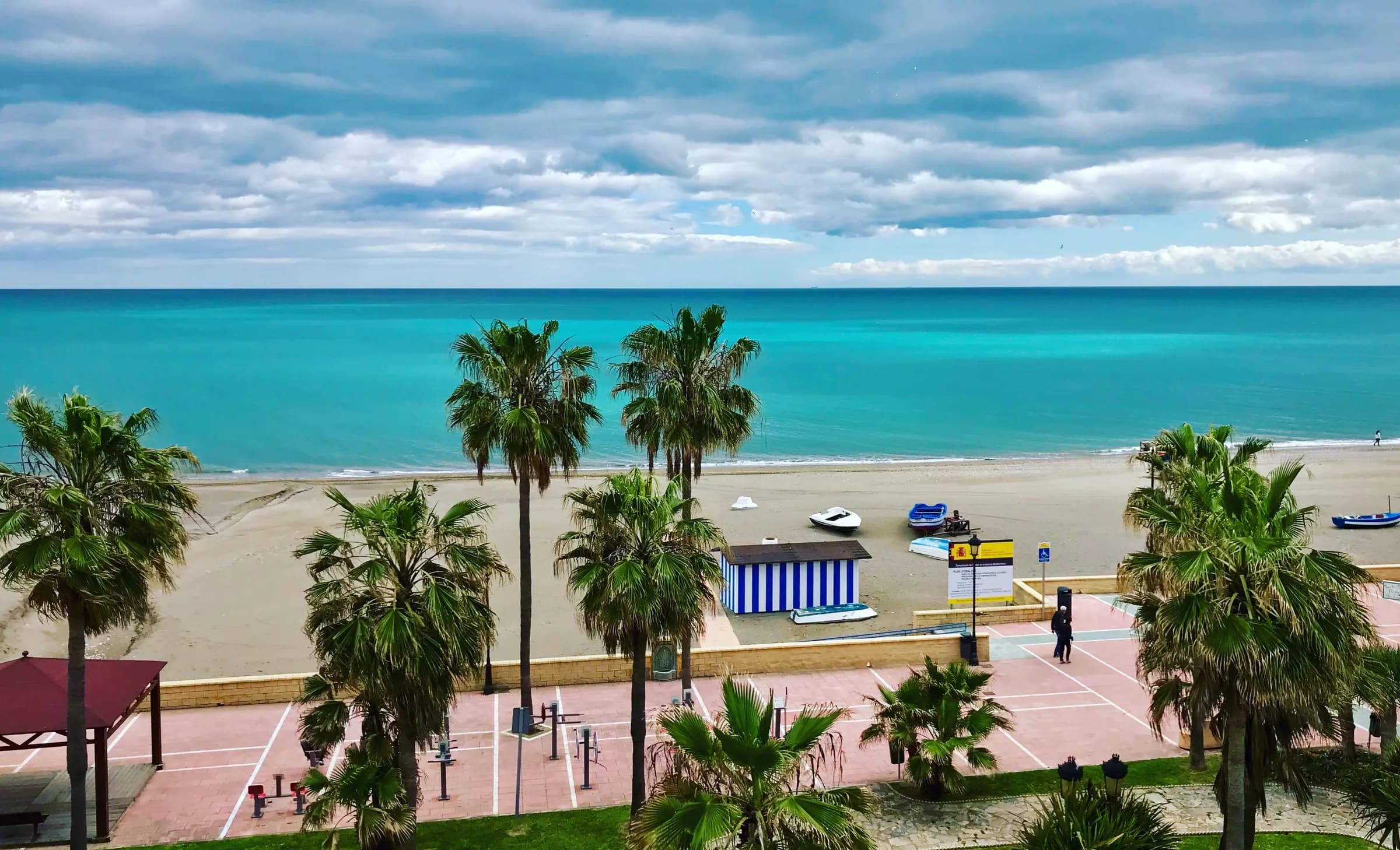
Stay Right on the Beach
The sand is 30 seconds from the door, and the balcony looks straight out at it. Book direct and save up to 20%.
- 3 Bedrooms
- 6 Guests
- 96 m²
Frequently Asked Questions
Related Articles
Winter Sun on the Costa del Sol: A Long-Stay Guide
Winter sun on the Costa del Sol: a long-stay guide to weather, costs, what's open in Sabinillas, and daily life here from November to March.

Zahara de los Atunes: A Day Trip to Spain's Tuna Coast
Zahara de los Atunes is the Costa de la Luz at its purest: 8 km of Atlantic sand and Spain's best tuna. How to do it as a day trip from the Costa del Sol.
Jerez Sherry & the Sherry Triangle: Bodega Guide
A practical guide to Jerez and the Sherry Triangle: which bodegas to tour, what fino, oloroso and PX taste like, and how to get there from the coast.
The Local's Costa del Sol, Monthly
One email a month: what's on in Sabinillas, the best local finds, and first pick of apartment dates. Free welcome gift: our Sabinillas Insider Guide.
We respect your privacy. Unsubscribe at any time.
Comments
No comments yetHave a tip, a question or a correction? Every comment is read and approved by hand before it appears, usually within a day.
No comments yet. Be the first to share a tip or ask a question.