A Day Trip to Morocco from Spain Is Closer Than You Think
We've hosted guests at our beachfront apartment in Sabinillas for over a year, and one question comes up again and again: "Can we really go to Africa for the day from here?" Yes. Genuinely. In less time than it takes to drive to Granada, you can cross the Strait of Gibraltar, step onto another continent, and get pleasantly lost in the alleys of Tangier's medina.
A day trip to Morocco from Spain works because the geography is absurd in your favour. At its narrowest the Strait of Gibraltar is about 14 km. You can stand on the beach at Tarifa and watch the Rif Mountains. The fast ferry covers the crossing in roughly an hour. Two continents, two languages, two currencies, and you're home for a late dinner on the balcony.
Tangier is not a resort. It has none of the duty-free shine of Gibraltar or the theatre of Ronda. What it offers is the real thing: a working Moroccan port with centuries stacked on top of one another (Phoenician, Roman, Arab, Portuguese, French, Spanish, briefly international), spice sellers in the same stalls their grandfathers used, and lanes so narrow you can't see 10 metres ahead. It's exhilarating. Occasionally it's a lot. It's worth the day.
Getting There: Tarifa to Tangier
Your day in Morocco starts in Tarifa, the southernmost town in mainland Spain, sitting right on the Strait. From our apartment in Sabinillas it's roughly 62 km, about an hour by car: the A-7/AP-7 towards Algeciras, then the N-340 along the coast. It's a properly good drive, with the Strait widening ahead of you and, on a clear day, Morocco laid out across the water.
Tarifa rewards an early start. It's a low-slung, whitewashed town that lives for wind, one of Europe's great kitesurfing spots, with long Atlantic beaches and unfussy seafood. Get to the ferry terminal at least 45 minutes before departure. You can't miss it; the port is signposted the moment you reach town.
The simplest plan from Sabinillas is to drive yourself, which lets you poke around Tarifa before the boat. You cross as a foot passenger, so the car stays in Tarifa. If you want wheels in Morocco, hire there: taking a Spanish hire car across the border is a paperwork headache most rental agreements forbid outright. Parking near the terminal runs about €10-15 for the day in summer, with a chance of free street parking if you arrive early.
The crossing that catches people out: Tarifa goes to Tangier Ville, the city-centre port, a short walk from the medina. The other Morocco ferries from Algeciras mostly run to Tanger Med, a cargo port roughly 40 km east of the city, which adds a long shuttle each way. For a day trip, you want Tarifa to Tangier Ville. Don't book Algeciras by accident.
Ferry Options and Booking
The ferry landscape on this route changed in 2025. The long-time operator FRS (acquired by Denmark's DFDS in 2024) ran its final Tarifa-Tangier Ville crossing on 4 May 2025 after losing the route concession. Today two companies run it: Baleària and Africa Morocco Link (AML). Both run fast ferries, both take about an hour, and both carry foot passengers all day. Choosing between them is mostly about which departure time suits you.
Baleària
Baleària won the long concession for the route and operates several fast-ferry rotations a day, around an hour each way. One-way foot-passenger fares hover around €40, and the online booking is clean and quick.
Africa Morocco Link (AML)
AML runs a similar pattern of daily fast sailings on the Tarifa-Tangier Ville route, again roughly an hour and around €40 one-way. Foot passengers simply buy a ticket, swap it for a boarding card, and walk on; the standard luggage allowance is generous (around 30 kg). Worth comparing against Baleària for the time you want.
Booking: Book online with either operator. We recommend it. It locks in your sailing, costs the same as the desk, and takes under two minutes. You can buy at the terminal on the day in shoulder season, but in July and August the popular morning and late-afternoon boats sell out, so book a few days ahead. Check-in closes 45 minutes before departure; don't cut it fine, as the queues for passport pre-clearance build fast.
Pro tip: Take an early ferry (roughly 07:00-09:00) and return on a late-afternoon one (around 17:00-19:00). That gives you a full six to seven hours on the ground: the difference between a proper visit and a rushed one. Both operators publish current timetables online; double-check sailing times the night before, as they shift seasonally.
Mind the Clock: Morocco's Time Zone
This one trips up more day-trippers than anything else. Morocco is normally one hour behind mainland Spain. Land in Tangier and you put your watch back an hour; head home and you put it forward again.
The danger is the return. Your ferry departs on Spanish time from a port running on Moroccan time. Get the conversion wrong and you'll watch your boat leave without you. The simplest fix: keep your phone on automatic time so it updates at the border, and set a phone alarm for "be at the terminal" based on the Spanish departure time.
One wrinkle worth knowing: Morocco suspends its daylight-saving hour during Ramadan, then restores it afterwards. During that window the gap with Spain can briefly become two hours. Ramadan moves through the calendar each year, so if you're travelling in spring, check the current difference before you go rather than assuming.
What to See in Tangier
The medina isn't large (you could walk it end to end in a couple of hours) but it rewards dawdling. Alleys double back, dead ends appear from nowhere, and the smells layer up (cumin, grilling lamb, fresh mint, sea salt, incense) until you have to stop and just take it in. You'll "get lost." That's fine. Keep drifting and you'll pop out at one of the main squares.
The Grand Socco
Start here. The Grand Socco is the big sloping plaza at the edge of the medina, ringed with palms and centred on a fountain, with the keyhole-arched gate of Bab Fass leading inside. Once a market, it's now the city's living room: locals nattering, the odd street musician, mopeds threading the crowd. It's also where the touts cluster, so this is where you set your tone: friendly, but a clear "no thank you" if you're exploring on your own.
Into the Medina
Step through Bab Fass and the lanes tighten at once. You'll pass spice merchants with their paprika and turmeric in neat cones, fabric and carpet sellers, leatherworkers, jewellers. Most greet you warmly; a few will fall into step ("Where are you from? You like carpet?"). That's the texture of the place: persistent, not hostile. A confident smile and "no, thank you" and they move on to the next person.
The medina is a maze on purpose. Follow the uphill lanes, or simply trail the locals heading home, and you'll gradually climb towards the kasbah.
The Kasbah and Kasbah Museum
The Kasbah crowns the highest point of the old town, the former fortress, all carved stucco, painted cedar, and zellij tilework. Inside the complex, the Kasbah Museum (Musée de la Kasbah) holds Moroccan and Islamic art, ceramics, and archaeology in a former sultan's palace. Entry is cheap (a few euros' worth of dirham). Opening days shift, and Moroccan museums often close one day a week, so check locally on arrival rather than building your whole afternoon around it. The terrace views over the medina rooftops to the harbour are the real prize, best in late-afternoon light.
The Petit Socco
Tucked inside the medina, the Petit Socco is a small square that was, in the city's wilder mid-century days, the social heart of Tangier: cafés, hotels, and rather more besides. It's quieter now and all the better for it: grab a glass of mint tea at a pavement table and watch the lane go by. A handful of decent places to eat overlook it.
Beyond the Medina: Cape Spartel and the Cave of Hercules
With energy to spare, Cape Spartel is the standout half-day add-on, about 14 km west of the centre (a taxi, roughly €5-8 each way; agree the fare first). This is the headland where the Mediterranean meets the Atlantic, with a 19th-century lighthouse on the cliffs and big, raw, windswept views. On a clear day you can see Spain across the Strait. The character flips completely out here: where the medina is dense and sheltered, the cape is wide open.
A little south sits the Cave of Hercules, a sea cave with a famous opening shaped, depending on who's selling the legend, like the map of Africa, looking straight out to the ocean. Entry is a few dirham; the walk down is lovely, the climb back up less so. Most day-trippers skip it for time, but it pairs naturally with Cape Spartel if you've taken an early ferry.
A Tangier Day Trip with Kids
Plenty of our families do this with children, and it works, with a couple of tweaks. The ferry itself is a hit (the open deck, the dolphins people sometimes spot mid-Strait, the moment land turns into "Africa"). Once ashore, the medina is sensory overload in the best and most tiring way, so keep it short and keep little ones close in the crowds.
A few practical notes. Buggies and medina cobbles don't mix; a baby carrier is far better. Take water, snacks, and sun hats: there's not much shade in the open squares. Toddlers tire of "walking past more shops" quickly, so build in a long café stop with mint tea and a pastry, and consider a taxi out to Cape Spartel where they can run around. And brief older kids gently on the touts beforehand so the attention doesn't unsettle them. For more on travelling this coast with little ones, see our guide to the Costa del Sol with kids.
Guided Tour vs Going Solo
This is a real decision, and there's no wrong answer.
Going solo buys you freedom. Your own pace, linger where you like, no commentary in your ear. It's a touch more work, you navigate the medina by instinct and the occasional "which way to the kasbah?", but it's the more immersive way to do it. Thousands manage it daily. The skills are simple street sense: don't flash a big camera or jewellery, keep your bag in front of you, and don't wander alone after dark.
Hiring a guide buys context and solves the maze. A good guide threads the history through the lanes, points out what you'd walk straight past, steers you off the tourist-trap restaurants, and quietly absorbs the touts on your behalf. Tours typically run €60-120 per person, usually including the return ferry and lunch, as a half- or full-day. Licensed local operators handle this well: book ahead through a reputable company's website, never via someone who collars you at the dock.
Good to know: If you arrive without a pre-booked guide, you'll be approached at the terminal by men offering to show you round. Some are genuinely good; the trouble is you can't verify any of it on the spot, and a few will claim a connection to a famous tour brand that doesn't exist. On a first visit, stick to an established operator. By your second trip, solo feels easy.
| Going solo | Guided tour | |
|---|---|---|
| Cost | Ferry + lunch only (~€55-75) | €60-120 per person all-in |
| Navigation | On you (part of the fun) | Handled |
| History/context | What you read beforehand | Built in |
| Tout pressure | You manage it | Guide buffers it |
| Flexibility | Total | Set itinerary |
| Best for | Confident, repeat visitors | First-timers, families, nervous travellers |
Our recommendation: book a guide through an established operator for your first visit: you'll soak up the history and feel far more at ease. Go solo on return trips, and many guests do come back.
Where to Eat
Food in Tangier is excellent and cheap. A main in a medina restaurant runs roughly 80-200 MAD (about €7-18). Fish is the thing: sea bream, sea bass, and squid all turn up fresh off the boats. Order a tagine (slow-cooked, often lamb with prunes and almonds, or chicken with preserved lemon), a plate of couscous, and finish with the inevitable, wonderful mint tea.
A general rule for the souks: if a place has no prices and a tout outside, be wary. The squares and lanes with locals eating are your safer bet. Restaurant names and exact hours change, so treat the picks below as a starting point and check current reviews before you set off.
- Around the Petit Socco: several long-running café-restaurants ring this little square, good for a sit-down lunch and people-watching with a glass of tea.
- The harbour and seafront: a cluster of fish restaurants near the port and Avenue d'Espagne do simple grilled catch of the day, handy if you've timed a late lunch before the ferry.
- Street food in the medina: the cheapest and often the most fun. A pastilla (flaky pie of chicken or pigeon, almonds, and egg, dusted with icing sugar and cinnamon) costs a couple of euros; a bread-and-kebab lunch maybe €3-4. It frees up your afternoon for wandering.
A safe approach if you're unsure: pick somewhere busy with Moroccans, glance at the bill before you sit, and you'll eat well for very little.
Safety and Scam Awareness
Tangier carries an old guidebook reputation for being dodgy. It's largely out of date, but a little caution still pays.
What's real: the touts. At the terminal, in the medina, near every big sight, you'll be offered guides, carpet "tours", camel rides, and "special shops". They aren't dangerous: they're people earning a living in a tourist economy built on guiding and shop commissions. A polite "no thank you" and don't break stride. Works every time.
What's overblown: violent crime against tourists, which is rare. Tangier handles thousands of day-trippers a week without incident, and women travel solo here without particular trouble, the usual city sense aside. The genuine risk is pickpocketing in crowds: bag zipped, phone in a front pocket, no flashy jewellery, and you remove most of it.
The scam to clock: the fake "official guide". Someone approaches at the ferry or near the Grand Socco claiming to be from a well-known tour company. They aren't. It's a bait-and-switch to sign you up to an unofficial, overpriced tour. Smile, decline, walk on. If you want a guide, you've already booked one online.
A reassuring note: there's a visible police and military presence, especially near the medina gates and government buildings, which adds to the general sense of order. Treat Tangier like any big city (aware, polite, valuables secured) and you'll have a brilliant day.
Practical Information
| Detail | Information |
|---|---|
| Distance from Sabinillas | ~62 km to Tarifa (about 1 hour by car) + ~1 hour ferry each way |
| Ferry route | Tarifa to Tangier Ville (city-centre port), not Tanger Med |
| Ferry operators | Baleària and Africa Morocco Link (AML) |
| Ferry cost | Around €40 per person one-way (roughly €70-95 return) |
| Ferry duration | About 1 hour (fastest sailings ~58 minutes) |
| Time zone | Morocco usually 1 hour behind Spain (can be 2 hours during Ramadan) |
| Parking in Tarifa | ~€10-15 per day near the terminal; some free street parking if early |
| Medina exploration time | 3-5 hours depending on pace |
| Currency | Moroccan dirham (MAD); ~11 MAD to €1; change at the port or an ATM in town |
| Passport | Required: valid UK/EU passport (3+ months beyond arrival; 6 months safer) |
| Visa | Not needed for UK/EU stays under 90 days |
| Best time to visit | September-May; July-August midday heat is brutal in the medina |
| Independent day cost | ~€55-75 per person (return ferry + lunch + tea) |
| Guided package | ~€80-120 per person (ferry, guide, lunch included) |
A Suggested Day
A realistic timeline, built around a morning crossing out and a late-afternoon ferry home. All times below are local to where you are at that moment: remember the hour you lose crossing south and gain coming back.
| Time | Plan |
|---|---|
| 07:00 | Leave Sabinillas, drive to Tarifa |
| 08:15 | Arrive at the terminal, check in or buy tickets |
| 09:00 | Ferry departs Tarifa |
| 10:00 (local) | Arrive Tangier Ville, clocks back one hour; walk to the Grand Socco |
| 10:30-13:00 | Explore the medina, climb to the kasbah, take it all in |
| 13:00-14:30 | Lunch in the medina (book ahead if it matters to you) |
| 14:30-16:30 | More medina, the Petit Socco, or a taxi out to Cape Spartel |
| 16:30-17:30 | Mint tea in a café as the light softens |
| 17:45 | Back to the terminal, clocks forward one hour for the Spanish departure |
| 18:00 / 19:00 | Return ferry departs Tangier |
| 19:00 / 20:00 (local) | Arrive Tarifa |
| 20:30-21:30 | Drive back to Sabinillas for a late dinner |
That's roughly six to seven hours on the ground: enough for a proper medina walk, one good meal, and a café stop. Want Cape Spartel as well? Take the earliest ferry and trim the medina.
Save money: you don't need a packaged tour to do this well. Ferry around €40 each way, lunch in the medina €12-15, mint tea a couple of euros: call it €55-75 per person all in. If you'd rather have the reassurance of a guide, a reputable operator runs €80-120 all-inclusive, which is still fair for what you get.
Planning Your Day Trip from Sabinillas
Based at our apartment in Sabinillas, a day trip to Morocco from Spain is genuinely straightforward. Make it a half-and-half day (a morning in Tarifa's old town and on the beach, then the afternoon and evening in Tangier) or treat it as a pure Africa-in-a-day mission. The drive is easy, parking is plentiful, and the ferries are frequent.
Nervous about the solo version? Book a Tangier tour operator for the Morocco leg and just drive yourself the short Sabinillas-to-Tarifa stretch, leaving the car and crossing on foot. Confident, and want to keep costs down? Book the ferry online, walk into the medina, and go at your own pace.
For more ideas closer to home, see our overview of day trips from the western Costa del Sol, which spans everything from Gibraltar and Ronda to the white villages of Andalucía. Our complete guide to Sabinillas covers the town itself, and you can browse the extras available with a direct booking to make your stay easier.
When you're ready to put Africa within reach, check availability and book your stay at our beachfront apartment. From the balcony you can see the lights of Morocco at night, and from here, it really is only a day away.
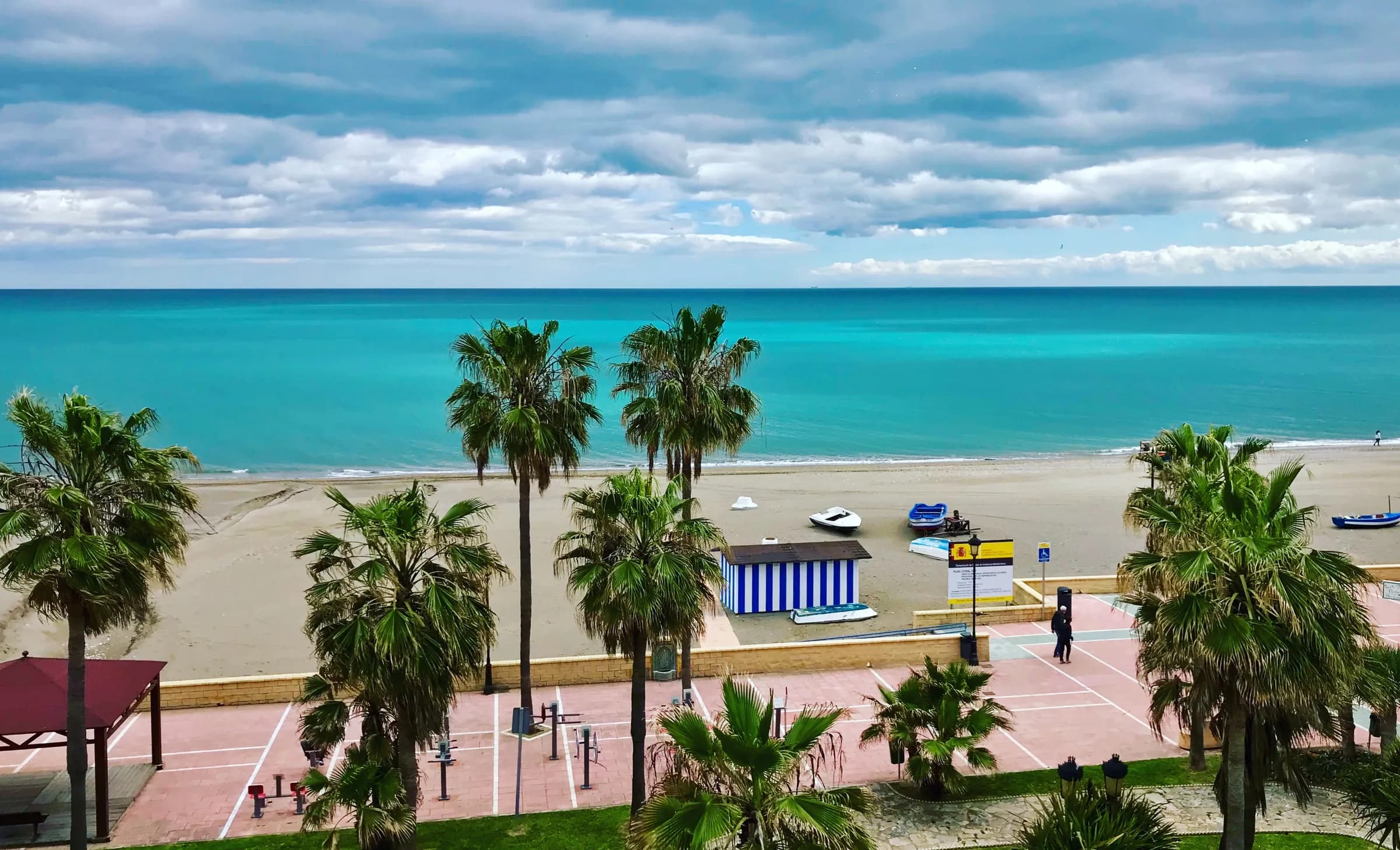
Stay Right on the Beach
The sand is 30 seconds from the door, and the balcony looks straight out at it. Book direct and save up to 20%.
- 3 Bedrooms
- 6 Guests
- 96 m²
Frequently Asked Questions
Related Articles

Tarifa Kitesurfing: Day Trip Guide from Sabinillas
Tarifa kitesurfing for first-timers and pros: the windiest beaches in Europe, plain advice on schools and conditions, and how to drive there in an hour.
Day Trips from Sabinillas & the Western Costa del Sol
Best day trips from Sabinillas and the western Costa del Sol: Ronda, Gibraltar, Caminito del Rey, white villages and Tangier, with drive times and costs.

Things to Do in Gibraltar: A Day Trip from Sabinillas
The best things to do in Gibraltar on a day trip from Sabinillas: the Rock, the wild monkeys, St Michael's Cave, the border and duty-free, 30 minutes away.
The Local's Costa del Sol, Monthly
One email a month: what's on in Sabinillas, the best local finds, and first pick of apartment dates. Free welcome gift: our Sabinillas Insider Guide.
We respect your privacy. Unsubscribe at any time.
Comments
No comments yetHave a tip, a question or a correction? Every comment is read and approved by hand before it appears, usually within a day.
No comments yet. Be the first to share a tip or ask a question.