The 2026 eclipse is behind us. The partial eclipse of 12 August 2026 was the preview, seen low at sunset. This is the main event: a total eclipse, on the morning of Monday 2 August 2027.
Totality Comes to This Coast
On Monday 2 August 2027, the moon's shadow crosses the Strait of Gibraltar and sweeps east along the southern edge of Spain. For a few minutes in the middle of the morning, the western Costa del Sol goes dark, the corona appears, and the temperature drops.
This is not a repeat of 12 August 2026, when the south of Spain got a deep partial eclipse at sunset. Inside the band, the sun disappears completely. After it, no total solar eclipse is visible from Spain again until 2053.
The important detail for anyone planning around it: the band does not cover the whole Costa del Sol equally, and most coverage of this eclipse is vague about that. The western end is well inside it. The eastern end barely scrapes it.
Where Is the Best Place to See the 2027 Eclipse in Spain?
As close to the Strait of Gibraltar as you can get. The centreline of the shadow runs along the north coast of Morocco, so all of mainland Spain sits in the northern half of the band, and totality lasts longer the closer you are to the Strait. Seville, Granada, Córdoba and Madrid are outside the band altogether and see only a partial eclipse. Inside it, the realistic choices come down to three:
- Tarifa and the Cádiz side of the Strait. The longest totality on the mainland: 4 min 38 s at Tarifa, 4 min 26 s at Algeciras and 4 min 23 s at La Línea, with Barbate (4 min 15 s) and Vejer de la Frontera (4 min 05 s) on the Atlantic side. Ceuta, a ferry ride across the Strait, has the longest in Spanish territory at 4 min 48 s. The catch is space: these are small towns that are already busy in August. And "Cádiz" on a map is not Cádiz city, which sits near the northern edge of the band and gets 2 min 54 s.
- The western Costa del Sol, from Manilva to Estepona. Manilva, which includes Sabinillas, gets 3 min 47 s, the longest in Málaga province, with Estepona at 3 min 36 s and Casares at 3 min 31 s. You give up less than a minute against Tarifa and keep a normal beach week with far more beds, and Tarifa is about an hour's drive if you want the extra seconds on the morning.
- Málaga city and the eastern coast. Still inside the band, but the shadow only clips it: Fuengirola 3 min 10 s, Torremolinos 2 min 40 s, Málaga 1 min 48 s, Nerja 1 min 39 s. If you fly into Málaga, it is worth heading west for the morning: Manilva roughly doubles Málaga's totality.
With the Sun about 38° up in the east during totality, you do not need a sea view or a high point anywhere in the band. Distance from the centreline is what counts. All figures above come from the IGN's municipal tables.
How Long Totality Lasts, Town by Town
Spanish towns from the Instituto Geográfico Nacional's municipal eclipse tables. Gibraltar, which the IGN does not cover, from timeanddate. Calculators disagree by a few seconds (timeanddate has Marbella at 3 min 21 s and Málaga at 1 min 57 s), so read the last digit as approximate:
| Location | Totality | Notes |
|---|---|---|
| Ceuta | 4 min 48 s | The longest in Spanish territory |
| Tarifa | 4 min 38 s | The longest on the Spanish mainland |
| Melilla | 4 min 34 s | |
| Gibraltar | 4 min 28 s | timeanddate figure, magnitude 1.022 |
| Algeciras | 4 min 26 s | |
| La Línea | 4 min 23 s | |
| Manilva (Sabinillas) | 3 min 47 s | 10:45:57 to 10:49:44. The longest in Málaga province |
| Estepona | 3 min 36 s | |
| Marbella | 3 min 16 s | 10:46:41 to 10:49:57 |
| Fuengirola | 3 min 10 s | |
| Cádiz city | 2 min 54 s | Close to the northern edge of the band |
| Málaga city | 1 min 48 s | Close to the northern edge of the band |
| Seville, Granada, Madrid | none | Partial eclipse only |
The Málaga figure is the one worth staring at. Málaga city gets less than half of what Manilva gets, because it sits near the edge where the shadow is only clipping the coast. Every kilometre along the coast toward the Strait buys you seconds. That single fact should drive where you choose to stay, and it is the reason a lot of people who book "the Costa del Sol" for this eclipse will end up with less than they could have had.
For Sabinillas itself, the figure to use is Manilva's: 3 minutes 47 seconds. Sabinillas is the coastal part of the municipality of Manilva, and the IGN calculates one point per municipality, so on the beach expect the same to within a few seconds. For an exact spot, use the IGN's official eclipse viewer.
The Timings
Local times (CEST) for Manilva, from the IGN. Between Marbella and Gibraltar they differ by less than a minute:
| Phase | Time |
|---|---|
| Partial eclipse begins | 09:41:11 |
| Totality begins | 10:45:57 |
| Maximum eclipse | 10:47:50 |
| Totality ends | 10:49:44 |
| Partial eclipse ends | 12:01:08 |
Two things follow from those numbers. First, the whole event takes 2 hours 20 minutes, so it is a morning, not a moment. Second, and this is the lucky part, the sun sits about 38 degrees above the horizon, in the east, during totality. You do not need a sea view, a hilltop or a clear western horizon the way you did for the 2026 sunset eclipse. A beach, a terrace, a car park or an open field all work.
Cloud: The Odds Are Good
Early August on this coast is about as reliable as weather gets in Europe. timeanddate's records for 2 August since 2000 show cloud in fewer than one year in ten at Marbella and Málaga, and 17% of the time at Gibraltar. The Gibraltar figure reflects the levanter, the easterly wind that wraps cloud around the Rock while the coast a few kilometres away stays clear.
That is a mild argument for basing yourself on the open coast rather than directly under the Rock: you keep most of the duration and shed some of the cloud risk. Our month-by-month weather guide covers what early August is normally like here.
Where to Base Yourself
The decision is a trade between seconds of totality and how many people you share them with.
- Gibraltar and Tarifa give the longest totality on the mainland side. Both are small, both are already tourist bottlenecks in August, and Gibraltar has a land border that can queue for hours on an ordinary day. Expect serious congestion.
- Algeciras and La Línea keep you above four minutes and are much bigger, but they are working port towns rather than places most people plan a summer week around.
- Estepona to Sotogrande, the stretch that includes Manilva and Sabinillas, gives you roughly three and a half to four minutes (3 min 47 s at Manilva) while being a normal beach holiday the rest of the week. Far more sand per person, and you can drive to Gibraltar or Tarifa on the morning itself if you want the extra seconds.
- Marbella eastwards starts costing you real time: 3 min 16 s at Marbella, and under two minutes by Málaga.
Eye Safety
For the hour before and the hour after totality, the sun is partly covered and looking at it without certified protection will damage your eyes. You need ISO 12312-2 eclipse glasses. Sunglasses, however dark, smoked glass, exposed film and phone cameras are not protection.
During totality itself, and only then, it is safe to look with the naked eye. Put the glasses back on the instant the first sliver of sun returns. If you are bringing children, hand out glasses well before the partial phase starts rather than in the middle of it.
Why Booking Early Genuinely Matters Here
We are usually sceptical about urgency in travel writing. This is the exception, and the reason is arithmetic rather than sales.
The path of totality across mainland Europe is a narrow strip along the southern Spanish coast. That strip contains a fixed number of beds. It also happens to fall in the first week of August, when much of Spain is on holiday at once and this coast is already at its busiest. Add the international eclipse-chasing community, which books years rather than months ahead, and the arithmetic does the rest.
Direct bookings here open on a rolling twelve-month window, and eclipse week is already inside it. If it matters to you, check the dates now rather than in spring 2027.
Making a Week of It
Standing in the shadow takes four minutes. The rest of the week has to stand up on its own, which is a point in favour of basing yourself somewhere that is a decent holiday regardless.
From this stretch of coast, the Gibraltar day trip is 30 minutes, Tarifa and the Atlantic are about an hour, and Ronda, the white villages and Seville are all in range. The summer also brings the local fiestas: the Full Moon Festival in July (its date follows the full moon) and the Feria de Manilva in early to mid August.
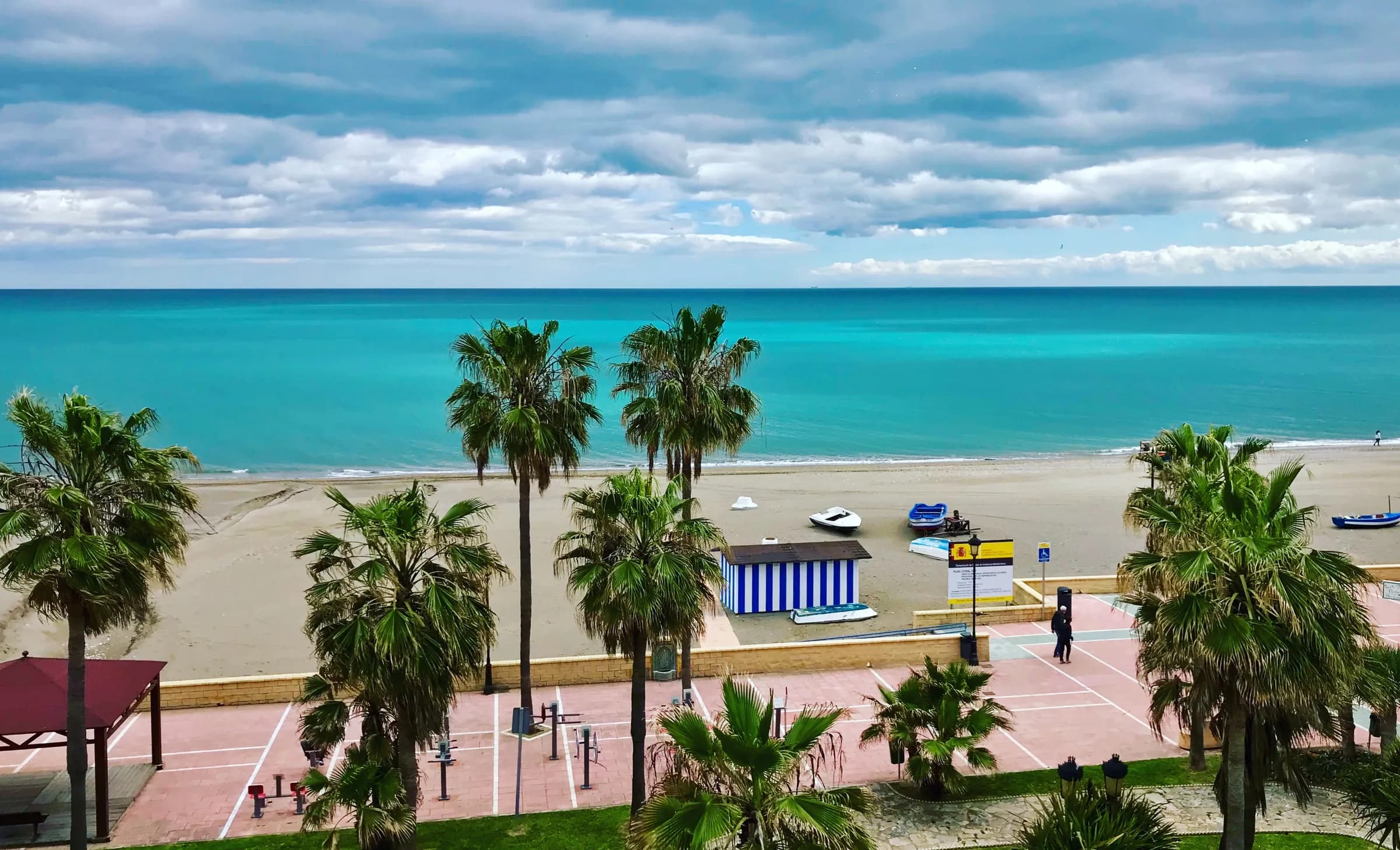
Our apartment is a 30-second walk from the sand in Sabinillas, inside the totality band (3 min 47 s at Manilva) and about 35 minutes from Gibraltar if you decide to chase the extra seconds on the morning. See what is available, and the neighbourhood guide covers the rest of the week.
Stay Right on the Beach
The sand is 30 seconds from the door, and the balcony looks straight out at it. Book direct and save up to 20%.
- 3 Bedrooms
- 6 Guests
- 96 m²
Frequently Asked Questions
Related Articles
Solar Eclipse 2026 on the Costa del Sol: Recap, and Totality in 2027
The 12 August 2026 eclipse was a deep partial at sunset on the Costa del Sol. Recap with IGN times, and what's next: totality here on 2 August 2027.

Costa del Sol Weather Month by Month
Costa del Sol weather month by month: average temperatures, sea temperature, rainfall and sunshine hours, plus what to pack and the best months to swim.
Quiet Beach Towns on the Costa del Sol (Not Marbella)
Tired of the Marbella crowds? These quiet beach towns on the Costa del Sol (Sabinillas, Manilva, La Duquesa and more) still feel like real Spain.
The Local's Costa del Sol, Monthly
One email a month: what's on in Sabinillas, the best local finds, and first pick of apartment dates. Free welcome gift: our Sabinillas Insider Guide.
We respect your privacy. Unsubscribe at any time.
Comments
No comments yetHave a tip, a question or a correction? Every comment is read and approved by hand before it appears, usually within a day.
No comments yet. Be the first to share a tip or ask a question.