The next eclipse here is total. The partial eclipse on this page happened at sunset on 12 August 2026. On Monday 2 August 2027 the path of totality crosses the Strait of Gibraltar and the western Costa del Sol, and Spain's Instituto Geográfico Nacional (IGN) gives Manilva, the municipality Sabinillas belongs to, 3 minutes 47 seconds of totality: the longest of any municipality in Málaga province. Town-by-town durations, timings and where to base yourself are in our total solar eclipse 2027 guide.
On the evening of 12 August 2026 the Costa del Sol had a deep partial eclipse that was still in progress when the sun set. This page keeps the record of how it played out from this coast (the times, how much of the sun was covered, where it sat in the sky) and what carries over to next summer's total eclipse.
2026 and 2027 Side by Side
Figures for Manilva from the IGN's municipal eclipse tables, in local time (CEST):
| 12 August 2026 | 2 August 2027 | |
|---|---|---|
| Type of eclipse here | Partial, magnitude 0.94 | Total |
| Time of day | Evening, ending at sunset | Mid-morning |
| Key moment | Maximum at 20:38:58 | Totality from 10:45:57 to 10:49:44 |
| Height of the sun | About 6°, west-northwest | About 38°, east |
| Viewing spot | Needed a clear western horizon | Almost any open ground |
| Eclipse glasses | Throughout | Throughout, except during totality |
2026 was the preview, low on the horizon at the end of a summer day. 2027 is the full event, high in a morning sky, with this coast inside the band.
It Was a Partial Eclipse Here, Not a Total One
On the Costa del Sol, the 12 August 2026 eclipse was partial. The IGN put the magnitude for Manilva at 0.94: the Moon covered about 94% of the Sun's diameter, but the sky did not go dark and the corona did not appear. Those only happen inside the narrow path of totality, which on 12 August 2026 ran across northern Spain, over A Coruña, Oviedo, León, Burgos, Bilbao, Zaragoza, Valencia and Palma. Madrid and Barcelona sat just outside it, and so did the whole south, this coast included.
What made it unusual here was the timing: it ran into sunset.
What Time It Happened, and Where the Sun Was
Because the Sun was already low in the west when the Moon began to cover it, the eclipse here played out as an eclipsed sunset: a shrinking crescent dropping toward the horizon and setting before the Moon had moved off it.
The IGN's times for Manilva (Sabinillas), in local time (CEST):
| Stage | Local time (CEST) | What was happening |
|---|---|---|
| Partial eclipse began | 19:43:40 | The Moon first touched the Sun's edge |
| Maximum | 20:38:58 | Magnitude 0.94. Sun about 6° above the horizon, west-northwest |
| Sunset | 21:15:12 | The Sun set still partly eclipsed |
Along the coast the times differed by well under a minute: the IGN had maximum at 20:38:14 in Málaga and 20:39:24 in Algeciras. What decided the evening was the height of the Sun. At maximum it was only about 6° up, so a clear view to the west-northwest mattered more than anything else.
The Viewpoints That Suited It Near Sabinillas
A low sunset eclipse wanted a low, open horizon to the west-northwest. From the Sabinillas beachfront the Sun sets off to the right, over the western coastline and hills rather than straight out to sea, so these were the spots with the right angle:
- The Sabinillas-Duquesa promenade (Paseo Marítimo). The flat, café-lined default, a 30-second stroll from the apartment. Its western end, past the Puerto de la Duquesa, has the most open aspect along this coast.
- Punta de la Chullera. The low rocky headland just southwest of Sabinillas, on the Málaga-Cádiz border, with an open sea horizon to the west toward Gibraltar.
- Casares village. The white village on its hilltop, about 20 minutes inland, where height makes up for a low sun. Our white villages guide has the lay of the land.
- Mirador de Peñas Blancas, Sierra Bermeja. The mountain viewpoint above Estepona, about 40 minutes' drive, with the widest western horizon of all.
None of that matters in 2027. During totality the Sun will be about 38° up in the east, so the beach in front of the apartment works as well as any headland.
Eye Safety: What Carries Over to 2027
In 2026 the Sun was never fully covered from this coast, so it was never safe to look at directly. On 2 August 2027 the same rule applies to the partial phases, which run for just over an hour before and after totality.
- Use certified eclipse glasses marked with the ISO 12312-2 standard. Ordinary sunglasses, however dark, are not protection, and neither is a phone camera, binoculars or a telescope without a proper solar filter.
- No glasses? Pinhole projection works: a small hole in card casts a crescent-sun image onto a surface behind it. The gaps in a colander, or light through leaves, do the same.
- The one difference in 2027: during totality itself, and only then, it is safe to look with the naked eye. Glasses go back on the moment the first bead of sunlight returns.
The Atlantic Option, and Why It Comes Back in 2027
For a sunset eclipse, the best horizon within a day trip was on the Costa de la Luz: west past Tarifa, the Sun sets over open Atlantic rather than over coastline and hills. From Sabinillas it is about 104 km and just under two hours to Zahara de los Atunes (our day-trip guide to Zahara and the tuna coast has the details, and it is one of the quietest beach escapes in the region), and a short drive further up the coast is the lighthouse headland of Cabo de Trafalgar, one of Andalucía's best-known sunset spots.
That coast matters again in 2027 for a different reason: it is closer to the centreline of the shadow. The IGN gives Tarifa 4 minutes 38 seconds of totality, the longest on the Spanish mainland, with Barbate at 4 min 15 s and Vejer de la Frontera at 4 min 05 s, against 3 min 47 s at Manilva. Our Tarifa day-trip guide covers Bolonia's dune and the Baelo Claudia Roman ruins on the way. One caveat that holds for any year: the Costa de la Luz is famously windy, and a strong levante makes the sea-level headlands blustery.
2 August 2027: Totality on This Coast
Spain is in the middle of a rare run of three eclipses: the total over northern Spain on 12 August 2026, a total across the south on 2 August 2027, and an annular eclipse on 26 January 2028. After 2027, the next total solar eclipse visible from Spain is in 2053.
On the morning of 2 August 2027 the Moon's shadow crosses the Strait of Gibraltar and runs east along the southern edge of Spain. From the IGN's municipal tables:
- Tarifa: 4 min 38 s, the longest on the Spanish mainland
- Manilva (Sabinillas): 3 min 47 s, from 10:45:57 to 10:49:44, the longest in Málaga province
- Estepona: 3 min 36 s. Marbella: 3 min 16 s
- Málaga city: 1 min 48 s, close to the northern edge of the band
The whole eclipse runs from about 09:41 to 12:01. The 12 August 2026 sunset partial was the warm-up; the date to plan around is the morning of 2 August 2027. Our 2027 total eclipse guide has the full town-by-town table, the cloud odds, where in Spain to watch it and where to base yourself.
Planning a Stay for 2027
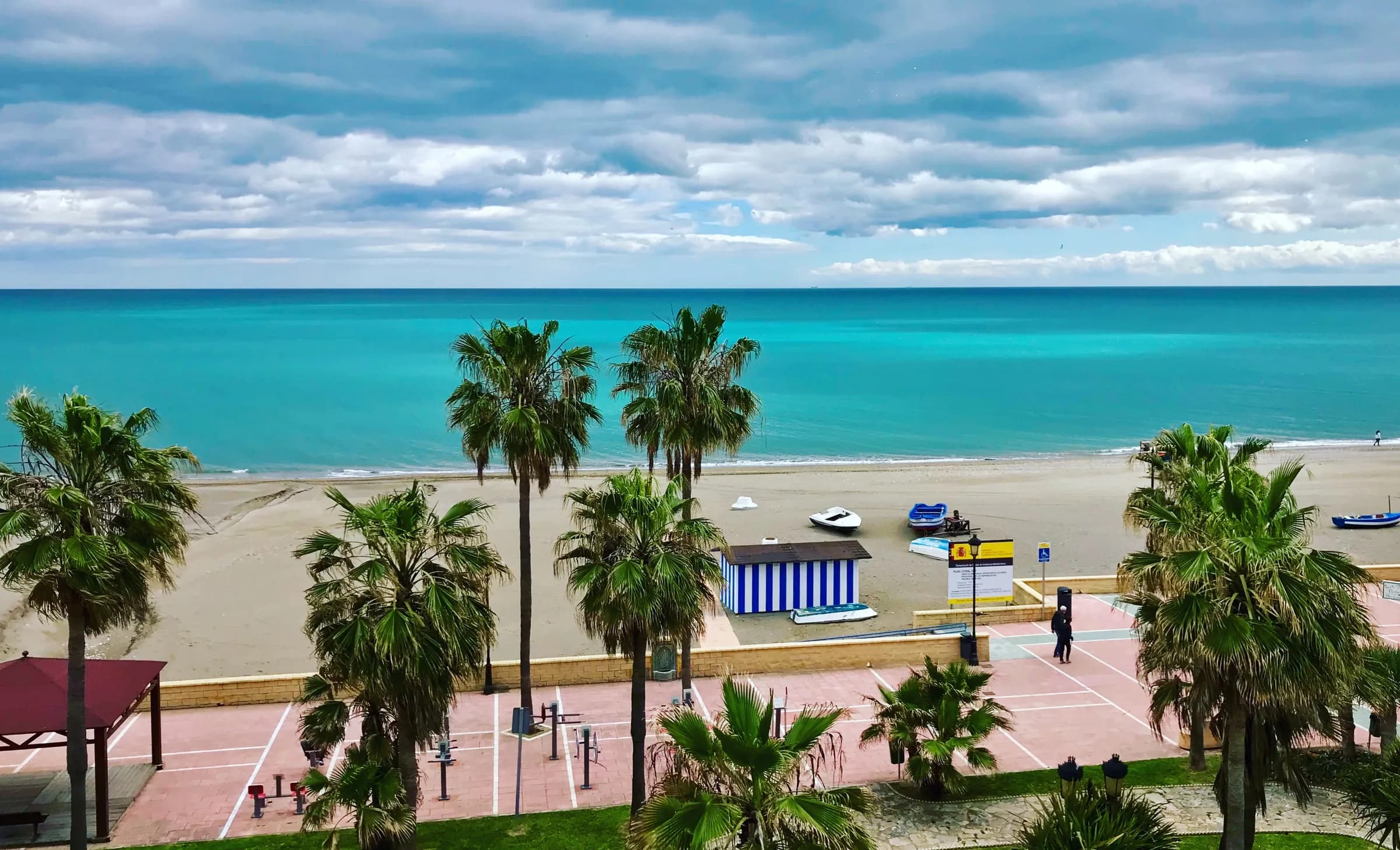
If you stay in our beachfront apartment in Sabinillas, you are inside the band and 30 seconds from the sand, and with the Sun high in the east you can watch totality from the beach. Direct bookings open on a rolling twelve-month window, so eclipse week is already bookable. The band is a narrow strip of coast at the height of the Spanish summer holidays, so if the eclipse is the reason for the trip, check dates early. Our month-by-month weather guide covers what early August is normally like here.
The rest of the summer has its own calendar: the Full Moon Festival on Sabinillas beach in July, and the San Luis fiesta in Sabinillas on its fixed date of 25 August. Our neighbourhood guide and things-to-do overview will help you fill the days in between.
Stay Right on the Beach
The sand is 30 seconds from the door, and the balcony looks straight out at it. Book direct and save up to 20%.
- 3 Bedrooms
- 6 Guests
- 96 m²
Frequently Asked Questions
Related Articles
Total Solar Eclipse 2027: Where to Watch on the Costa del Sol
Total solar eclipse, 2 August 2027: where in Spain to see it. Tarifa 4m38s, Manilva (Sabinillas) 3m47s, Málaga city under 2m. Where to stay, when to book.

Full Moon Festival Sabinillas 2026: A Beach in White
Each July, Sabinillas beach becomes a sea of white for the Full Moon Festival: candles, fire shows and moonlight. The 2026 timing, dress code and how to do it.

Tarifa Kitesurfing: Day Trip Guide from Sabinillas
Tarifa kitesurfing for first-timers and pros: the windiest beaches in Europe, plain advice on schools and conditions, and how to drive there in an hour.
The Local's Costa del Sol, Monthly
One email a month: what's on in Sabinillas, the best local finds, and first pick of apartment dates. Free welcome gift: our Sabinillas Insider Guide.
We respect your privacy. Unsubscribe at any time.
Comments
No comments yetHave a tip, a question or a correction? Every comment is read and approved by hand before it appears, usually within a day.
No comments yet. Be the first to share a tip or ask a question.