Semana Santa in Andalucía is unlike anything you'll witness elsewhere. It's not theme-park theatre or a spectacle staged for tourists. It's a centuries-old religious tradition where thousands of people dress in robes and hoods, shoulder sculptures weighing several tonnes, and process through the streets, some weeping openly, others moved to tears they can't quite explain.
If you're staying on the Costa del Sol over Easter week, or thinking of timing a visit around it, this guide explains what you're looking at, where to go, and how to experience it respectfully. The headline event is Málaga, an hour up the coast, but you can also catch the same tradition, in miniature, a few minutes from Sabinillas.
What Is Semana Santa (And Why It Matters)
Semana Santa, literally "Holy Week", is the week running up to Easter Sunday. But calling it a "celebration" misses the point. It's an observance of suffering, redemption and community, with roots reaching back to the 16th century in Andalucía.
The backbone of the week is the procession: groups of anywhere from a few hundred to nearly three thousand robed figures, accompanied by brass bands and floats called pasos, moving slowly through the streets from morning until the following dawn. The floats are extraordinary: elaborate wooden sculptures depicting scenes from the Passion of Christ or images of Mary grieving her Son, many covered in gold leaf, silver and banks of candles. The largest weigh several tonnes and need dozens of bearers: costaleros in Seville, who carry the weight on the back of the neck, hidden beneath the float; or hombres de trono in Málaga, who walk in the open alongside the much larger thrones.
The most visually striking figures are the nazarenos, members of religious brotherhoods called cofradías, in penitential robes and tall pointed hoods. For centuries outsiders have misread these robes, linking them to extremist movements an ocean away. They have nothing to do with each other. The capirote is a tradition of humility and penance that predates any such group by hundreds of years; the hood conceals the wearer's identity to stress that all are equal before God. Some walk barefoot. Some drag crosses. Many pass in absolute silence.
It's deeply moving, often emotional, and entirely sincere. If you want to understand Andalusian tradition beyond Holy Week, read our guide to flamenco shows across Andalucía.
Semana Santa Málaga: The Grand Stage
If you're in Málaga during Holy Week, you're watching one of Spain's great spectacles. Málaga's Semana Santa was declared a Fiesta of International Tourist Interest in 1980, having held the original tourist-interest designation since 1965, and it earns it.
Around forty brotherhoods stage roughly forty processions across the week. The historic centre (narrow alleys lined with whitewashed buildings, opening onto grand plazas) fills with Malagueños, Spanish holidaymakers and visitors from abroad. The scale is enormous. Málaga's tronos are among the biggest and heaviest in Spain, far larger than the floats elsewhere; some need over two hundred bearers and can't even pass down certain streets. The brass is deafening. The air is thick with incense and orange blossom.
The processions follow a rhythm. Morning and early-afternoon ones tend to be quieter and more solemn. As evening falls the night processions take on a different character entirely: thousands of candles lit, the streets dimmed, brass building a wall of sound that ricochets off the stone. The intensity can floor you. People cry openly. It feels less like a show and more like witnessing something genuinely sacred.
The Christ of Mena and the Spanish Legion
The single most famous moment of the Málaga week comes on Maundy Thursday (Jueves Santo), when a detachment of the Spanish Legion disembarks and parades the image of the Cristo de la Buena Muerte, the Christ of Mena. The legionnaires march at their characteristic fast pace, singing "El Novio de la Muerte" ("The Bridegroom of Death"), and at one point hoist the Christ figure aloft. Tens of thousands pack the route. It's loud, martial, divisive among locals, and unforgettable: easily the most photographed scene of the entire Andalusian Holy Week. If you only catch one Málaga procession, this is the one people travel for.
Two other names worth knowing: El Cautivo ("Jesús Cautivo", the Captive Christ of the Trinidad brotherhood), known affectionately as El Señor de Málaga and drawing vast Monday-night crowds; and La Esperanza, one of the city's most beloved images of the Virgin. You don't need to memorise the calendar, but recognising these helps you understand why a particular crowd is ten deep.
Where to Stand in Málaga
The main routes converge on the official course (the carrera oficial) through the centre, with the Cathedral and Calle Marqués de Larios as key points. These thoroughfares fill an hour or more before a procession arrives. For a decent view without dawn dedication, post yourself on a side street feeding into them; you'll still see the paso pass, with fewer elbows.
Two paid options exist. You can buy a numbered seat on the official grandstand along the carrera oficial, sold in advance through the brotherhoods' council (the Agrupación de Cofradías); handy, but it ties you to one spot for hours. Or you can rent a private balcony overlooking a route, which is genuinely the best vantage point and books up months ahead. Either way, everything else is free.
Seville: The Grand Tradition
Seville's Semana Santa is, for many Andalusians, the finest in Spain. It's certainly the most storied: around seventy brotherhoods process across the week, and some routes run for twelve hours or more.
What sets Seville apart is the sheer feeling. The lanes of the Barrio Santa Cruz become rivers of robed figures, brass and trailing incense. The floats are draped in silver for the Virgin or gold for Christ, and the bearers are hidden beneath, so the whole thing seems to glide. The rhythm is hypnotic: drums, brass, footsteps, silence, repeat. The emotional summit is the Madrugá, the long night between Maundy Thursday and Good Friday, when the city's most venerated brotherhoods (La Macarena, El Gran Poder, El Silencio) process before dawn.
Seville is roughly 215 km from Sabinillas, about 2.5 hours by car, or drive/coach to Málaga and take the high-speed Avant train. If you're serious about Semana Santa and willing to travel, Seville offers a scale and tradition that stays with you. (It also hosts the Feria de Abril, a separate spring festival a couple of weeks after Easter, and is well worth a weekend trip in its own right.)
Good to know: Seville books out early. For Easter week, sort accommodation by January or February.
Málaga vs Seville vs the Local Towns: Which Suits You?
There's no single "best" Semana Santa; it depends on what you're after. Here's the comparison for someone based on the western Costa del Sol.
| Málaga | Seville | Estepona / Manilva | |
|---|---|---|---|
| Scale | Huge, theatrical | The biggest, most revered | Small, intimate |
| Floats | Vast open tronos, hundreds of bearers | Hidden costaleros, gliding pasos | A mix of both styles |
| Crowds | Very heavy on key nights | Heaviest of all (esp. Madrugá) | Manageable, mostly locals |
| Signature moment | Christ of Mena + Spanish Legion (Maundy Thu) | The Madrugá (Thu→Fri night) | Genuine village devotion |
| From Sabinillas | ~1h15 by car / Avanza coach | ~2.5h by car or via Málaga | 0-20 min |
| Best for | Spectacle without leaving the province | A pilgrimage-level experience | A first taste, with kids, no fuss |
If it's your first Holy Week and you don't want a four-hour round trip, start local. If you want the iconic images, give Málaga a full evening. Save Seville for a year you can commit a night or two.
Smaller Town Processions: The Intimate Alternative
Not everyone wants Málaga-sized crowds. The quiet advantage of basing yourself near Sabinillas is that the small towns nearby (Estepona, Manilva and others) hold their own processions. Less famous, less crowded, and easier to see.
Estepona, about 15-20 minutes' drive away, is the pick. The town runs several processions across Holy Week, from Palm Sunday through to Easter. What makes it interesting is the mix of float styles: some carried costalero-style on the neck like Seville, others on exterior poles like Málaga. It feels like a family affair, with real participation from across the town rather than a show put on for visitors. Estepona is a lovely place year-round; after the processions, wander the old town's flower-filled lanes and the marina.
Manilva, our neighbouring town, also keeps the tradition with its own processions. The scale is smaller, the crowds gentler, the feel completely local: Spanish families, Spanish customs, no tour buses.
For anyone staying in Sabinillas, Estepona is the sweet spot: an authentic Holy Week without Málaga's crush or Seville's distance. Make a day of it and pair it with Estepona's best beaches.
A Typical Procession Evening: What Happens
If you've never seen one, here's how a night tends to unfold, so you know what you're waiting for.
- The wait. People gather on the route well before the float appears, an hour or more on a busy night. Bars do a roaring trade; families stake out kerbs with folding stools.
- The approach. You hear it before you see it: a distant drum, then brass swelling as the column rounds a corner. The nazarenos come first, in robes and hoods, many carrying tall candles.
- The paso. Then the float itself, swaying gently as the bearers move in step beneath or beside it. It moves at walking pace, often stopping to rest; this is your chance to look closely.
- The saeta. At unannounced moments, someone may break into a saeta, a raw, unaccompanied flamenco lament sung from a balcony to the passing image. Everything stops. It's spine-tingling.
- The silence. During a Silencio procession, the band falls away entirely and the street goes quiet but for footsteps and dripping wax. Hold your tongue here; the hush is the whole point.
- The small hours. Big processions run very late; some don't return to their church until three or four in the morning. You can leave whenever you like; nobody minds.
What to Expect as a Visitor: The Sensory Reality
Semana Santa is an assault on the senses, and we mean that as a compliment.
Sound is the most overwhelming part. Brass so loud it's almost physical; drums in perfect lockstep filling a plaza; then the sudden, total silence of the Silencio, broken only by footsteps. Sight matches it: thousands of robed figures moving as one, the great floats swaying under their weight, candlelit faces lining the route. The pace is slow, so you have time to take it in.
Crowds vary wildly by day and hour. Mornings are quiet and contemplative, mostly local devotees. Afternoons get busier but stay walkable. Evenings on the key days are shoulder-to-shoulder, but that's where the intensity lives.
Emotion is real. Plenty of visitors are surprised to find themselves welling up: not from belief, necessarily, but from the sheer weight of watching thousands of people do something this sincere and this old. It's fine to feel something. That's rather the idea.
A Word on Etiquette
Holy Week is sacred to Andalusians. You're genuinely welcome; just show respect.
- Photography: No flash during evening processions. It's disruptive and rude.
- The Silencio: If a procession is marked "Silencio", stop talking, even mid-sentence. The quiet is essential.
- Never cross a procession: Don't walk between the nazarenos or cut across a paso. Wait for the gap.
- Dress modestly: Skip beachwear, very short skirts or revealing clothing. This is an observance, not a party.
- Treat it like a church service: Because in many ways that's exactly what it is: an open-air, centuries-old one.
When Is Semana Santa? Dates for the Next Two Years
The dates move every year because Easter is a moveable feast: the first Sunday after the first full moon following the spring equinox, a rule in place since 325 AD. So Holy Week can land anywhere from late March to mid-April.
| Year | Palm Sunday (start) | Holy Wednesday | Good Friday | Easter Sunday (end) |
|---|---|---|---|---|
| 2026 | 29 March | 1 April | 3 April | 5 April |
| 2027 | 21 March | 24 March | 26 March | 28 March |
Planning Around the Dates
The biggest days are Maundy Thursday (Jueves Santo, the Christ of Mena in Málaga) and Good Friday (Viernes Santo), with Holy Wednesday (Miércoles Santo) also drawing big crowds, and in Seville the overnight Madrugá between Thursday and Friday. Aim for these for the most dramatic processions, but expect the heaviest crowds and book early. Prefer something calmer? Palm Sunday and Holy Saturday are gentler while still meaningful; Palm Sunday processions often feature children in costume and have a softer, family feel.
Practical Information for Visiting
Getting to the Processions
This is the bit that trips people up, so be clear: there is no train from the western Costa del Sol. The coastal Cercanías line only starts at Fuengirola, well to the east. From Sabinillas your options are:
- Málaga: about 1h15 by car on the AP-7 (toll) or A-7, or take the Avanza intercity coach from Estepona. Once in Málaga, the old town is entirely on foot. Parking in the centre during Holy Week is a lost cause; use a car park on the edge or come by coach. For more, see our complete Málaga city guide.
- Estepona: 15-20 minutes by car. Parking is tight during Semana Santa, so arrive early or use a public car park and walk in.
- Manilva: minutes away; easily walkable or a very short drive.
- Seville: 2.5 hours by car, or drive/coach to Málaga and take the high-speed Avant train. If you're making a night of it, flying home from Seville (SVQ) can be simpler than doubling back to Málaga.
Weather & What to Wear
Late March and April on the Costa del Sol are pleasant: daytime highs of around 18-20°C, mornings and evenings nearer 12°C. Holy Week 2027 falls in March, so check Costa del Sol weather in March before you pack. The sun can be strong, so bring sunscreen and a hat for daytime processions, and a light jacket or cardigan for the late ones, which run well into the night. Most important: comfortable shoes. You'll be standing for hours on cobbles, or walking the route to follow a float. (For a fuller picture, see our month-by-month Costa del Sol weather guide.)
Finding a Viewing Spot
- Málaga: Arrive 1-2 hours early for a spot on the main routes; side streets are quieter but still good. A rented balcony beats everything if you can get one.
- Estepona: Far more relaxed; a decent spot 30-45 minutes ahead is usually fine.
- Manilva: Very easy; locals will often shuffle up to make room.
Accommodation
Book early, ideally 2-3 months ahead. Málaga's city-centre hotels sell out completely, and Holy Week overlaps Spanish school holidays, one of the country's peak travel windows. Staying out on the western Costa del Sol gives you a calmer, cheaper base; reach Málaga by car or the Avanza coach for the processions.
Save money: Base yourself on the western Costa del Sol and travel in for the day. You get a quiet apartment, lower nightly rates, and you skip the worst of the city crush.
Cost
Watching from the street is free: no tickets, no reserved areas. The only paid choices are a numbered seat on the official grandstand (sold in advance via the local brotherhoods' council) or a rented private balcony. Everything else costs nothing but the time you spend waiting.
A Quick Glossary
A handful of words you'll hear all week:
- Cofradía / Hermandad: a religious brotherhood; the group behind each procession.
- Nazareno: a robed, hooded penitent walking in the procession.
- Paso / Trono: the float bearing the sacred image (trono is the Málaga term).
- Costalero / Hombre de trono: a bearer; hidden beneath the float in Seville, in the open in Málaga.
- Saeta: a raw flamenco lament sung to a passing image.
- Madrugá: the overnight Thursday-to-Friday processions, Seville's emotional peak.
- Silencio: a procession (or moment) observed in strict silence.
Planning Your Semana Santa Visit
If you're staying at our beachfront apartment in Sabinillas, Holy Week is a genuinely memorable way to meet Andalusian culture head-on. You'll have a quiet, comfortable base 30 seconds from the sand, and you're well placed for Estepona (15-20 minutes), Málaga (about an hour and a quarter) or even Seville (2.5 hours), with the beach to come home to afterwards.
For more on the area at other times of year, see our complete guide to Sabinillas and the surrounding towns, and for the rest of the Andalusian festival calendar, browse our culture and fiestas section.
Come for the religious significance, the spectacle, or simply to see something authentically Spanish and quietly overwhelming; either way, Semana Santa is worth your time. Arrive early, dress respectfully, and be ready to feel something you didn't expect.
Semana Santa dates are confirmed for 2026 and 2027. Exact procession times and routes vary by town and year; check the local tourism office or brotherhoods' council a week or two before you go for the detailed schedule.
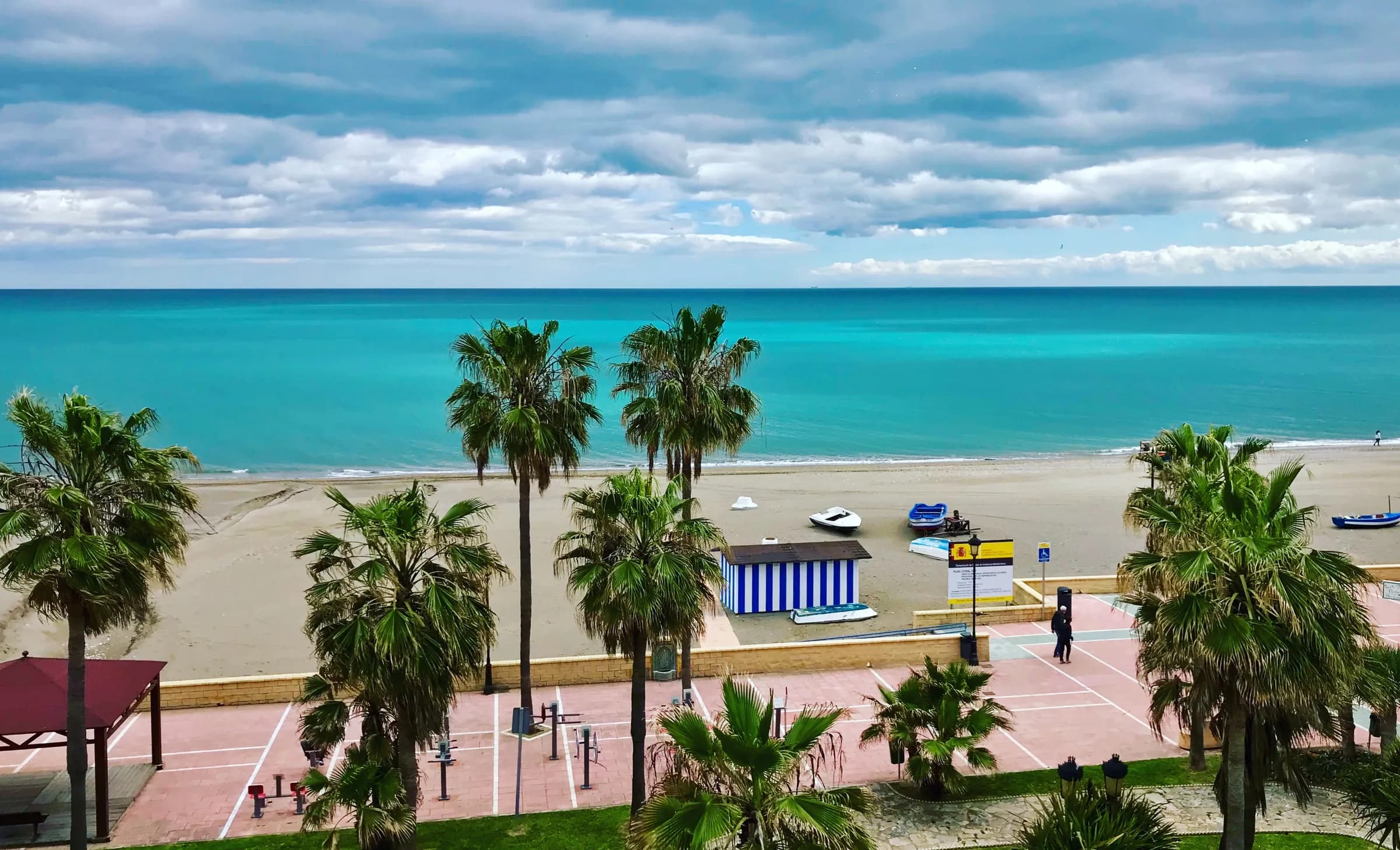
Stay Right on the Beach
The sand is 30 seconds from the door, and the balcony looks straight out at it. Book direct and save up to 20%.
- 3 Bedrooms
- 6 Guests
- 96 m²
Frequently Asked Questions
Related Articles
Flamenco in Málaga & Andalucía: Where It's Real
Where to see real flamenco in Málaga and across Andalucía: our picks from intimate tablaos and Estepona peñas to the legendary stages of Seville and Jerez.

Things to Do in Seville: Itinerary & Day-Trip Guide
Planning the things to do in Seville from the Costa del Sol? The Alcázar, Cathedral and Plaza de España, plus tapas, flamenco, getting there and an itinerary.
Things to Do in Málaga: A Day Trip from Sabinillas
The best things to do in Málaga in a day from Sabinillas: Alcazaba, Picasso Museum, cathedral, the port and beaches, with prices, hours and how to get there.
The Local's Costa del Sol, Monthly
One email a month: what's on in Sabinillas, the best local finds, and first pick of apartment dates. Free welcome gift: our Sabinillas Insider Guide.
We respect your privacy. Unsubscribe at any time.
Comments
No comments yetHave a tip, a question or a correction? Every comment is read and approved by hand before it appears, usually within a day.
No comments yet. Be the first to share a tip or ask a question.