Most day trips from this coast are a town, a view and a long lunch. This one is a 5,000-year-old chamber you can stand upright inside, built from stones so large that the biggest of them has only recently been weighed properly, and deliberately aimed at a mountain that looks like a sleeping face. Then, fifteen minutes up the road, a limestone plateau that spent its early life on a seabed and now looks like one.
UNESCO treats all of it as a single site, which is the best argument for treating it as a single drive. It is about an hour and a half from Sabinillas, and it is the most genuinely strange thing within that radius.
Five Parts, One Site
The Antequera Dolmens Site was inscribed on the World Heritage List on 15 July 2016, the first in Málaga province. What makes it unusual is the shape of the listing. It covers three built monuments, the dolmens of Menga and Viera and the tholos of El Romeral, and two natural ones, the karst plateau of El Torcal and the crag of the Peña de los Enamorados.
The mountains are in the listing because the monuments are aimed at them. Most megalithic tombs across Europe face sunrise. In UNESCO's own words, these show "anomalous orientations": Menga is the only dolmen in continental Europe facing an anthropomorphic mountain, and El Romeral, facing El Torcal, is one of very few on the whole Iberian Peninsula pointed at the western half of the sky. Menga sits at an azimuth of 45°, El Romeral at 199°.
The detail that makes it land: Menga's axis does not just point vaguely at the Peña. Extended, it meets the crag at the Abrigo de Matacabras, a rock shelter on the north face carrying schematic prehistoric paintings. Someone chose that hill, and that angle, on purpose.
Menga: The Numbers Do the Work
Menga was built around 3800 to 3600 BC. That is roughly a thousand years before the great sarsen stones went up at Stonehenge, and it makes Menga the oldest of Iberia's great dolmens.
- 27.5 m long, counting atrium, corridor and chamber
- 2.7 m high at the entrance, rising to 3.5 m at the head
- 6 m across at its widest
- Seven uprights a side, some 4.7 m tall and a metre and a half thick
- Four capstones, and three pillars down the central axis, a construction method described in the official archaeology as very rare in European megalithism
- The largest capstone measures 6.95 × 6 × 1.88 m and weighs about 150 tonnes, the heaviest stone moved anywhere in Iberia during the megalithic period
- The stone came from Cerro de la Cruz, about a kilometre away
One correction worth making, because it is all over the internet and it is wrong. Menga is often called Europe's oldest roofed monument. It is not: the Cairn de Barnenez in Brittany has roofed chambers dated around a thousand years earlier. You lose nothing by dropping the claim. "The most colossal stone monument built in its time in Europe" is what the peer-reviewed work says, and standing under 150 tonnes of it is not improved by an inflated caption. If you see an older guidebook quoting 250 tonnes for the capstone, that is the pre-2023 estimate.
Viera and El Romeral
Viera sits next to Menga, in the same enclosure and on the same ticket. It is narrower, tighter and more conventional, with a long passage and a small square chamber, and it makes a good contrast: this is what a normal dolmen of the period looks like, and it is precisely what Menga is not.
El Romeral is different again, a tholos, with a corbelled beehive chamber built of small flat stones rather than giant slabs. It is in a separate enclosure about 3.5 km away, roughly a seven-minute drive off the A-7283, and it runs on exactly the same opening hours as Menga and Viera. Skipping it is the most common mistake, and it is the one aimed at El Torcal.
Hours, Tickets and the Summer Trap
This is the part to get right before you set off, because the site runs three seasonal schedules rather than the usual two.
| Period | Tuesday to Saturday | Sundays and public holidays |
|---|---|---|
| 21 Sep – 20 Mar | 09:00–18:00 | 09:00–15:00 |
| 21 Mar – 20 Jun | 09:00–18:00 (Tue–Thu) 09:00–21:00 (Fri–Sat) | 09:00–15:00 |
| 21 Jun – 20 Sep | 09:00–14:00 and 19:00–22:00 | 09:00–15:00 |
Closed Mondays, except when the Monday is the eve of a public holiday. Last admission is 30 minutes before closing, and no tickets are issued after that, which is why some official pages list times half an hour earlier than the ones above.
The summer line is the one that ruins days. Between 21 June and 20 September the site shuts at 14:00 and does not reopen until 19:00. Drive up from the coast after a slow beach morning in August and you will arrive to a locked gate. Go early, or go for the evening opening, which is genuinely the nicer option in that heat.
Admission is €1.50, and free for EU citizens with ID. It is not free for everyone, so British, American and other non-EU visitors should expect to pay, and everyone should carry ID. Your visit starts at the Museo de Sitio at Llano de Rojas, where the ticket is issued. There is free parking, and both enclosures are described as accessible to visitors with reduced mobility, with wheelchairs available at reception. No animals are allowed in either enclosure.
Two dates worth knowing if you are here in autumn: the site is normally shut on Mondays, but it opens on Monday 12 October, Monday 2 November and Monday 7 December 2026, all of which are public holidays. Those are also the days everyone else in Andalucía has off, which matters more for El Torcal than for the dolmens. Our guide to what's open when in Spain covers the autumn holiday calendar in full.
El Torcal: The Stone Sea
El Torcal is a karst plateau over 1,200 metres up, fifteen minutes and a lot of hairpins above the dolmens. The limestone formed on a seabed and then weathered into stacks, towers and pavements that genuinely do read as a petrified sea, which is why the imagery has stuck.
Entry is free, and so is parking. The Centro de Visitantes Torcal Alto opens 09:30 to 17:30 daily, closed on 25 December, 1 January and 6 January.
Take the altitude seriously. The official guidance warns of a significant temperature drop compared with Antequera or Málaga, strong northerly winds and dense fog for much of the year. Guests leave Sabinillas in shorts and arrive somewhere that needs a fleece and a windproof. Boots rather than sandals: the ground is officially described as very stony and irregular, and that is not a formality. It is also a protected bird area, which is why drones are banned outright, and if the raptors overhead get you interested, the bird migration over the Strait is the closer spectacle from our side of the province.
The Car Restriction, and the Shuttle
The single most useful thing to know about El Torcal: on weekends, public holidays and long weekends from autumn through spring, and sometimes on weekdays, the road to the top closes to private cars.
- There is no fixed closing time. The road shuts when the upper car park fills, which on a fine holiday morning can be early.
- It generally reopens between 14:00 and 15:00, and at 14:00 on restricted weekdays.
- When it is shut, a shuttle runs from the lower car park on the A-7075 between km 41 and 42, at €3 per person, the same fare one way or return, roughly every 30 minutes until around 17:00.
- The shuttle thins out or pauses in the early afternoon while the driver takes a mandatory break, broadly between 13:30 and 15:30.
- Buses, taxis, and vehicles displaying a disabled parking card are always allowed up.
- There is no booking system and no car park fee.
- No public transport reaches El Torcal, and the site itself warns against arriving by ride-hailing app, because Antequera has no authorised service to get you back down.
The official pages currently disagree with each other on the fare, one saying €3 and an older one €2, so carry a few coins and check the sign on the day. And note how neatly this collides with the autumn holidays: 12 October, 2 November and 7 December 2026 are exactly the kind of days the restriction is designed for. Arrive before ten or plan on the shuttle.
The Three Waymarked Routes
All three are free, signposted, need no permit, and share the same very stony ground.
| Route | Distance | Ascent | Time | Notes |
|---|---|---|---|---|
| Verde | 1.5 km circular | +40 m | 45 min | The one to do if you have an hour |
| Amarilla | 3 km circular | +53 m | 2 hours | The best formations |
| Naranja | 3.6 km linear | +263 m | 3.5 h return | Links the lower car park to the upper one |
The Naranja is worth understanding even if you never walk it: it is the walking alternative on a day when the road is closed and you have missed the shuttle.
Dogs are welcome at El Torcal on a lead, which is the opposite of the dolmens, where they are banned outright. They are not allowed on the shuttle, though, apart from assistance dogs and small dogs crated in the hold, so a dog effectively commits you to driving up or walking the Naranja. Pushchairs do not work on any of the three routes, but the visitor centre is adapted and there are short accessible paths and two adapted accesses around it.
The Peña de los Enamorados: Look, Don't Climb
The crag on the horizon, around 880 metres, is the other half of the story. The Junta describes its profile as recalling a sleeping woman's face; locals call it el Indio. It has been occupied since the Lower Palaeolithic and holds the painted Matacabras shelter that Menga is aimed at.
It is also privately owned, the only part of the World Heritage property that is, and no official body publishes a public path to the top. Informal routes exist, finish with a scramble, and one crosses private farmland. Treat it as a thing to look at.
The two best places to do that are Menga's own entrance, and a viewpoint in town that we would have walked past without knowing. The Mirador Michael Hoskin, by the Arco de los Gigantes, holds a bronze bust of the archaeoastronomer who did much of the work on these alignments, and it faces the Peña, mirroring the dolmen's own orientation. The neighbouring Mirador Almenillas frames the same view.
As for the lovers who gave the rock its name, a Muslim girl and a Christian boy who leapt from it rather than be separated: it is a legend with several competing versions and no historical basis. Enjoy it as folklore.
An Hour in the Town
Antequera itself deserves the time if the day allows it. The Alcazaba and the Renaissance Real Colegiata de Santa María la Mayor sit together at the top of the old town, both open 10:00 to 18:00 daily with last entry at 17:15. Separately they are €5 and €4; the combined ticket is €8, or €4 reduced, and both are free on Tuesdays from 14:00 to 18:00 outside holidays. There is no combined ticket that includes the dolmens or El Torcal.
Park at Plaza de Castilla (paid, 24 hours) or Parking Centro on Calle Diego Ponce, whose ticket also gets you onto a 360° rooftop viewpoint. Free parking sits at La Moraleda, Plaza de Jesús, Paseo de los Colegiales and Calle Saeta.
Eat porra antequerana, the town's own cold soup: thicker than Córdoba's salmorejo, made with pepper as well as tomato, dense enough to take a spoon, usually topped with ham and egg. It appears in our Málaga tapas guide too, but this is where it belongs.
2026 is the site's tenth anniversary as a World Heritage property, with two temporary exhibitions that opened in July.
Doing It in a Day from Sabinillas
Verified on Google Maps rather than estimated:
| Leg | Time | Distance |
|---|---|---|
| Sabinillas → Menga, via AP-7 (tolled) | 1 h 31 | 143 km |
| Sabinillas → Menga, via A-7 and A-45 (toll-free) | 1 h 49 | 152 km |
| Sabinillas → El Torcal visitor centre | 1 h 45 | 139 km |
| Menga → El Romeral | 7 min | 3.5 km |
| Menga → El Torcal | 26 min | 16.3 km |
A running order that works: leave by 08:00, dolmens and the site museum from 09:00, El Romeral at about 11:00, then straight up to El Torcal for the Ruta Amarilla and lunch. Town in the late afternoon, home for a late dinner on the balcony. In high summer, invert it: El Torcal in the cool of the morning, the town over the long afternoon, and the dolmens at 19:00 when they reopen and the light on that stone is worth the wait.
Two things not to do. Do not arrive at the dolmens mid-afternoon between late June and late September. And do not plan El Torcal for a holiday Monday morning without a shuttle contingency.
You need a car for this one; there is no sensible public-transport version, and our car hire notes cover the local practicalities. If you would rather have the day laid out for you, ask us when you book and we will tell you what the road is doing that week. It pairs naturally with Ronda or the Caminito del Rey across a week, though not on consecutive days: all three are early starts, and the point of being here is the sea in between.
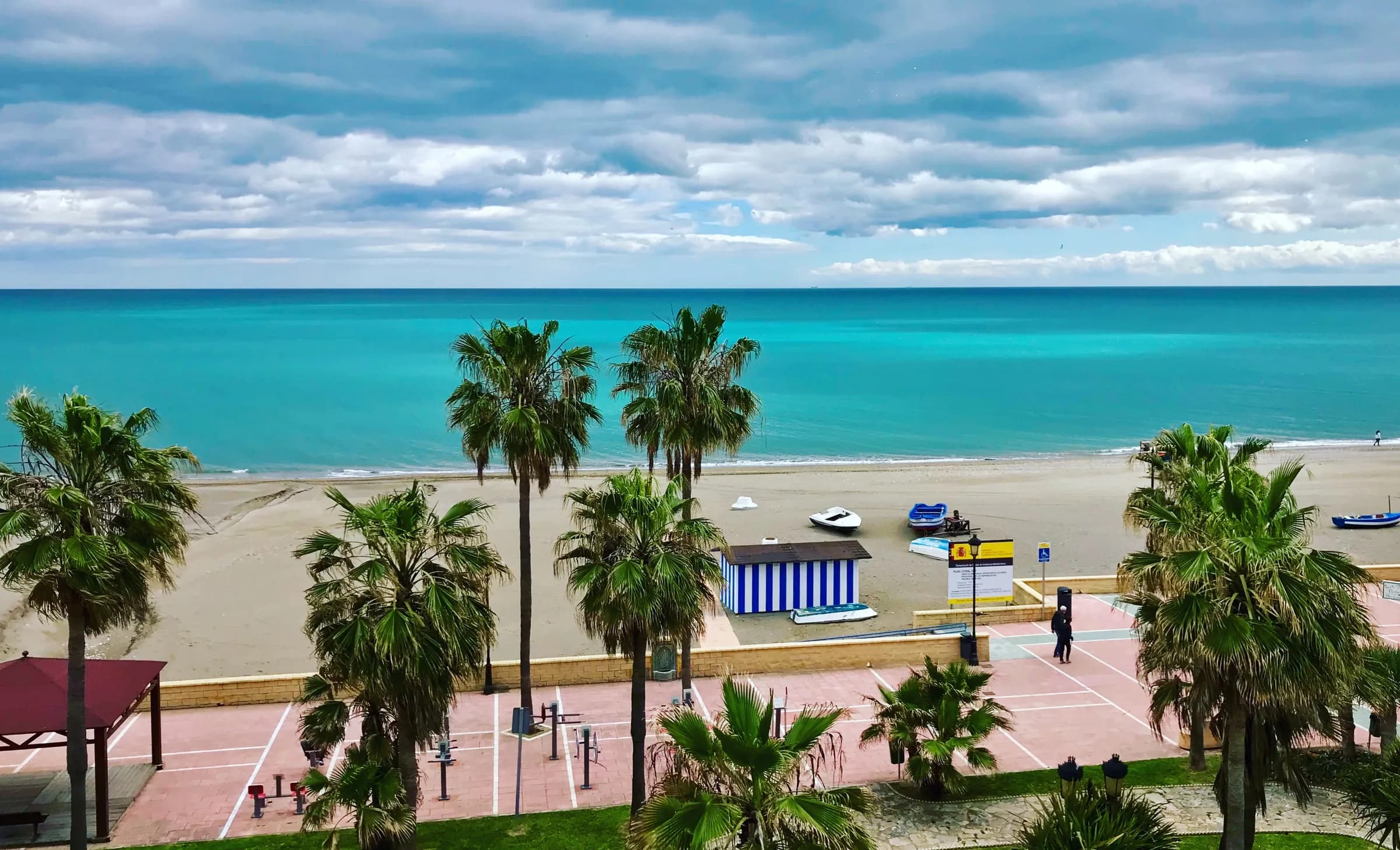
Stay Right on the Beach
The sand is 30 seconds from the door, and the balcony looks straight out at it. Book direct and save up to 20%.
- 3 Bedrooms
- 6 Guests
- 96 m²
Frequently Asked Questions
Related Articles
Caminito del Rey: Tickets, Walk & Day Trip Guide
How to book Caminito del Rey tickets, walk the cliff-pinned gorge boardwalk one-way, and plan the drive from the western Costa del Sol. A practical guide.
Day Trips from Sabinillas & the Western Costa del Sol
Best day trips from Sabinillas and the western Costa del Sol: Ronda, Gibraltar, Caminito del Rey, white villages and Tangier, with drive times and costs.

Ronda Day Trip from Sabinillas: Things to Do & Itinerary
A Ronda day trip from the Costa del Sol: the best things to do, where to eat, how to get there from Sabinillas or Málaga, and a full one-day itinerary.
The Local's Costa del Sol, Monthly
One email a month: what's on in Sabinillas, the best local finds, and first pick of apartment dates. Free welcome gift: our Sabinillas Insider Guide.
We respect your privacy. Unsubscribe at any time.
Comments
No comments yetHave a tip, a question or a correction? Every comment is read and approved by hand before it appears, usually within a day.
No comments yet. Be the first to share a tip or ask a question.