Before you go anywhere: the wind decides this trip, so check the live wind direction on our Costa del Sol weather page first. An easterly and a westerly send you to opposite ends of the coast.
Twice a year, a strip of coast about an hour's drive from our apartment becomes one of the busiest places on the planet for birds. Not busy in the sense of a few more than usual. Busy in the sense that Fundación Migres, the research foundation that counts them, logged 589,000 soaring birds passing through in 2024, and that was a good year rather than a freak one.
Most people staying on this coast in September have no idea it is happening overhead. It is free, it needs no booking, and on the right day it is the most memorable hour of a holiday here.
Why Half a Million Birds Funnel Through One Gap
The explanation is mechanical, and once you know it the whole thing makes sense.
Big birds do not migrate the way small ones do. A warbler can flap across open water through the night. A stork or an eagle weighs far too much for that, so it travels by soaring: it finds a thermal, a column of warm air rising off ground the sun has heated, circles upward inside it until it is high enough, then peels off and glides for miles losing height, until it finds the next thermal and does it again. The bird barely flaps. It is a very efficient way to cross a continent and costs almost nothing in energy.
The problem is that thermals form over land, not over water. Sea does not heat the air the same way. So for a soaring bird, open water is a barrier it must cross in one long glide, with no way to climb again until it reaches the far side.
That turns the whole of the Mediterranean into a wall with two doors, and this is the western one. The Strait of Gibraltar narrows to about 14 km at its tightest point, close enough that a bird can climb high on the Spanish side and glide to Morocco. Everything soaring between western Europe and Africa is squeezed into that gap.
Stand on a hillside above Tarifa in late September and you are standing in the doorway.
What Crosses, and When
Around 30 species of soaring bird cross the Strait regularly. Two dominate the numbers: the white stork and the black kite, each passing in excess of 100,000 birds.
Storks are the ones that convert non-birdwatchers. They travel in enormous loose flocks, and when a flock finds a thermal the whole group stacks into a slow rotating column, sometimes several hundred birds turning together in the same direction. Birders call it a kettle. It looks like the sky is stirring.
Beyond those two, the regular cast includes:
- Honey buzzards, in tens of thousands, with a famously concentrated passage
- Short-toed eagles, often hanging motionless overhead while hunting snakes
- Booted eagles, in light and dark colour forms
- Egyptian vultures and griffon vultures
- Black storks, far scarcer than the white ones and a real find
- Sparrowhawks, harriers, ospreys and lesser kestrels
Two passages a year, in opposite directions:
| Passage | Months | Direction | Notes |
|---|---|---|---|
| Autumn (post-breeding) | Mid-July to mid-October | Europe → Africa | The big one for volume. Late August to early October is the core |
| Spring (pre-breeding) | February to May | Africa → Europe | March is the peak month for birds of prey |
| Late griffon movement | Mid-October to late November | Southbound | Young griffon vultures move last, after the main rush |
Timing within the day matters as much as the month. The birds need the sun to build thermals before they can climb, so there is no dawn rush. Activity generally picks up from around 10am to midday, with a second surge in the mid to late afternoon. A lie-in is not a problem here.
The One Thing That Decides Your Day: Read the Wind
This is the piece of local knowledge that separates a good day from a wasted drive, and it is why the lede tells you to check the forecast first.
Soaring birds crossing the Strait drift downwind. They are not flying a fixed line; they are gliding across a moving airmass, so whichever way the wind blows, that is where they end up. The two winds that matter here are the same two that make Tarifa a kitesurfing destination: the levante from the east, and the poniente from the west.
| Wind | Birds drift | Go to |
|---|---|---|
| Levante (easterly) | Westward | Tarifa, Cazalla, and on strong days as far west as Bolonia |
| Poniente (westerly) | Eastward | Punta Carnero, the Rock of Gibraltar, and our own coastal sierras |
| Calm / light | Nowhere much | Tarifa. The birds concentrate at the narrowest crossing |
Get this backwards and you can spend a morning on an empty hillside while the entire passage streams over a ridge 30 km away. Get it right and the birds come over your head.
The useful consequence for anyone staying here: a poniente day is a local day. You do not need to drive to Tarifa at all.
Where to Watch: The Main Sites
| Site | From Sabinillas | Best wind | Notes |
|---|---|---|---|
| Mirador de Cazalla (Tarifa) | ~60 km, ~55 min | Light levante or calm | The flagship. Free, parking, toilets |
| Algarrobo (Tarifa) | ~65 km, ~1 hr | Levante | The second official Migres count post |
| Punta Carnero (Algeciras) | ~45 km, ~45 min | Poniente | Headland site, birds pass low |
| Upper Rock, Gibraltar | ~30 min + border | Poniente | Jews' Gate observatory, plus the apes |
| Sierra Crestellina (Casares) | ~20 min | Poniente | Closest by far, resident vultures |
Mirador de Cazalla, Tarifa
The main public observatory, at km 87 of the N-340 just before Tarifa, and one of the two points from which Fundación Migres runs its daily counts. It opened in 2016 and took over 13,000 visitors in 2023, so it is a proper facility rather than a layby: viewing deck, parking, toilets, and no admission charge. It works best in calm conditions or a light to moderate levante.
Getting there from Sabinillas is about 60 km and just under an hour, and you can do the whole run toll-free on the A-7 and then the N-340, the same road our Tarifa day trip guide describes. The faster route uses a toll; the free one costs you about six extra minutes.
Worth knowing: the recommended season here is essentially year-round except June and December, the two dead months between passages.
Gibraltar and the Upper Rock
On westerly winds the birds pile up at this end of the Strait, and the Rock becomes the place to be. The Gibraltar Ornithological & Natural History Society runs a ringing station and field observation centre at Jews' Gate, on the Upper Rock Nature Reserve, ringing on suitable days from February to June and again from August to November. Visiting birdwatchers are welcome and guides can be arranged.
It also combines neatly with a normal Gibraltar day, since you are already up on the Rock for the Barbary macaques. Budget for the border either way, which our border crossing guide covers in detail.
The Closest Option: The Sierras Behind Casares
Here is the part that surprises most guests. You are already living underneath the flyway.
The Diputación de Málaga lists the province's coastal sierras, Sierra Crestellina above Casares and Sierra Bermeja among them, as excellent vantage points for watching the post-breeding migration, specifically on days of prevailing westerly wind. That is a 20-minute drive inland, not an hour each way.
Sierra Crestellina is a protected paraje natural and a Natura 2000 bird-protection zone, and it holds the largest griffon vulture colony in Málaga province, one of only three breeding nuclei in the province. That means there are large birds in the air above Casares for most of the year, migration or not. A pull-in on the A-377, past Venta La Laguna heading towards Gaucín, looks straight across at the vulture cliffs on the western face. From the Sierra Crestellina refuge you can reach the Mirador de la Cosalba, which looks over Casares and out towards the Campo de Gibraltar.
If you would rather walk than park, the Crestellina circuit from Casares is covered in our Sierra Bermeja hiking guide, and the village end of the day, parking and lunch included, is in the Casares white village guide.
What to Bring, and What Not to Bother With
You need very little.
- Binoculars if you have them. Not essential for storks, transformative for everything else. No telescope required
- Sun protection, a hat and water. Every watchpoint here is an open hillside with no shade, and you will be looking up for an hour
- A windproof layer. The levante can blow hard and cold even in September
- Patience, in roughly one-hour units. Passage comes in waves rather than a steady stream
You do not need a hide, a guide, a permit or a booking. The observatories are free and open. Guided trips exist and the specialist operators around Tarifa are genuinely expert, but nobody needs one to stand at Cazalla and look up.
Being Straight About the Quiet Days
Some days nothing much happens. A strong headwind, thick cloud with no thermals, or simply the wrong week, and you will see a handful of birds and a lot of sky. Nobody can promise you a kettle of 300 storks on the morning you happen to be free.
The odds improve a great deal if you do three things: go in the core window of late August to early October, check the wind direction before choosing between Tarifa and Casares, and arrive mid-morning rather than at dawn. Do those and a blank day becomes unusual.
It is also worth setting expectations about scale. The birds are often high, and high storks look like grains of rice. The spectacle here is one of numbers and movement, a sky that will not sit still, rather than close-up views of individual birds. If you want wildlife at arm's length, the dolphin trips out of La Duquesa deliver that far more reliably.
Making a Day of It From Sabinillas
The two natural shapes for the day:
The Tarifa day (levante or calm). Leave around 9am, at Cazalla for 10, watch through the late morning, then drop into Tarifa for lunch in the old town and an afternoon on Los Lances or Bolonia. Home by early evening. This pairs with everything in our Tarifa guide.
The local day (poniente). A much shorter version. Drive up to Casares mid-morning, watch from the A-377 pull-in or walk part of the Crestellina circuit, have lunch in the village, and be back on the beach by mid-afternoon.
Autumn is quietly the best season on this coast for exactly this kind of thing. The sea is still warm from summer, the crowds have gone, the light is better for photographs, and the rates drop a long way from the July and August peak: October falls to our mid-season rate and November onward to the low-season one, from €110 a night. The migration is running through all of it.
If you are working out when to come, our month-by-month weather guide sets out what September and October are like here, and you can check dates and prices for the autumn passage whenever you are ready. Guests staying with us are always welcome to ask which way the wind is blowing before setting off; it is the one question that decides the whole day.
Stay Right on the Beach
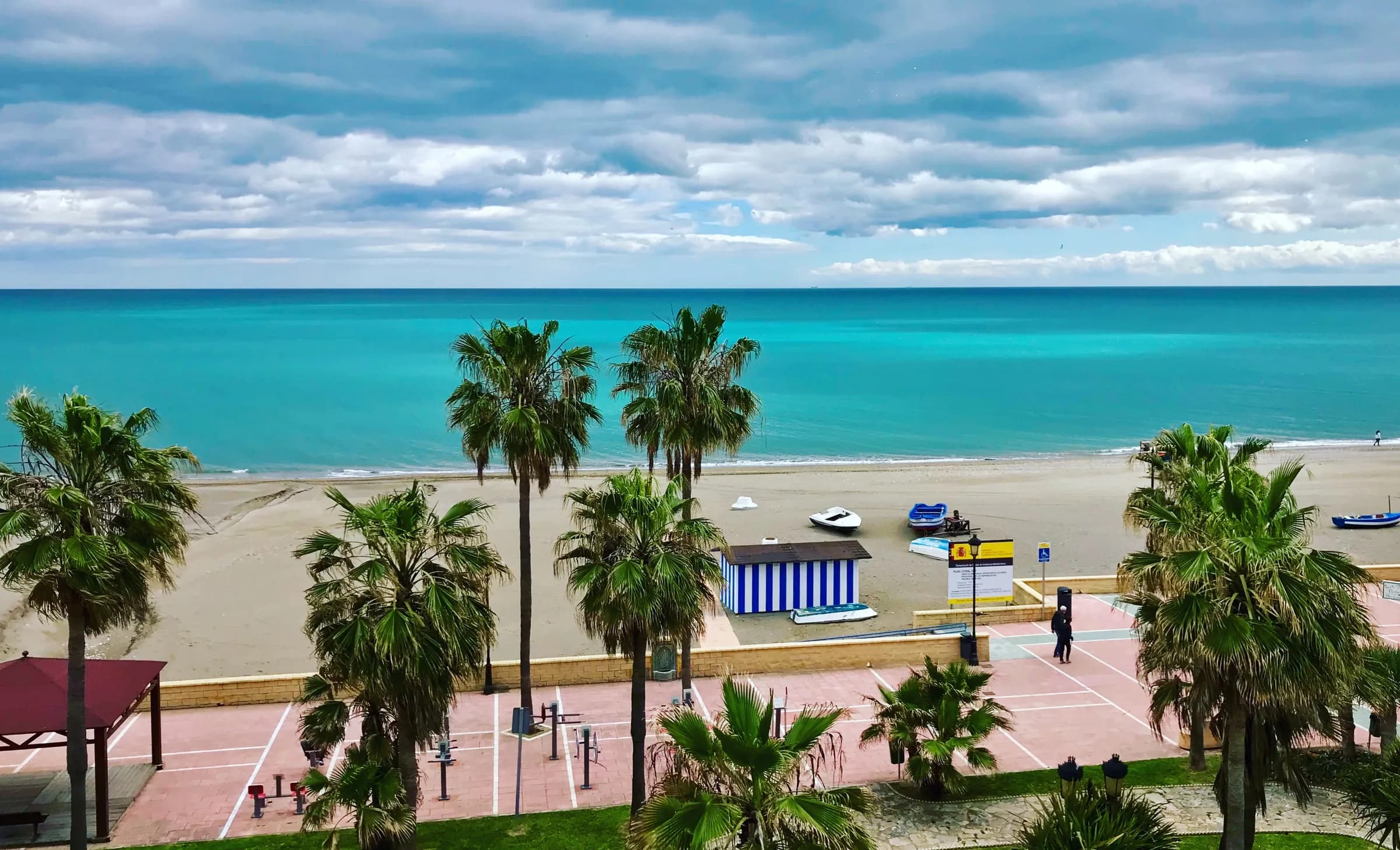
The sand is 30 seconds from the door, and the balcony looks straight out at it. Book direct and save up to 20%.
- 3 Bedrooms
- 6 Guests
- 96 m²
Frequently Asked Questions
Related Articles
Dolphin Watching, Gibraltar Strait: Tours & Tips
Dolphin watching in the Gibraltar Strait: boat trips from La Duquesa, Gibraltar bay and Tarifa, what you'll see, the best season, prices and how to book.
Hiking on the Costa del Sol: Sierra Bermeja Trails
A walker's guide to hiking on the Costa del Sol: Sierra Bermeja's red peridotite peaks, rare pinsapo firs and realistic trail grades, an hour from Sabinillas.

Tarifa Kitesurfing: Day Trip Guide from Sabinillas
Tarifa kitesurfing for first-timers and pros: the windiest beaches in Europe, plain advice on schools and conditions, and how to drive there in an hour.
The Local's Costa del Sol, Monthly
One email a month: what's on in Sabinillas, the best local finds, and first pick of apartment dates. Free welcome gift: our Sabinillas Insider Guide.
We respect your privacy. Unsubscribe at any time.
Comments
No comments yetHave a tip, a question or a correction? Every comment is read and approved by hand before it appears, usually within a day.
No comments yet. Be the first to share a tip or ask a question.