If you have walked Calle Larios during the August feria you have already seen a verdiales panda without knowing it: the hats heaped with flowers and little mirrors, and a violin scraping above a wall of guitars while the cymbals rattle a beat that makes standing still difficult. That music has one big day of its own, in December, an hour and a quarter from our apartment. On 28 December, while the rest of Spain is checking the news for the annual hoax, the hill villages above Málaga come down to Puerto de la Torre to compete.
What verdiales are
Verdiales is a rural fandango, sung and danced, from the Montes de Málaga, the hill country of wine presses and mule tracks that climbs from the city towards Colmenar. The name is usually traced to the verdial olive grown on those slopes. The Junta de Andalucía's Decreto 453/2010, which listed the Fiesta de Verdiales as a Bien de Interés Cultural, describes it as a fandango abandolao with a pre-flamenco character: older than flamenco, rustic in melody and step, and later taken into flamenco as one of its palos.
It is played in a panda. A panda is a group of ten to twenty people, musicians, singers and dancers together, with a fixed line-up: one violin, two or more guitars, a large pandero (frame drum or tambourine), two or more pairs of platillos (small cymbals) and palillos (castanets), plus a lute or bandurria depending on the style. The violin is what you hear first, a short repeating line sitting on top of everything. The cymbals are what you feel first, a very fast triple beat that the guitars strum without pause.
Each panda is run by an alcalde, a "mayor" with no town hall, who carries a ribboned baton and uses it to start and stop each piece and to call who sings and who dances. In front goes the abanderado, who dances with a Spanish, Andalusian or Málaga flag. Then there is the hat: a wide straw hat buried under fabric flowers, small mirrors, beads and long coloured ribbons that fall down the back. It is the most photographed thing at the fiesta and the first thing a child asks to touch.
The singing is short and high and goes straight back into the music after four or five lines. The dancing is in couples with castanets, circling without touching, and in the trenzaíllo the dancers cross and uncross positions in a line. When two pandas meet and play face to face to see who lasts longer and who takes the crowd, that is a lucha de fiesta, and it is the best thing you will see all day.
The three styles
There are three verdiales, named after the ground they come from, and the 2010 decree writes them down:
- Montes. From the Montes de Málaga proper. The tambourine carries the weight, the beat is the heaviest of the three and many consider it the oldest.
- Almogía. The fastest. The violin leads, the dancing is lighter, and the Almogía flower-and-mirror hat is the one you see in photographs.
- Comares. From the Axarquía, with its own guitar-and-violin tuning and the most elaborate dancing; to an outsider it sounds the most distinct.
Every panda belongs to one style and one district and does not play the others. At the Fiesta Mayor the three styles perform in separate blocks, each with its own contest.
What the Fiesta Mayor is
It is the one day all the pandas gather in the same place. It has run since 1962 on 28 December, the Día de los Inocentes, organised by Málaga city council with the Federación de Pandas de Verdiales. The 2025 edition was the 64th: Sunday 28 December from 12:00 in the grounds of the Parque Andrés Jiménez Díaz in the Puerto de la Torre district, with 28 pandas entered (6 Comares, 12 Montes, 10 Almogía) and €34,910 in prize money, per the council's communiqué of 17 December 2025.
The date is the point. The Junta's decree explains that the verdiales cycle runs from 25 to 28 December and that the last day is its climax, the day of the inocentes, the fools, when the fiesta people become kings. That it coincides with Spain's April Fools is part of the joke.
In 2026 the 28th is a Monday. As we write, the council has not yet published its official notice; it does so in mid-December, and the festival listings already assume the same park, free entry and a midday-to-dusk day. Check malaga.eu/navidad the week before, and if anything changes we will correct it here.
How the day runs
Arrive at twelve if you want to watch it assemble. The pandas walk into the grounds in their hats with their flags, already playing, and for the first hour there is as much to see off the stage as on it. Then the running order starts, style by style. In 2025 Comares opened, Montes followed and Almogía closed, with pandas such as El Borge, Jotrón y Lomillas and Raíces de Almogía. Each panda has a few minutes on stage and a jury scores it.
The prize categories are the same for all three styles: fiesta (the full performance), couple dance, trenzaíllo dance, flag dance and best singer. There are also children's couple and flag dances for the pandas' youngest members, who get a gift and most of the applause. When a panda finishes it comes off the stage and keeps playing in a circle among the crowd, which is where the luchas happen and where you will be closest to a violin.
There are bars selling beer, Montes wine and something to eat, in the style of a neighbourhood feria caseta. Do not expect a restaurant. The sensible move is to eat beforehand or bring something and eat it standing up while they play, which is what half the site does. And wrap up: December in Málaga gives you sun at midday and a cold that bites from about five, and you will be on your feet in the open the whole time.
Getting there from the coast
From Sabinillas it is about 99 km, around 1 hour 15 minutes. Take the A-7 (or the AP-7 toll road, which skips the Marbella traffic lights) towards Málaga, join the MA-20 western ring road and exit for Puerto de la Torre; the park sits in the upper part of the district.
Parking is the weak point. Puerto de la Torre is a residential district with narrow streets, and on 28 December cars arrive from the whole province. The council sets up parking areas around the site, but plan on leaving the car ten or fifteen minutes' walk away and on a slow exit at the end. If you would rather avoid it, park in central Málaga and take the EMT bus up: line 21 (Paseo del Parque, Carlos Haya, Puerto de la Torre) ends in the district; check the stop nearest the park in the EMT app on the day, because the line's terminus has moved in recent years.
Public transport from the western coast does not work for this. The intercity bus to Málaga and the change eat the morning. If you are here without a car, our Costa del Sol car-rental guide explains how to do it cheaply in winter.
Then the Calle Larios lights
This is what rounds the day off. When the light goes in the park, around six, you are twenty minutes by car from the centre of Málaga and the Calle Larios Christmas lights are still on: 28 December is well inside the season, which runs to Reyes. That guide has the show times, the central car parks and where to eat; here we only say that it fits. In 2025 the council also put a verdiales carol by the panda Jotrón y Lomillas into the first Larios show each evening from 23 to 28 December, so you may hear the same violin twice in one day.
The full plan: leave Sabinillas at half past ten, verdiales from twelve to five, down to the centre, park, eat something, watch one lights show, and back on the coast before eleven. It is a long day and a very Málaga one, and 29 December is a normal working day, so the road home is quiet.
Who it suits
It is for anyone who wants a tradition that was not built for visitors. At the Parque Andrés Jiménez Díaz on 28 December there are no guides or signs in English, and almost everyone around you is from the districts and villages the pandas come from. For a family with children it works well because it is daytime, free and never still. For a visitor who does not follow the singing it works just as well, because the hook is the beat and the hats.
It is not for anyone who wants a seated show with a fixed running time, or who has little patience for parking or cold. And it is not a tablao: if what you want is flamenco in a venue with dinner, our guide to flamenco shows across Andalucía serves you better. If you would rather see verdiales in summer, the pandas play Calle Larios at midday during the Feria de Málaga, without the contest and with a far bigger crowd.
The week between Christmas and New Year on the coast
The week between Christmas and New Year is one of the quietest of the year in Sabinillas: empty beach and sun at midday, with Christmas Day behind you and Nochevieja ahead. The 28th sits in the middle of it as a day out, with the car in our garage the rest of the week. If that appeals, check dates and prices for that week; low season starts in November, from €110 a night, and we will tell you what else is on in Málaga while you are here.
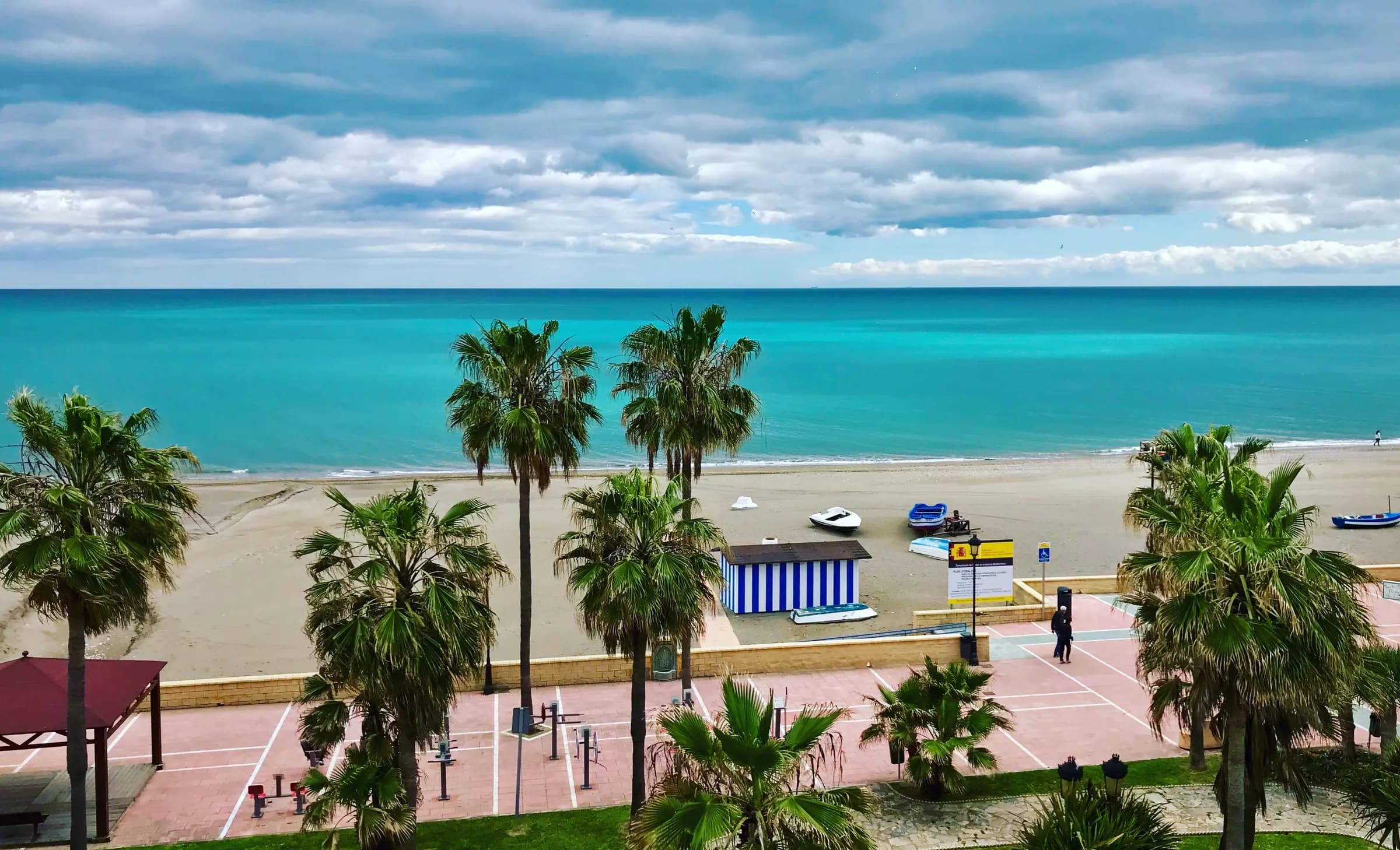
Stay Right on the Beach
The sand is 30 seconds from the door, and the balcony looks straight out at it. Book direct and save up to 20%.
- 3 Bedrooms
- 6 Guests
- 96 m²
Frequently Asked Questions
Related Articles
Christmas Day in Spain: What's Open on the Costa del Sol
Christmas Day in Spain from a beach town: Nochebuena, Misa del Gallo, what is open on 24, 25 and 26 December on the Costa del Sol, and where to eat.
Twelve Grapes at Midnight: New Year's Eve on the Costa del Sol
What Spain does at midnight on 31 December: the twelve grapes, the cena de Nochevieja, and where to celebrate on the western Costa del Sol.
Málaga Christmas Lights 2026: Dates, Times & the Day Trip
Málaga's Christmas lights 2026: switch-on expected Friday 27 November on Calle Larios, the free light show times, the markets and an evening from the coast.
The Local's Costa del Sol, Monthly
One email a month: what's on in Sabinillas, the best local finds, and first pick of apartment dates. Free welcome gift: our Sabinillas Insider Guide.
We respect your privacy. Unsubscribe at any time.
Comments
No comments yetHave a tip, a question or a correction? Every comment is read and approved by hand before it appears, usually within a day.
No comments yet. Be the first to share a tip or ask a question.